

Daily Devotional
Sunday, October 26, 2025 (NS), October 13, 2025 (OS)
No Fasting.
The Sunday of the Holy Fathers
According to Gk. usage, if the 11th of October should fall on Sunday, we commemorate the service of The Holy Fathers of the Seventh Œcumenical Synod. If not, we commemorate the service on the following Sunday. According Sl. usage, if the 11th of October should fall on Wednesday or earlier, the service is commemorated on the preceding Sunday. If the 11th should fall on Thursday or later, then the service is commemorated on the following Sunday.
Sunday of the Twentieth Week
Mode Three — Ninth Eothinon
The commemoration of the holy Martyrs Karpos, Papylos, Agathodoros, and Agathonike.
Scripture Readings
Special Commemorations
The Sunday of the Holy Fathers
According to Gk. usage, if the 11th of October should fall on Sunday, we commemorate the service of The Holy Fathers of the Seventh Œcumenical Synod. If not, we commemorate the service on the following Sunday. According Sl. usage, if the 11th of October should fall on Wednesday or earlier, the service is commemorated on the preceding Sunday. If the 11th should fall on Thursday or later, then the service is commemorated on the following Sunday.
Epistle
The Reading is from the Epistle of Saint Paul to Saint Titus [§ mid 302 A]: Child Titus:
3 8Faithful is the word. And concerning these things I desire thee to be affirming, in order that they who have believed God may give heed to set before themselves good works. These things are good and profitable to men. 9But be shunning foolish inquiries, and genealogies, and strifes, and contentions relating to points of the law; for they are unprofitable and vain. 10A heretical man, after a first and second admonition, be rejecting, 11knowing that such a one hath been perverted, and sinneth, being self-condemned.
12Whenever I should send Artemas to thee, or Tychikos, hasten to come to me in Nicopolis, for I have decided to winter there. 13Send forth with haste Zenas the lawyer and Apollos, in order that nothing may be lacking to them. 14And let ours also be learning to set before themselves good works for necessary uses, that they may not be unfruitful.
15All those with me salute thee. Greet those who love us in faith.
Grace be with you all. Amen.
For Sl. usage, see [Heb. 13:7-16].
Gospel
The Reading is from the Holy Gospel according to Saint Matthew [§ 11]. The Lord said to His disciples:
5 14“Ye are the light of the world. A city situated on the top of a mountain cannot be hid. 15“Nor do they light a lamp and put it under the bushel, but upon the lampstand, and it giveth light to all those in the house. 16“Thus, let your light shine before men, that they might see your good works, and might glorify your Father Who is in the heavens.
17“Do not begin to think that I came to abolish the law or the prophets; I came not to abolish, but to fulfill. 18“For verily I say to you, until the heaven and the earth shall have passed away, one iota or one tittle in no wise shall pass away from the law, until all shall have taken place. 19“Whosoever then shall break one of the least of these commandments, and shall teach men so, he shall be called least in the kingdom of the heavens; but whosoever shall do and teach them, this one shall be called great in the kingdom of the heavens.”
for Sl. usage, see [Jn. 17:1-13].
Paschalion — Movable Calendar
Sunday of the Twentieth Week
Mode Three — Ninth Eothinon
Epistle
The Reading is from the Epistle of Saint Paul to the Galatians [§ 200].
1 11Brethren, I make known to you the Gospel which was preached as good tidings by me, that it is not according to man; 12for I neither received it from man, nor was I taught it, but by a revelation of Jesus Christ. 13For ye heard of my manner of life at one time in Judaism, that according to excess, I used to persecute the Church of God, and was ravaging her. 14And I kept on advancing in Judaism beyond many contemporaries in mine own race, being more exceedingly a zealot of the traditions of my fathers. 15But when it pleased God, Who separated me from my mother’s womb and called me by His grace, 16to reveal His Son in me, that I be preaching Him as good tidings among the nations, immediately I conferred not with flesh and blood, 17neither did I go up to Jerusalem to those who were apostles before me, but I went away into Arabia, and again returned to Damascus. 18Then after three years I went up to Jerusalem to visit Peter, and remained with him fifteen days; 19but of the other apostles I saw none, except Iakovos the brother of the Lord.
Gospel
The Reading is from the Holy Gospel according to Saint Luke [§ 35]. The Lord said this parable:
8 5“The one who soweth went out to sow his seed. And as he was sowing, some seed indeed fell by the wayside; and it was trampled down, and the birds of the heaven devoured it. 6“And other seed fell upon the rock; and having sprung up, it was dried up, because it had no moisture. 7“And other seed fell in the midst of the thorns; and the thorns, having sprung up together, choked it. 8“And other seed fell upon the good ground; and having sprung up, it produced fruit a hundredfold.” And after He said these things, He cried, “The one who hath ears to hear, let him hear.” 9And His disciples were asking Him, saying, “What may this parable be?” 10And He said, “To you it hath been given to know the mysteries of the kingdom of God, but to the rest in parables, that ‘seeing they see not, and hearing they understand not [cf. Is. 6:9].’ 11“Now the parable is this: The seed is the word of God. 12“And those by the wayside are the ones who hear; then the devil cometh and taketh away the word from their heart, lest after they believe they should be saved. 13“And those upon the rock are the ones who, whenever they hear, receive the word with joy; and yet these, who for a time believe, have no root, and in time of temptation withdraw. 14“And that which fell into the thorns, these are the ones who heard, and while they are going on their way, they are being choked by cares and wealth and pleasures of life, and do not bring fruit to perfection. 15“But that in the good ground, these are they who, after they hear the word with a noble and good heart, held fast and bore fruit in patience.”
Menaion — Fixed Calendar
The commemoration of the holy Martyrs Karpos, Papylos, Agathodoros, and Agathonike.
Epistle
The Reading is from the Epistle of Saint Paul to the Ephesians [§ 233].
6 10Brethren, keep on being empowered in the Lord and in the strength of His might. 11Put on the full armor of God, for you to be able to stand against the wiles of the devil; 12because for us the wrestling is not against blood and flesh, but against the principalities, against the powers, against the cosmic rulers of the darkness of this age, against spiritual hosts of evil on account of the heavenly things. 13For this cause take up the full armor of God, in order that ye might be able to withstand in the evil day, and having counteracted all things, to stand. 14Stand therefore, having girt your loins with truth, and having put on for yourselves the breastplate of righteousness, 15and having shod your feet in readiness of the Gospel of peace; 16on the whole, take up the shield of faith, with which ye shall be able to quench all the fiery darts of the evil one. 17And take the helmet of salvation, and the sword of the Spirit, which is the word of God.
Gospel
The Reading is from the Holy Gospel according to Saint Matthew [§ 21]. The Lord said:
7 12“All things whatsoever ye wish that men be doing to you, so also be ye doing to them; for this is the law and the prophets.
13“Enter through the narrow gate; for wide is the gate and broad is the way that leadeth away to destruction, and many are they who enter through it. 14“For narrow is the gate and straitened is the way that leadeth away to life, and few are they who find it. 15“But be on guard against the false prophets, who come to you in sheep’s clothing, but within they are rapacious wolves. 16“From their fruits ye shall fully know them. They do not gather a bunch of grapes from thorns, or figs from thistles, do they? 17“Thus, every good tree produceth good fruits, but the rotten tree produceth bad fruits. 18“A good tree is not able to produce bad fruits, nor is a rotten tree able to produce good fruits. 19“Every tree which produceth not good fruit is cut off and cast into the fire. 20“Then surely by their fruits ye shall fully know them.
21“Not everyone who saith to Me, ‘Lord, Lord,’ shall enter into the kingdom of the heavens, but the one who doeth the will of My Father in the heavens.”
Lives of the Saints (Prologue)
Special Commemorations
Commemoration of the Seventh Ecumenical Council.
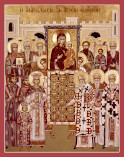 This Council was held in 787 in Nicaea. in the reign of the
devout Empress Irene and her son Constantine, and in the time of Patriarch Tarasius. This Council
finally upheld the veneration of icons, expounding it from Holy Scripture, the witness of the
holy fathers and the examples of miracles in connection with the holy icons. Among other examples
cited, the Cypriot bishop, Constantine, brought forward this one: A herdsman from the city of
Constantia, driving his flock out to pasture one day, saw an icon of the Mother of God adorned
with flowers by the devout. ‘Why give so much honour to a rock?’, said the herdsman,
obviously brought up in iconoclasm, and threw his iron stave at the icon, damaging the right eye
of the Mother of God. As soon as he had left that spot, he stumbled over the same stave and put
out his own right eye. Returning blinded to the city, he cried out tearfully that it was a
punishment from the Mother of God.
This Council was held in 787 in Nicaea. in the reign of the
devout Empress Irene and her son Constantine, and in the time of Patriarch Tarasius. This Council
finally upheld the veneration of icons, expounding it from Holy Scripture, the witness of the
holy fathers and the examples of miracles in connection with the holy icons. Among other examples
cited, the Cypriot bishop, Constantine, brought forward this one: A herdsman from the city of
Constantia, driving his flock out to pasture one day, saw an icon of the Mother of God adorned
with flowers by the devout. ‘Why give so much honour to a rock?’, said the herdsman,
obviously brought up in iconoclasm, and threw his iron stave at the icon, damaging the right eye
of the Mother of God. As soon as he had left that spot, he stumbled over the same stave and put
out his own right eye. Returning blinded to the city, he cried out tearfully that it was a
punishment from the Mother of God.
This Council also decided that the relics of the martyrs be placed in the antimins.* Three hundred and sixty-seven fathers took part in the Council. May the Lord have mercy on us and save us by their prayers.
*Antimins: A cloth containing relics of the saints that is spread on the Holy Table for the celebration of the Divine Liturgy—Tr.
Menaion — Fixed Calendar
October 26th – Civil Calendar
October 13th – Church Calendar
1. The Holy Martyrs Karpos and Papylos.
Karpos was Bishop of Thyateira and Papylos was a deacon. They were born in Pergamum, where they finally suffered for the Christian Faith at the hands of the wicked governor, Valerius, in Decius’ reign. Valerius bound them behind horses and dragged them off to Sardis, where he put them to harsh torture; but an angel of God appeared to them, healed them of their wounds and strengthened them. Karpos’ servant, Agathodoros, followed his master with great sorrow until he also was taken for torture. After that, Valerius again bound them behind horses and dragged them from Sardis to Pergamum. When holy Karpos was tied to a tree and so terribly flogged that his whole body was laid open and his blood streamed down onto the ground, he smiled in the midst of these tortures. When they asked him why he smiled, the holy martyr replied that he saw the heavens open and the Lord sitting on His throne, surrounded by cherubim and seraphim. At the time of Papylos’ martyrdom, this holy martyr healed a man, blind in one eye, by his prayers. Many, seeing this, came to believe in Christ the Lord. Thrown before wild beasts, the martyrs remained unhurt. When they were thrown into a fiery furnace, Agathonika, Papylos’ sister, saw this and leapt into the flames. But the flames did not burn them. Finally, they were all beheaded with the sword in 251. Thus, after great spiritual endeavor, they received the wreath of glory in the kingdom of Christ.
2. The Hieromartyr Benjamin the Deacon.
This soldier of Christ was a Persian, and zealously preaching the Gospel, brought many pagans, both Persians and Greeks, to the Christian Faith. He suffered in the time of the Persian King Yazdgird, in about 412. When he was thrown into prison, one of the king’s nobles pleaded for him to the king. The king was willing to let him go free, on condition that he kept silent and spoke no more to the people about Christ. To this, Benjamin replied: ‘I cannot possibly do that. Those who hide the talent they have received will be given over to greater suffering,’ and he continued to spread the Christian Faith. The king then ordered that thorns be driven under his nails, and had him tortured until he gave his soul into God’s hands.
3. The Holy Martyr Zlata of Meglin (Bulgaria).
Born in the village of Slatina in the Meglin region, of poor peasants who had three other daughters, St. Zlata was a meek and devout girl, wise with Christ’s wisdom and golden (‘zlata’ means ‘gold’) not only in name but also in her God-fearing heart. When Zlata went out one day to get water, some shameless Turks seized her and carried her off to their house. When one of them urged her to embrace Islam and become his wife, Zlata answered fearlessly: ‘I believe in Christ, and know Him alone as my Bridegroom; I shall never deny Him even if you put me to a thousand tortures and cut me into pieces.’ Her parents and sisters then arrived, and said to her: ‘O our daughter, have mercy on yourself and us. Deny Christ publicly, that we can all be happy. Christ is merciful: He will forgive your sin, committed under the pressure of life.’ Her poor parents and kinsfolk wept bitterly. But Zlata’s heroic soul would not be overcome by devilish seduction. She replied to her parents: ‘When you urge me to deny Christ, the true God, you are no longer parents or sisters to me; I have the Lord Jesus Christ as Father, the Mother of God as mother, and for brothers and sisters, the saints.’ Then the Turks threw her into prison, where she lay for three months, and they took her out every day and flogged her until her blood flowed onto the ground. Finally, they hanged her upside-down and made a fire to choke her to death with the smoke. But God was with Zlata, and gave her strength in her suffering. At the very end, they hanged her from a tree and cut her into small pieces. Thus this martyr-maiden gave her soul into God’s hands, and entered into the realm of Paradise, in 1796. Pieces of her relics were taken by Christians to their homes, that they might bring a blessing to them.
4. The Translation to Moscow of the Iveron Icon of the Most Holy Theotokos.
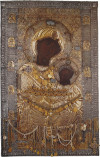 In 1648, Patriarch Nikon of Moscow, while he was
still Archimandrite of Novospassky Monastery, commissioned an exact copy of the Iveron Icon
to be made and sent to Russia. Almost immediately upon its arrival on October 13, the icon
was glorified with numerous miracles attributed to it by the faithful. The Iverskaya Chapel
was built in 1669 to enshrine the icon next to the Kremlin walls in Moscow. In 1648, Patriarch Nikon of Moscow, while he was
still Archimandrite of Novospassky Monastery, commissioned an exact copy of the Iveron Icon
to be made and sent to Russia. Almost immediately upon its arrival on October 13, the icon
was glorified with numerous miracles attributed to it by the faithful. The Iverskaya Chapel
was built in 1669 to enshrine the icon next to the Kremlin walls in Moscow.
|
FOR CONSIDERATION
There is nothing more wretched than a man who, in the hour of need, abandons hope in God and flees to a means of safety contrary to God’s law. Such a man not only cannot put right his outward circumstances, but also loses his soul. This is what happened to the Emperor Michael Palaiologos, the apostate to the Latins. In order to safeguard his kingdom, terrorized by the Bulgarians and Serbs, he sought help from the pope and made a Union with him in 1274. What did this gain? The kingdom was not saved and he did innumerable evil deeds, coming rapidly to an unhappy end in a campaign against Prince John Doukas of Epirus in 1282. The Orthodox people were so resentful towards him that his son Andronikos dared not bury him openly, but put him in the ground at night without funeral or prayers. He was rejected by the Orthodox Church and not received by the Roman, and Michael died outside the Church of God. His wife the empress, after his death, issued the following statement: ‘My Majesty hates and regards as loathsome this action (the Union) that has recently come about in the Church and has caused such discord.... As the holy Church of God has determined not to sanction any official commemoration of my departed spouse, our lord and king, on account of his aforementioned actions and intrigues, my Majesty also, bowing in all things to the fear of God and submitting to the holy Church, approves and accepts her decree, and will never presume to commemorate the soul of my lord and spouse in any way.’
Daily Scripture Readings taken from The Orthodox New Testament, translated and published by Holy Apostles Convent, Buena Vista, Colorado, copyright © 2000, used with permission, all rights reserved.
Daily Prologue Readings taken from The Prologue of Ochrid, by Bishop Nikolai Velimirovic, translated by Mother Maria, published by Lazarica Press, Birmingham, England, copyright © 1985, all rights reserved. Edited by Dormition Skete.