

Daily Devotional
Friday, October 3, 2025 (NS), September 20, 2025 (OS)
Fast Day. No Meat, Fish, Dairy, Eggs, Alcohol or Olive Oil Allowed.
Friday of the Seventeenth Week
The commemoration of the Afterfeast of the Exaltation, and the holy Great-martyr Efstathios and those with him.
Scripture Readings
Paschalion — Movable Calendar
Friday of the Seventeenth Week
Epistle
The Reading is from the Epistle of Saint Paul to the Ephesians [§ 226]. Brethren:
4 17This I say and testify in the Lord: ye are no longer to walk even as also the rest of the nations walk, in the vanity of their mind, 18who have been darkened in thought and alienated from the life of God, because of the ignorance which is in them, because of the hardness of their heart; 19who, having become insensible, gave themselves up to licentiousness, for the working of all uncleanness with greediness. 20But ye have not thus learned the Christ— 21if indeed ye heard Him and were taught in Him, as truth is in Jesus: 22to put off from yourselves the old man, with respect to the former manner of life, who is being corrupted according to the desires of the deceit, 23and to be renewed in the spirit of your mind, 24and to put on the new man, who, according to God, was created in righteousness and holiness of the truth.
25Wherefore, having put off the falsehood, “Be speaking truth each one with his neighbor [cf. Zach. 8:16].”
Gospel
The Reading is from the Holy Gospel according to Saint Luke [§ 14]. At that time:
4 22The crowds were wondering at the words of grace which were proceeding out of Jesus’ mouth, and were saying, “This is the Son of Joseph, is it not?” 23And He said to them, “No doubt, ye will say this parable to Me, ‘Physician, heal thyself; as much as we heard was done in Capernaum, do also here in Thy country.’” 24And He said, “Verily I say to you that not one prophet is accepted in his own country. 25“But in truth I say to you, many widows were in Israel in the days of Elias, when the heaven was shut up for three years and six months, when a great famine arose over all the land; 26“and to not even one of them was Elias sent, except to Sarepta of Sidon, to a woman who was a widow. 27“And many lepers were in Israel in the time of Elisaios the prophet, and not one of them was cleansed, except Neman the Syrian.” 28And all in the synagogue were filled with anger when they heard these things. 29And they rose up and cast Him outside of the city; and they led Him up to the brow of the hill on which their city had been built, in order to throw Him down headlong. 30But He, having passed through the midst of them, kept going on His way.
Menaion — Fixed Calendar
The commemoration of the Afterfeast of the Exaltation, and the holy Great-martyr Efstathios and those with him.
Epistle
The Reading is from the Epistle of Saint Paul to the Ephesians [§ 233].
6 10Brethren, keep on being empowered in the Lord and in the strength of His might. 11Put on the full armor of God, for you to be able to stand against the wiles of the devil; 12because for us the wrestling is not against blood and flesh, but against the principalities, against the powers, against the cosmic rulers of the darkness of this age, against spiritual hosts of evil on account of the heavenly things. 13For this cause take up the full armor of God, in order that ye might be able to withstand in the evil day, and having counteracted all things, to stand. 14Stand therefore, having girt your loins with truth, and having put on for yourselves the breastplate of righteousness, 15and having shod your feet in readiness of the Gospel of peace; 16on the whole, take up the shield of faith, with which ye shall be able to quench all the fiery darts of the evil one. 17And take the helmet of salvation, and the sword of the Spirit, which is the word of God.
Gospel
The Reading is from the Holy Gospel according to Saint Luke [§ 106]. The Lord said to His disciples, “Be taking heed of men:
21 12“For they shall lay their hands upon you and persecute you, delivering you up to synagogues and prisons, bringing you before kings and governors on account of My name; 13“but it shall prove to be a testimony for you. 14“Therefore settle it for yourselves in your hearts not to premeditate to make a defense; 15“for I will give you a mouth and wisdom, which all those who oppose you shall not be able to contradict nor withstand. 16“And ye shall be delivered up also by parents, and kinfolk, and friends, and brethren; and they shall put some of you to death. 17“And ye shall be hated by all for My name’s sake. 18“But a hair of your head in no wise shall perish. 19“In your patience win your souls.”
Lives of the Saints (Prologue)
October 3rd – Civil Calendar
September 20th – Church Calendar
1. The Holy and Great Martyr Efstathios (Eustace), the General Placidus.

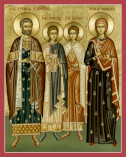 He was a great
Roman military leader in the time of the Emperors Titus and Trajan. Although a pagan, Placidus
(for that was his pagan name) was a righteous and merciful man, like the centurion Cornelius, who
was baptized by the Apostle Peter (Acts 10). Going hunting one day, he found a stag. By the
providence of God, a shining Cross appeared among the stag’s antlers and the voice of God
came to Placidus, telling him to go to a Christian bishop and be baptized. Placidus was baptized,
along with his wife and two sons. At his Baptism, he received the name Efstathios, his wife the
name Theopiste and their sons the names Agapius and Theopistus. After his Baptism, Efstathios
went back to the very place where the revelation through the stag had occurred, and thanked God
on his knees that he had brought him to the truth. At that, the voice of God came to him again,
foretelling suffering for His name and strengthening him. Then Efstathios secretly left Rome with
his family, with the intention of hiding among simple people and serving God in an unknown and
humble way. Arriving in Egypt, he was immediately beset by trials. Some wicked barbarian carried
off his wife, and his two sons were seized by wild beasts. But the barbarian quickly came to a
bad end, and a herdsman saved the boys from the wild beasts. Efstathios settled in the
Palestinian village of Vadisis, and there lived as a village hireling for fifteen years. After
this, the barbarians descended on the Roman Empire, and the Emperor Trajan was sorry that his
brave commander Placidus, who had been victorious wherever he had fought, was not with him. The
emperor sent his officers to seek the great general throughout the empire. By God’s
providence, these officers, who had been friends of Efstathios, came to this village of Vadisis,
found him and took him to the emperor. Efstathios gathered the army together and defeated the
barbarians. On the way back to Rome, Efstathios went and found his wife and sons. When he arrived
in Rome, the Emperor Trajan had died and the Emperor Hadrian was on the throne. When Hadrian
summoned Efstathios to offer sacrifice to idols, Efstathios told him that he was a Christian. The
emperor put him to torture, together with his wife and sons. When the wild beasts did them no
harm, he threw them into a white-hot metal ox. On the third day, they took out their bodies, dead
but untouched by the fire. Thus this glorious general gave to Caesar that which is
Caesar’s, and to God that which is God’s, and entered into the eternal kingdom of
Christ our God.
He was a great
Roman military leader in the time of the Emperors Titus and Trajan. Although a pagan, Placidus
(for that was his pagan name) was a righteous and merciful man, like the centurion Cornelius, who
was baptized by the Apostle Peter (Acts 10). Going hunting one day, he found a stag. By the
providence of God, a shining Cross appeared among the stag’s antlers and the voice of God
came to Placidus, telling him to go to a Christian bishop and be baptized. Placidus was baptized,
along with his wife and two sons. At his Baptism, he received the name Efstathios, his wife the
name Theopiste and their sons the names Agapius and Theopistus. After his Baptism, Efstathios
went back to the very place where the revelation through the stag had occurred, and thanked God
on his knees that he had brought him to the truth. At that, the voice of God came to him again,
foretelling suffering for His name and strengthening him. Then Efstathios secretly left Rome with
his family, with the intention of hiding among simple people and serving God in an unknown and
humble way. Arriving in Egypt, he was immediately beset by trials. Some wicked barbarian carried
off his wife, and his two sons were seized by wild beasts. But the barbarian quickly came to a
bad end, and a herdsman saved the boys from the wild beasts. Efstathios settled in the
Palestinian village of Vadisis, and there lived as a village hireling for fifteen years. After
this, the barbarians descended on the Roman Empire, and the Emperor Trajan was sorry that his
brave commander Placidus, who had been victorious wherever he had fought, was not with him. The
emperor sent his officers to seek the great general throughout the empire. By God’s
providence, these officers, who had been friends of Efstathios, came to this village of Vadisis,
found him and took him to the emperor. Efstathios gathered the army together and defeated the
barbarians. On the way back to Rome, Efstathios went and found his wife and sons. When he arrived
in Rome, the Emperor Trajan had died and the Emperor Hadrian was on the throne. When Hadrian
summoned Efstathios to offer sacrifice to idols, Efstathios told him that he was a Christian. The
emperor put him to torture, together with his wife and sons. When the wild beasts did them no
harm, he threw them into a white-hot metal ox. On the third day, they took out their bodies, dead
but untouched by the fire. Thus this glorious general gave to Caesar that which is
Caesar’s, and to God that which is God’s, and entered into the eternal kingdom of
Christ our God.
2. The Hieromartyr Hypatios, Bishop of Ephesus, and Andrew the Priest.
Two childhood friends, born in Lycia, they both gave themselves with their whole souls to the service of God when they grew up, Hypatios as a strict monk and ascetic, and Andrew as a priest among the people and a preacher of the word of God. For his great virtues, Hypatios was made Bishop of Ephesus, and Andrew was made priest in the same city. They both suffered in the time of the iconoclast Emperor Leo the Isaurian. After terrible tortures for Orthodoxy, they were beheaded in 730, and both went from this transitory world to eternal life.
3. The Holy Prince Michael and his Counselor Theodore.
Prince Michael (Mikhail) of Chernigov went to the Tartar horde with his counselor, Theodore (Fedor), at the invitation of their ruler, Bati. When they refused to follow the Tartar custom of passing through fire and worshiping idols on being received by Bati, they were beheaded, in 1244. Their relics, the witnesses of their death by martyrdom for the sake of Christ, are preserved in the Church of the Archangel in Moscow.
4. Our Holy Father, the Martyr Hilarion
A monk of the Holy Mountain, he suffered voluntarily for the Christian Faith at the hands of the Turks in Constantinople on September 20th, 1804. His wonder-working relics are preserved in the Church of the Transfiguration on the island of Proti.
FOR CONSIDERATION
Suicide is a sin against the Holy Spirit, Who gives life. Suicide is a much graver sin than murder, as a man can yet repent of murder, while there is no repentance for the sin of suicide. Here are two examples of the greatest misfortune, in which a man of little soul would have committed suicide, but in which holy men of God showed themselves heroic. St. Efstathios found himself one day in this predicament: he had left one of his sons on one bank of the river while he carried the other to the opposite bank and returned for the second. Coming to the middle of the river, he looked on one bank and saw a lion seize the son that was there and carry him off; he looked at the other bank and saw a wolf grab hold of his son and carry him off. One little of soul would, in such a situation, have drowned himself in the river and made an end. Efstathios, filled with grief, did not kill himself, but with hope in God, lived for fifteen years as a hireling and waited with patience to see his two sons again. And God rewarded his faith and patience.
St. Hilarion was constrained as a young man to embrace Islam, but his conscience began to torment him and he had no peace. He returned to the Christian Faith, became a monk and gave his body to strict fasting and the harshest asceticism, but spiritual peace did not return to him. Therefore, he went to Constantinople with his spiritual father, Vissarion, and not only confessed his faith in Christ openly at the sultan’s court, but also counseled Bash Agha to go to Russia and be baptized. After ridicule and torture, this brave young man was beheaded, and God glorified him in heaven and on earth. His holy relics have wonder-working power to this day. But where is the glory of the suicide? Where are his relics?
Daily Scripture Readings taken from The Orthodox New Testament, translated and published by Holy Apostles Convent, Buena Vista, Colorado, copyright © 2000, used with permission, all rights reserved.
Daily Prologue Readings taken from The Prologue of Ochrid, by Bishop Nikolai Velimirovic, translated by Mother Maria, published by Lazarica Press, Birmingham, England, copyright © 1985, all rights reserved. Edited by Dormition Skete.