

Daily Devotional
Sunday, September 14, 2025 (NS), September 1, 2025 (OS)
No Fasting.
Sunday of the Fourteenth Week
Mode Plagal One — Third Eothinon
The beginning of the Indiction, which is the Church New Year. The commemoration of our venerable Father Symeon, Archimandrite and Stylite.
Scripture Readings
Paschalion — Movable Calendar
Sunday of the Fourteenth Week
Mode Plagal One — Third Eothinon
Epistle
The Reading is from the Second Epistle of Saint Paul to the Corinthians [§ 170]. Brethren:
1 21The One Who establisheth us with you in Christ, and Who anointed us, is God, 22Who also sealed us and gave us the earnest of the Spirit in our hearts.
23And I invoke God as witness upon my soul, that I spared you, and came not now to Corinth. 24Not that we lord it over your faith, but are fellow workers of your joy; for by faith ye stand.
2 1But I decided this within myself, not to come again to you in grief. 2For if I grieve you, who then is the one who maketh me glad, except the one who is grieved by me? 3And I wrote this same thing to you, lest, after I come, I should have grief from those of whom I ought to rejoice, having confidence in you all that my joy is the joy of you all. 4For out of much affliction and anguish of heart I wrote to you through many tears, not that ye should be grieved, but that ye might know the love which I have more abundantly toward you.
Gospel
The Reading is from the Holy Gospel according to Saint Matthew [§ 89]. The Lord said this parable:
22 2“The kingdom of the heavens hath been likened to a man, a king, who made wedding festivities for his son. 3“And he sent forth his slaves to call those who had been invited to the wedding festivities; and they were not willing to come. 4“Again, he sent forth other slaves, saying, ‘Tell those who have been invited, “Behold, I prepared the midday meal; mine oxen and the fatlings have been slain, and all things are ready. Come to the wedding festivities.”’ 5“But having no care for it they went away, the one to his own field, and another to his commerce; 6“and the rest laid hold of his slaves, and insulted them, and slew them. 7“Now after the king heard it, he was provoked to anger; and he sent his armies, and destroyed those murderers, and burned their city. 8“Then he saith to his slaves, ‘The wedding indeed is ready, but those who had been invited were not worthy. 9“‘Go therefore into the thoroughfares of the highways, and as many as ye shall find, call them to the wedding festivities.’ 10“And those slaves went out into the highways and gathered together all, as many as they found, both evil and good; and the wedding was filled full of those reclining at table. 11“And after the king came in to see those who reclined at table, he saw there a man who had not clothed himself with a wedding garment. 12“And he saith to him, ‘Comrade, how didst thou enter here not having a wedding garment?’ And he was put to silence. 13“Then the king said to the servants, ‘Bind his hands and feet, and take him away, and cast him out into the darkness, the outer one.’ There shall be there the weeping and the gnashing of the teeth. 14“For many are called, but few are chosen.”
Menaion — Fixed Calendar
The beginning of the Indiction, which is the Church New Year. The commemoration of our venerable Father Symeon, Archimandrite and Stylite.
Epistle
For the Indiction:
The Reading is from the First Epistle of Saint Paul to Saint Timothy [§ 282]. Child Timothy:
2 1I exhort therefore, first of all, that entreaties, prayers, intercessions, and thanksgivings be made for all men, 2for kings and all those who are in authority, that we may pass a quiet and peaceable life in all piety and gravity. 3For this is good and acceptable before God our Savior, 4Who willeth all men to be saved and to come to a full knowledge of the truth. 5For there is one God, and one Mediator between God and man, the Man Christ Jesus, 6Who gave Himself a ransom for all, the testimony in its own times, 7for which I was appointed a herald and an apostle—I speak the truth in Christ, I lie not—a teacher of nations in faith and truth.
For the venerable Father:
The Reading is from the Epistle of Saint Paul to the Colossians [§ 258]. Brethren:
3 12Put on for yourselves, as elect of God, holy and beloved, compassion from your inward parts, kindness, humbleness of mind, meekness, long-suffering, 13bearing with one another, and graciously forgiving one another, if anyone hath a complaint against someone; even as the Christ graciously forgave you, thus also do ye. 14And over all these things, put on love, which is the bond of perfection. 15And let the peace of God be presiding in your hearts, to which also ye were called in one body; and keep on becoming thankful. 16Let the word of Christ dwell in you richly, in all wisdom, teaching and admonishing one another in psalms and hymns and spiritual odes, singing with grace in your heart to the Lord.
Gospel
For the Indiction:
The Reading is from the Holy Gospel according to Saint Luke [§ 13]. At that time:
4 16 Jesus came to Nazareth, where He had been brought up; and according to what was customary to Him, He went into the synagogue on the day of the sabbath, and stood up to read. 17And there was handed over to Him the roll of Esaias the prophet. And having unfolded the roll, He found the place where it was written: 18“The Spirit of the Lord is upon Me, on account of which He anointed Me; He hath sent Me to preach the good tidings to the poor, to heal those who have been broken in heart, to proclaim release to the captives and recovery of sight to the blind [Is. 61:1], to send forth in deliverance those who have been broken in pieces [cf. Is. 58:6], 19“to proclaim the acceptable year of the Lord [cf. Is. 61:2].” 20And after He folded up the roll, He gave it back to the attendant and sat down. And the eyes of all in the synagogue were looking intently on Him. 21And He began to say to them, “Today this Scripture hath been fulfilled in your ears.” 22And all were bearing witness to Him, and were wondering at the words of grace which were proceeding out of His mouth, and were saying, “This is the Son of Joseph, is it not?”
For the venerable Father:
The Reading is from the Holy Gospel according to Saint John [§ 36]. The Lord said to the Jews who had come to Him:
10 9“I am the door; by Me if anyone should enter, he shall be saved, and shall go in and go out and find pasture. 10“The thief cometh not, except that he might steal, and slay, and destroy. I came that they may have life, and may have it abundantly. 11“I am the good shepherd. The good shepherd layeth down his life for the sheep. 12“But the hireling, who indeed is not a shepherd, whose own the sheep are not, seeth the wolf coming, and leaveth the sheep and fleeth; and the wolf seizeth them and scattereth the sheep. 13“Now the hireling fleeth, because he is a hireling and careth not about the sheep. 14“I am the good shepherd; and I know those that are Mine, and am known of those that are Mine. 15“Even as the Father knoweth Me, I also know the Father; and I lay down My life for the sheep. 16“And I have other sheep which are not of this fold; them also it is needful for Me to bring, and they shall hear My voice; and there shall be one flock and one Shepherd.”
for Sl. usage, see [Mt. 11:27-30].
Lives of the Saints (Prologue)
September 14th – Civil Calendar
September 1st – Church Calendar
1. The Beginning of the Church’s Year.
The First Ecumenical Council decreed that the Church’s year should begin on September 1st. The month of September was, for the Jews, the beginning of the civil year (see Exodus 12:2), the month of the gathering of fruits and the bringing to God of sacrifices of thanksgiving. It was at the time of this feast that the Lord Jesus went into the synagogue in Nazareth, opened the Book of the Prophet Isaias (Isaiah) and read the words: ‘The Spirit of the Lord is upon Me; because He hath anointed Me to preach good tidings unto the meek; He hath sent Me to bind up the broken-hearted, to proclaim liberty to the captives, and the opening of the prison to them that are bound; to proclaim the acceptable year of the Lord, and the day of vengeance’ (Is. 61:1-2; cf. Luke 4:16-21). This month of September is also noted in the history of Christianity because it was during September that Constantine the Great was victorious over Maxentius, the enemy of the Christian Faith, a victory followed by the granting of freedom of confession of the Christian Faith throughout the whole Roman Empire. For a long time, the civil year in the Christian world was reckoned in the same way as the Church’s year, from September 1st, but it was later changed to January 1st, first in western Europe and then also in Russia in the time of Peter I.
2. Our Holy Father Simeon the Stylite.
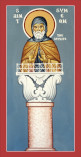 Born in Syria of peasant parents, he fled from them at
the age of eighteen and became a monk. He gave himself to the strictest asceticism, sometimes
fasting for forty days. After that, he followed a particular ascesis, until then unknown:
standing day and night on a pillar in unceasing prayer. His pillar was at first three meters
high, then one of six meters was built for him, then eleven, eighteen and finally twenty. His
mother, Martha, came to see him twice, but he would not receive her, saying to her from his
pillar: ‘Don’t disturb me now, mother dear, if we are to be worthy to meet in the
next world.’ St. Simeon endured innumerable assaults from demons, overcoming them all by
prayer. He worked great miracles, healing the sick by his prayers and his words. People from all
sides gathered around his pillar: rich and poor, kings and slaves. He helped them all, restoring
bodily health to some, giving comfort and instruction to others and denouncing some for their
heretical faith. The Empress Evdokia-Athenaïs was thus turned from the Eftychian heresy back
to Orthodoxy. Simeon lived in asceticism during the reigns of the Emperors Theodosios the
Younger, Marcian and Leo the Great. This first Christian stylite and great wonder-worker, St.
Simeon, lived for seventy years, and entered into rest in the Lord on September 1st, 459. His
relics were taken to Antioch, to the church dedicated to his name.
Born in Syria of peasant parents, he fled from them at
the age of eighteen and became a monk. He gave himself to the strictest asceticism, sometimes
fasting for forty days. After that, he followed a particular ascesis, until then unknown:
standing day and night on a pillar in unceasing prayer. His pillar was at first three meters
high, then one of six meters was built for him, then eleven, eighteen and finally twenty. His
mother, Martha, came to see him twice, but he would not receive her, saying to her from his
pillar: ‘Don’t disturb me now, mother dear, if we are to be worthy to meet in the
next world.’ St. Simeon endured innumerable assaults from demons, overcoming them all by
prayer. He worked great miracles, healing the sick by his prayers and his words. People from all
sides gathered around his pillar: rich and poor, kings and slaves. He helped them all, restoring
bodily health to some, giving comfort and instruction to others and denouncing some for their
heretical faith. The Empress Evdokia-Athenaïs was thus turned from the Eftychian heresy back
to Orthodoxy. Simeon lived in asceticism during the reigns of the Emperors Theodosios the
Younger, Marcian and Leo the Great. This first Christian stylite and great wonder-worker, St.
Simeon, lived for seventy years, and entered into rest in the Lord on September 1st, 459. His
relics were taken to Antioch, to the church dedicated to his name.
3. Rt. Jesus (Joshua) the Son of Navee.
Jesus was the leader of the Jewish people after the death of Moses. Only he and Caleb, of the several hundred thousand Jews that left Egypt, entered the Promised Land. Read of his faithfulness to God, his works and his wonders in the Book of Joshua. He lived for a hundred and ten years, and died in about 1440 B.C.
FOR CONSIDERATION
We must, while we are in this world, make use of all that is at hand for the formation of our souls, for, when death plucks us out of it, we shall take nothing to the other world except our souls as they have been formed in this. St. Simeon the Stylite, while still a young man of eighteen, fell flat on his face on the ground one day and breathed a prayer to God that He would show him the way of salvation. Lying there thus long in prayer, he had this vision: he was digging a trench as a foundation for something, and stopped digging to have a rest. At that, he heard a voice: ‘Dig deeper!’ He began to exert himself to dig deeper, but the voice came again: ‘Dig deeper!’ and he began again with a yet more intensive effort. The voice then said: ‘Stop; that’s enough. Now you must build, but you will not get anywhere without effort.’ Those who make little effort and build the life of their soul on sensual shallows build their building on sand, and such a building cannot stand in this transitory world—and even less in the world that endures.
Daily Scripture Readings taken from The Orthodox New Testament, translated and published by Holy Apostles Convent, Buena Vista, Colorado, copyright © 2000, used with permission, all rights reserved.
Daily Prologue Readings taken from The Prologue of Ochrid, by Bishop Nikolai Velimirovic, translated by Mother Maria, published by Lazarica Press, Birmingham, England, copyright © 1985, all rights reserved. Edited by Dormition Skete.