

Daily Devotional
Monday, September 15, 2025 (NS), September 2, 2025 (OS)
No Fasting.
Monday of the Fifteenth Week
The commemoration of the holy Martyr Mamas, and of our venerable Father John the Faster, Patriarch of Constantinople.
Scripture Readings
Paschalion — Movable Calendar
Monday of the Fifteenth Week
Epistle
The Reading is from the Epistle of Saint Paul to the Galatians [§ 202]. Brethren:
2 11When Peter came to Antioch, I withstood him to the face, because he stood condemned. 12For before the coming of certain ones from Iakovos, he was eating with the Gentiles; but when they came, he began to draw back and separate himself, being afraid of those of the circumcision. 13And also the rest of the Jews were dissembling with him, so that even Barnabas was carried away with their dissimulation. 14But when I saw that they were not walking uprightly according to the truth of the Gospel, I said to Peter in front of them all, “If thou, being a Jew, livest after the manner of Gentiles, and not after the manner of the Jews, why dost thou compel the Gentiles to live as Jews? 15“We—Jews by nature, and not sinners of the Gentiles— 16“knowing then that a man is not being justified by the works of the law, except through faith in Jesus Christ, even we believed in Christ Jesus, in order that we might be justified by faith in Christ and not by the works of the law; because by the works of the law shall no flesh be justified.”
Gospel
The Reading is from the Holy Gospel according to Saint Mark [§ 21]. At that time:
5 24A great crowd was following Jesus and pressing upon Him. 25And a certain woman who had a flow of blood for twelve years— 26and who suffered much under many physicians and spent all from her own means, and was not profited at all, but rather came to be the worse for it— 27after she heard about Jesus, came in the crowd behind, and touched His garment; 28for she was saying within herself, “If I might but touch His garments, I shall be made well.” 29And straightway the fountain of her blood was dried up; and she knew in her body that she had been healed from the scourge. 30And Jesus, straightway having fully known in Himself that the power from Him went forth, turned around in the crowd and was saying, “Who touched Me on My garments?” 31And His disciples were saying to Him, “Thou seest the crowd pressing on Thee, and sayest Thou, ‘Who touched Me?’” 32And He kept looking around Himself to see her who had done this. 33And the woman, fearing and trembling, knowing that which had been done for her, came and fell down before Him, and told Him all the truth. 34And He said to her, “Daughter, thy faith hath made thee well; go in peace, and be sound in body from thy scourge.”
Menaion — Fixed Calendar
The commemoration of the holy Martyr Mamas, and of our venerable Father John the Faster, Patriarch of Constantinople.
Epistle
For the Martyr:
The Reading is from the Epistle of Saint Paul to the Romans [§ 99]. Brethren:
8 28We know that to those who love God all things work together for good, to those who are called according to purpose. 29For whom He foreknew, He also foreordained to be conformable to the image of His Son, in order for Him to be the firstborn among many brethren. 30But whom He foreordained, these also He called; and whom He called, these also He justified; and whom He justified, these also He glorified. 31What then shall we say to these things? If God is for us, who can be against us? 32He Who indeed spared not His own Son, but delivered Him up for us all, how shall He not with Him also graciously give us all things? 33Who shall bring an accusation against the elect of God? God is the One Who justifieth. 34Who is the one who condemneth? Christ is the One Who died, but much more is He the One also Who was raised, Who also is at the right of God, Who also intercedeth for us. 35Who shall separate us from the love of Christ? Shall affliction, or distress, or persecution, or famine, or nakedness, or danger, or sword? 36Even as it hath been written: “For on account of Thee, we are being put to death the whole day; we were counted as sheep of slaughter [Ps. 43(44):23(22)].” 37But in all these things we more than conquer through the One Who loved us. 38For I have been persuaded that neither death, nor life, nor angels, nor principalities, nor powers, nor things present, nor things coming, 39nor height, nor depth, nor any other created thing, shall be able to separate us from the love of God, which is in Christ Jesus our Lord.
For the Faster:
The Reading is from the Epistle of Saint Paul to the Hebrews [§ 318]. Brethren:
7 26Such a High Priest was fitting for us: holy, guileless, undefiled, Who hath been separated from the sinners and hath become higher than the heavens, 27Who hath no need daily, even as the high priests, to offer up sacrifices, first for his own sins, then for those of the people; for this He did once for all after He offered up Himself. 28For the law appointeth men high priests who have weakness; but the word of the oath, which is after the law, appointeth the Son, Who hath been perfected forever.
8 1Now in reference to the things being spoken of, the chief point is: We have such a High Priest, Who sat down on the right of the throne of the majesty in the heavens, 2a Liturgist of the holies and of the tabernacle, the true one, which the Lord pitched, and not man.
Gospel
For the Martyr:
The Reading is from the Holy Gospel according to Saint John [§ 50]. The Lord said to His disciples:
15 1“I am the vine, the true one, and My Father is the vinedresser. 2“Every branch in Me which beareth not fruit He taketh away; and every branch which beareth fruit, He pruneth it, in order that it may bear more fruit. 3“Already ye are clean by reason of the word which I have spoken to you. 4“Abide in Me, and I in you. Even as a branch is not able to bear fruit of itself, unless it abide in the vine, so neither can ye, unless ye abide in Me. 5“I am the vine, ye are the branches. The one who abideth in Me, and I in him, this one beareth much fruit; for apart from Me ye are not able to do anything. 6“Unless one abide in Me, he is cast out as the branch and is withered—and they gather them together and cast them into the fire—and is burned. 7“If ye abide in Me, and My words abide in you, ye shall ask for yourselves whatever ye will, and it shall come to pass for you. 8“In this is My Father glorified, that ye may bear much fruit, and shall become disciples to Me. 9“Even as the Father loved Me, I also loved you; abide in the love, that which is Mine. 10“If ye keep My commandments, ye shall abide in My love, even as I have kept the commandments of My Father, and abide in His love. 11“These things I have spoken to you, that My joy might remain in you, and that your joy might be made full.”
For the Faster:
The Reading is from the Holy Gospel according to Saint John [§ 36]. The Lord said to the Jews who had come to Him:
10 9“I am the door; by Me if anyone should enter, he shall be saved, and shall go in and go out and find pasture. 10“The thief cometh not, except that he might steal, and slay, and destroy. I came that they may have life, and may have it abundantly. 11“I am the good shepherd. The good shepherd layeth down his life for the sheep. 12“But the hireling, who indeed is not a shepherd, whose own the sheep are not, seeth the wolf coming, and leaveth the sheep and fleeth; and the wolf seizeth them and scattereth the sheep. 13“Now the hireling fleeth, because he is a hireling and careth not about the sheep. 14“I am the good shepherd; and I know those that are Mine, and am known of those that are Mine. 15“Even as the Father knoweth Me, I also know the Father; and I lay down My life for the sheep. 16“And I have other sheep which are not of this fold; them also it is needful for Me to bring, and they shall hear My voice; and there shall be one flock and one Shepherd.”
Lives of the Saints (Prologue)
September 15th – Civil Calendar
September 2nd – Church Calendar
1. The Holy Martyr Mamas.
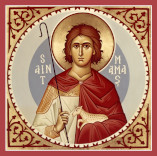 He was born in Paphlagonia of eminent Christian parents, Theodotus
and Rufina, who were thrown into prison for the name of Christ. In the prison, Theodotus was the
first to die, and Rufina, after giving birth to a son, soon followed her husband, and the newborn
child was left in the prison beside the bodies of his parents. God the Provider sent His holy
angel to a noble widow, Ammia, whom the angel told in a dream to go to the prison and take the
child. Ammia asked the city governor’s permission to bury the dead and take the child into
her own home. The child was dumb until the age of five, and then his first word was
‘Mama,’ because of which he was given the name Mamas. At school, he showed an unusual
brightness, and being brought up at home in a Christian spirit, did not conceal his faith but
confessed it before his contemporaries, mocking at the idols. In the time of the Emperor
Aurelian, there was a vicious persecution of Christians, and the pagans did not spare even
Christian children. Mamas was fifteen years old when he was taken before the emperor. The emperor
told him to deny Christ only with his lips. To this Mamas replied: ‘I shall not deny my God
and King Jesus Christ either in my heart or with my lips.’ The emperor ordered that he be
beaten, burned with torches and finally thrown into the sea, but an angel of God saved him and
took him to a high mountain near Caesarea. There he lived in solitude and prayer, and fierce wild
beasts were tamed by his holiness. He was eventually found there by the persecutors and put again
to torture. Overcoming both the power of fire and the fierceness of wild beasts, holy Mamas was
stabbed with a trident by a pagan priest. He thus gave his holy soul to the God to Whom he had
remained faithful in all his sufferings. Many of the sick have been healed by his relics.
He was born in Paphlagonia of eminent Christian parents, Theodotus
and Rufina, who were thrown into prison for the name of Christ. In the prison, Theodotus was the
first to die, and Rufina, after giving birth to a son, soon followed her husband, and the newborn
child was left in the prison beside the bodies of his parents. God the Provider sent His holy
angel to a noble widow, Ammia, whom the angel told in a dream to go to the prison and take the
child. Ammia asked the city governor’s permission to bury the dead and take the child into
her own home. The child was dumb until the age of five, and then his first word was
‘Mama,’ because of which he was given the name Mamas. At school, he showed an unusual
brightness, and being brought up at home in a Christian spirit, did not conceal his faith but
confessed it before his contemporaries, mocking at the idols. In the time of the Emperor
Aurelian, there was a vicious persecution of Christians, and the pagans did not spare even
Christian children. Mamas was fifteen years old when he was taken before the emperor. The emperor
told him to deny Christ only with his lips. To this Mamas replied: ‘I shall not deny my God
and King Jesus Christ either in my heart or with my lips.’ The emperor ordered that he be
beaten, burned with torches and finally thrown into the sea, but an angel of God saved him and
took him to a high mountain near Caesarea. There he lived in solitude and prayer, and fierce wild
beasts were tamed by his holiness. He was eventually found there by the persecutors and put again
to torture. Overcoming both the power of fire and the fierceness of wild beasts, holy Mamas was
stabbed with a trident by a pagan priest. He thus gave his holy soul to the God to Whom he had
remained faithful in all his sufferings. Many of the sick have been healed by his relics.
2. St. John the Faster, Patriarch of Constantinople.
St. John is also commemorated on August 30th. He was a goldsmith at first, then, by God’s providence and for his great virtues, was ordained priest. As a young man, St. John was once walking with an old monk from Palestine, Evsevios. Suddenly, a voice came to Evsevios from some invisible source: ‘Father, don’t walk on the right of great John!’ This, the voice of God, was predicting the high service to which John was soon to be called. After blessed Eftychios’ death, John was chosen as Patriarch of Constantinople. He was most unwilling to accept, but was overawed by a heavenly vision and thus gave his consent. He was a great faster, a man of prayer and a wonder-worker right up to his death, entering into rest in 595. After his death, his only possessions were found to be a wooden spoon, a linen shirt and an old cassock. His writings on repentance and confession are well-known.
3. St. Eleazar.
The son of Aaron and second high priest in Israel, he helped Moses to number the Israelites and Jesus the son of Navee to apportion the Promised Land among the twelve tribes. He faithfully guarded the Ark of the Covenant in Shiloh, and died peacefully.
4. Feast of the Miracle of the Kaluga Icon of the Mother of God.
This is recorded in the passage for consideration below.
FOR CONSIDERATION
The Orthodox Church has, within her experience, innumerable examples of almighty God’s showing of His power through natural and mortal things, especially through those which serve as signs of the incarnation, life and suffering of our Lord Jesus Christ: the Cross, icons of the Mother of God and the saints, holy water, oil, myrrh and so forth. Thus was there wrought a miracle by an icon of the holy Mother of God in 1748, in the house of a boyar, Chitrov, near the town of Kaluga in Russia. Two of the boyar’s serving girls, turning out junk in the attic one day, found a piece of folded linen on which was a beautiful painting of a woman’s face. The face was full of light and devotion. One of these girls was modest and serious, but the other was vain and given to gossip. The former looked at the face on the linen and gave it the name `the abbess,’ but Evdokia, for that was the name of the gossipy one, would not have that, but jeered at her modest companion. To give more force to her words, she spat on the image, and at that moment fell to the ground, her whole body contorted. She became blind and dumb, and began to foam at the mouth. That night, the Mother of God appeared to the parents of the afflicted girl, related to them what had happened to their daughter, and told them to call the priest to pray before the discovered icon and sprinkle the girl with holy water, and she would then be healed. When this had been done, Evdokia was restored to health, and from that time, her character changed and she became serious. Thus it was discovered that this was the miraculous face of the Mother of God. The icon was taken to the church in Kaluga, where it is found today, still working wonders.
Daily Scripture Readings taken from The Orthodox New Testament, translated and published by Holy Apostles Convent, Buena Vista, Colorado, copyright © 2000, used with permission, all rights reserved.
Daily Prologue Readings taken from The Prologue of Ochrid, by Bishop Nikolai Velimirovic, translated by Mother Maria, published by Lazarica Press, Birmingham, England, copyright © 1985, all rights reserved. Edited by Dormition Skete.