

Daily Devotional
Monday, July 28, 2025 (NS), July 15, 2025 (OS)
No Fasting.
Monday of the Eighth Week
The commemoration of the Martyrs Julitta and her child Kyrikos.
According to Gk. usage, this service is commemorated on the 15th of July. For Gk. usage, see [Mt. 17:24-18:4].
According to Sl. usage, this service has been transferred from the 15th to the 14th of July, due to the commemoration of St. Vladimir on the 15th. For Sl. usage, see [Lk. 10:19-21].
Scripture Readings
Paschalion — Movable Calendar
Monday of the Eighth Week
Epistle
The Reading is from the First Epistle of Saint Paul to the Corinthians [§ 142]. Brethren:
9 13Ye know, do ye not, that those who labor at the holy things eat of the things of the temple, and those who wait upon the altar partake with the altar? 14Even so the Lord appointed to those who proclaim the Gospel to live of the Gospel. 15But I used none of these things. Now I am not writing these things that it should be so with me; for it were good for me to die rather than that anyone should make empty the basis for my boasting. 16For if I be preaching the Gospel, it is no boast to me, for necessity is laid upon me; and woe to me if I be not preaching the Gospel! 17For if I practise this willingly, I have a reward; but if unwillingly, I have been entrusted with a stewardship. 18What then is my reward? That when I preach the Gospel, I might set forth the Gospel of Christ without charge, so as not to have made full use of mine authority in the Gospel.
Gospel
The Reading is from the Holy Gospel according to Saint Matthew [§ 65]. At that time:
16 1The Pharisees and Sadducees, having come to Jesus, put Him to the test and asked Him to show them a sign from the heaven. 2And He answered and said to them, “After it becometh evening, ye say, ‘Fine weather, for the heaven is fiery red’; 3“and at morning, ‘Stormy weather today, for the heaven is fiery red and lowering.’ Hypocrites! On the one hand ye know how to discern the face of the heaven, but on the other hand are ye not able to know the signs of the times? 4“An evil and adulterous generation seeketh a sign, and a sign shall not be given to it, except the sign of Jonas the prophet.” And He left them behind and went away.
5And His disciples, having come to the other side, forgot to take bread. 6But Jesus said to them, “Be taking heed and be on guard against the leaven of the Pharisees and Sadducees.”
Menaion — Fixed Calendar
The commemoration of the Martyrs Julitta and her child Kyrikos.
According to Gk. usage, this service is commemorated on the 15th of July. For Gk. usage, see [Mt. 17:24-18:4].
According to Sl. usage, this service has been transferred from the 15th to the 14th of July, due to the commemoration of St. Vladimir on the 15th. For Sl. usage, see [Lk. 10:19-21].
Epistle
14, 15. The commemoration of the Martyrs Julitta and her child Kyrikos.
According to Gk. usage, this service is commemorated on the 15th of July.
According to Sl. usage, the service to these saints has been transferred from the 15th to the 14th of July, due to the commemoration of St. Vladimir on the 15th of July.
The Reading is from the First Epistle of Saint Paul to the Corinthians [§ mid 154]. Brethren:
13 11When I was an infant, as an infant I used to talk, as an infant I used to understand, as an infant I used to reason; but when I became a man, I did away with the things of the infant. 12For now we see by means of a mirror, darkly, but then face to face. Now I know in part, but then I shall fully know even as I also was fully known. 13And there now abideth faith, hope, love, these three things; but the greatest of these is love.
14 1Keep on pursuing love and emulously desiring spiritual gifts, but much more that ye may prophesy. 2For the one who speaketh in a tongue, speaketh not to men, but to God; for no one heareth, but in spirit he speaketh mysteries. 3But the one who prophesieth to men speaketh for edification, and exhortation, and consolation. 4The one who speaketh in a tongue edifieth himself; but the one who prophesieth edifieth a church. 5Now I wish for you all to speak in tongues, but much more that ye may prophesy; for greater is the one who prophesieth than the one who speaketh in tongues, unless he be interpreting in order that the Church might receive edification.
15. The commemoration of Prince Vladimir the Great, Equal-to-the-apostles.
The Reading is from the Epistle of Saint Paul to the Galatians [§ 200].
1 11Brethren, I make known to you the Gospel which was preached as good tidings by me, that it is not according to man; 12for I neither received it from man, nor was I taught it, but by a revelation of Jesus Christ. 13For ye heard of my manner of life at one time in Judaism, that according to excess, I used to persecute the Church of God, and was ravaging her. 14And I kept on advancing in Judaism beyond many contemporaries in mine own race, being more exceedingly a zealot of the traditions of my fathers. 15But when it pleased God, Who separated me from my mother’s womb and called me by His grace, 16to reveal His Son in me, that I be preaching Him as good tidings among the nations, immediately I conferred not with flesh and blood, 17neither did I go up to Jerusalem to those who were apostles before me, but I went away into Arabia, and again returned to Damascus. 18Then after three years I went up to Jerusalem to visit Peter, and remained with him fifteen days; 19but of the other apostles I saw none, except Iakovos the brother of the Lord.
Gospel
14, 15. The commemoration of the Martyrs Julitta and her child Kyrikos.
According to Gk. usage, this service is commemorated on the 15thof July. For Gk. usage, see [Mt. 17:24-18:4], hereunder:
According to Sl. usage, this service has been transferred from the 15thto the 14thof July. For Sl. usage, see [Lk. 10:19-21].
15. The commemoration of Prince Vladimir the Great, Equal-to-the-apostles.
The Reading is from the Holy Gospel according to Saint John [§ mid 35]. The Lord said to those Jews who had come to Him:
10 1“Verily, verily, I say to you, the one who entereth not by the door into the fold of the sheep, but goeth up from another place, that one is a thief and a robber. 2“But the one who entereth by the door is a shepherd of the sheep. 3“To this one the doorkeeper openeth, and the sheep hear his voice; and he calleth his own sheep by name and leadeth them out. 4“And whenever he should put forth his own sheep, he goeth before them; and the sheep follow him, because they know his voice. 5“But a stranger in no wise will they follow, but will flee from him, because they know not the voice of strangers.” 6This parable Jesus spoke to them; but they understood not what it was which He spoke to them. 7Then said Jesus to them again, “Verily, verily, I say to you that I am the door of the sheep. 8“All, as many as came before Me, are thieves and robbers; but the sheep heard them not. 9“I am the door; by Me if anyone should enter, he shall be saved, and shall go in and go out and find pasture.”
Lives of the Saints (Prologue)
July 28th – Civil Calendar
July 15th – Church Calendar
1. The Holy Martyrs Kyrikos and Julitta.
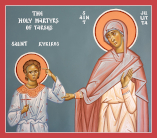 Holy Julitta was of noble
birth. She was widowed young, and left with a newborn child, Kyrikos (Cerycus). She lived in
Iconium, a city of Lykaonia, and was a very devout Christian. She had her son baptized
immediately after his birth, and when he was three years old, instructed him in the Faith and
taught him to pray insofar as a child of that age is capable of learning. When Diocletian
launched a persecution of Christians, much innocent blood was shed in the city of Iconium.
Julitta took her son and hid from the wrath of the pagans in the town of Seleucid, but things
were no better there. Julitta was arrested as a Christian and brought to trial. Seeing Julitta so
courageously proclaim her faith in the Lord Jesus, the judge, to distress her and make her waver,
took the child in his arms and began to kiss it. But Kyrikos shouted: ‘I am a Christian;
let me go to my mother!’ and he began to scratch the judge, turning his face away from him.
The judge was furious, threw the child to the ground and kicked it, and the child rolled down the
stone steps and gave his holy and innocent soul to God. Seeing how Kyrikos suffered before her,
Julitta was filled with joy and gave thanks to God that her son had been counted worthy of the
wreath of martyrdom. After harsh torture, Julitta was beheaded, in the year 304. The relics of
Ss. Kyrikos and Julitta have wonder-working power to this day. A part of the relics of these
saints is to be found in Ochrid, in the Church of the Holy Mother of God, the Healer.
Holy Julitta was of noble
birth. She was widowed young, and left with a newborn child, Kyrikos (Cerycus). She lived in
Iconium, a city of Lykaonia, and was a very devout Christian. She had her son baptized
immediately after his birth, and when he was three years old, instructed him in the Faith and
taught him to pray insofar as a child of that age is capable of learning. When Diocletian
launched a persecution of Christians, much innocent blood was shed in the city of Iconium.
Julitta took her son and hid from the wrath of the pagans in the town of Seleucid, but things
were no better there. Julitta was arrested as a Christian and brought to trial. Seeing Julitta so
courageously proclaim her faith in the Lord Jesus, the judge, to distress her and make her waver,
took the child in his arms and began to kiss it. But Kyrikos shouted: ‘I am a Christian;
let me go to my mother!’ and he began to scratch the judge, turning his face away from him.
The judge was furious, threw the child to the ground and kicked it, and the child rolled down the
stone steps and gave his holy and innocent soul to God. Seeing how Kyrikos suffered before her,
Julitta was filled with joy and gave thanks to God that her son had been counted worthy of the
wreath of martyrdom. After harsh torture, Julitta was beheaded, in the year 304. The relics of
Ss. Kyrikos and Julitta have wonder-working power to this day. A part of the relics of these
saints is to be found in Ochrid, in the Church of the Holy Mother of God, the Healer.
2. St. Vladimir, Great Prince of Russia.
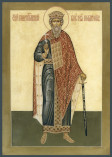 Vladimir was the son of Prince Svyatoslav, and
grandson of Igor and Olga, and was at first completely pagan in faith and life. Learning of the
existence of various faiths, he began to examine them, to decide which was best. He sent envoys
throughout the world to examine all of the major religions, and to report back to him what they
had found. The envoys who examined the Indian, Moslem, Jewish, and Latin faiths were not
impressed; but the envoys who visited the Orthodox in Constantinople, told the prince that they
had been at a service in the Orthodox Church of Hagia Sophia, and that they had been ‘out
of ourselves, not knowing if we were on earth or in heaven’. This inspired Vladimir to be
baptized, receiving the name Vasily (Basil), and to baptize his people. The chief idol, Perun,
was dragged off the hill of Kiev and thrown into the Dnieper. Embracing the Christian Faith,
Vladimir utterly changed his way of life and devoted all his labor to the perfect fulfilling of
the demands of his faith. He decreed that churches be built throughout the land on the places
where the idols had been pulled down, and himself built a beautiful church in Kiev to the most
holy Mother of God. This church was built on the same spot where St. Theodore and his son John
suffered martyrdom for Christ (see July 12th). With the same irresistible force with which
Vladimir earlier upheld idolatry, he now spread Christianity. He entered into rest in the Lord in
1015.
Vladimir was the son of Prince Svyatoslav, and
grandson of Igor and Olga, and was at first completely pagan in faith and life. Learning of the
existence of various faiths, he began to examine them, to decide which was best. He sent envoys
throughout the world to examine all of the major religions, and to report back to him what they
had found. The envoys who examined the Indian, Moslem, Jewish, and Latin faiths were not
impressed; but the envoys who visited the Orthodox in Constantinople, told the prince that they
had been at a service in the Orthodox Church of Hagia Sophia, and that they had been ‘out
of ourselves, not knowing if we were on earth or in heaven’. This inspired Vladimir to be
baptized, receiving the name Vasily (Basil), and to baptize his people. The chief idol, Perun,
was dragged off the hill of Kiev and thrown into the Dnieper. Embracing the Christian Faith,
Vladimir utterly changed his way of life and devoted all his labor to the perfect fulfilling of
the demands of his faith. He decreed that churches be built throughout the land on the places
where the idols had been pulled down, and himself built a beautiful church in Kiev to the most
holy Mother of God. This church was built on the same spot where St. Theodore and his son John
suffered martyrdom for Christ (see July 12th). With the same irresistible force with which
Vladimir earlier upheld idolatry, he now spread Christianity. He entered into rest in the Lord in
1015.
FOR CONSIDERATION
Hospitality exists among other faiths, but Christianity has stressed hospitality as a duty and an obligation. Gratitude for hospitality is no less a duty and an obligation for the Christian. He who learns to be grateful for hospitality will also be grateful to God for His hospitality, for what are we here on earth but God’s guests? What else are the angels in heaven? The following is told of King Philip of Macedon, who harshly punished one of his courtiers for ingratitude: The king sent this courtier overseas to carry out a certain piece of work. The courtier completed it and set off home by ship. A storm destroyed the ship, and the courtier found himself among the waves. Fortunately, this was not far from land, and a fisherman saw the man drowning and brought him to land. When he had recovered and rested, the courtier returned to the king, and told him of his calamity in the storm at sea. The king, desiring to reward him, asked him what he desired. The courtier mentioned the fisherman, and told the king that his greatest desire was that the king should give him the farm of that fisherman by the sea. The king immediately did as he asked. When the courtier had taken possession of the farm of his greatest benefactor, the latter went to the king and related the whole story with great lamentation. He told how he had saved the courtier’s life and how he had driven the fisherman from his home. Hearing this, the king was furious with the ungrateful courtier, and ordered that he be branded on the forehead with the words: ‘An ungrateful guest’.
Daily Scripture Readings taken from The Orthodox New Testament, translated and published by Holy Apostles Convent, Buena Vista, Colorado, copyright © 2000, used with permission, all rights reserved.
Daily Prologue Readings taken from The Prologue of Ochrid, by Bishop Nikolai Velimirovic, translated by Mother Maria, published by Lazarica Press, Birmingham, England, copyright © 1985, all rights reserved. Edited by Dormition Skete.