

Daily Devotional
Sunday, July 27, 2025 (NS), July 14, 2025 (OS)
No Fasting.
13-19. The Sunday of the Holy Fathers.
According to the Typikon of the Great Church, if the 13th is a Sunday, we commemorate the holy and God-bearing Fathers of the Fourth Œcumenical Synod at Chalcedon. If the 13th is not a Sunday, the service is celebrated on the first Sunday following the 13th, but not later than the 19th of July.
According to the Typikon of St. Savvas, when it is the 16th of July, if it should fall on Wednesday or earlier, we celebrate the service to the holy and God-bearing Fathers of the first Six Œcumenical Synods on the preceding Sunday. If the 16th falls on a Thursday or later, the service is commemorated on the following Sunday.
Sunday of the Seventh Week
Mode Plagal Two — Seventh Eothinon
The commemoration of the holy Apostle Aquila of the Seventy.
14, 15. The commemoration of the Martyrs Julitta and her child Kyrikos.
According to Gk. usage, this service is commemorated on the 15th of July.
According to Sl. usage, the service to these saints has been transferred from the 15th to the 14th of July, due to the commemoration of St. Vladimir on the 15th of July.
Scripture Readings
Special Commemorations
13-19. The Sunday of the Holy Fathers.
According to the Typikon of the Great Church, if the 13th is a Sunday, we commemorate the holy and God-bearing Fathers of the Fourth Œcumenical Synod at Chalcedon. If the 13th is not a Sunday, the service is celebrated on the first Sunday following the 13th, but not later than the 19th of July.
According to the Typikon of St. Savvas, when it is the 16th of July, if it should fall on Wednesday or earlier, we celebrate the service to the holy and God-bearing Fathers of the first Six Œcumenical Synods on the preceding Sunday. If the 16th falls on a Thursday or later, the service is commemorated on the following Sunday.
Epistle
The Reading is from the Epistle of Saint Paul to Saint Titus [§ mid 302 A]: Child Titus:
3 8Faithful is the word. And concerning these things I desire thee to be affirming, in order that they who have believed God may give heed to set before themselves good works. These things are good and profitable to men. 9But be shunning foolish inquiries, and genealogies, and strifes, and contentions relating to points of the law; for they are unprofitable and vain. 10A heretical man, after a first and second admonition, be rejecting, 11knowing that such a one hath been perverted, and sinneth, being self-condemned.
12Whenever I should send Artemas to thee, or Tychikos, hasten to come to me in Nicopolis, for I have decided to winter there. 13Send forth with haste Zenas the lawyer and Apollos, in order that nothing may be lacking to them. 14And let ours also be learning to set before themselves good works for necessary uses, that they may not be unfruitful.
15All those with me salute thee. Greet those who love us in faith.
Grace be with you all. Amen.
for Sl. usage, see [Heb. 13:7-16].
Gospel
The Reading is from the Holy Gospel according to Saint Matthew [§ 11]. The Lord said to His disciples:
5 14“Ye are the light of the world. A city situated on the top of a mountain cannot be hid. 15“Nor do they light a lamp and put it under the bushel, but upon the lampstand, and it giveth light to all those in the house. 16“Thus, let your light shine before men, that they might see your good works, and might glorify your Father Who is in the heavens.
17“Do not begin to think that I came to abolish the law or the prophets; I came not to abolish, but to fulfill. 18“For verily I say to you, until the heaven and the earth shall have passed away, one iota or one tittle in no wise shall pass away from the law, until all shall have taken place. 19“Whosoever then shall break one of the least of these commandments, and shall teach men so, he shall be called least in the kingdom of the heavens; but whosoever shall do and teach them, this one shall be called great in the kingdom of the heavens.”
for Sl. usage, see [Jn. 17:1-13].
Paschalion — Movable Calendar
Sunday of the Seventh Week
Mode Plagal Two — Seventh Eothinon
Epistle
The Reading is from the Epistle of Saint Paul to the Romans [§ 116]. Brethren:
15 1We who are strong ought to bear the infirmities of the weak, and not to please ourselves. 2For let each of us be pleasing his neighbor for the good, toward building up. 3For even the Christ pleased not Himself; but even as it hath been written: “The reproaches of those who reproach Thee are fallen on Me [Ps. 68(69):12(9)].” 4For whatsoever things were written aforetime were written for our instruction, in order that we through patience and the consolation of the Scriptures may have hope. 5Now may the God of patience and consolation grant you to be like-minded among one another according to Christ Jesus, 6that with one accord and with one mouth ye may glorify the God and Father of our Lord Jesus Christ. 7Wherefore, be receiving one another, even as also the Christ Himself received us to the glory of God.
Gospel
The Reading is from the Holy Gospel according to Saint Matthew [§ 33]. At that time:
9 27When Jesus passed by from that place, two blind men followed Him, crying and saying, “Have mercy on us, Son of David!” 28And after He came into the house, the blind men came to Him; and Jesus saith to them, “Believe ye that I am able to do this?” They say to Him, “Yes, Lord.” 29Then He touched their eyes, saying, “According to your faith, let it be to you.” 30And their eyes were opened. And Jesus earnestly admonished them, saying, “See to it, let no one know it.” 31But they, after they went out, made Him known in all that land. 32And as they went out, behold, they brought to Him a mute man possessed by a demon. 33And after the demon was cast out, the mute spoke. And the crowds marvelled, saying, “It was never so seen in Israel.” 34But the Pharisees were saying, “He casteth out the demons by the ruler of the demons.”
35And Jesus was going about all the cities and villages, teaching in their synagogues, and proclaiming the Gospel of the kingdom, and curing every disease and every bodily weakness among the people.
Menaion — Fixed Calendar
The commemoration of the holy Apostle Aquila of the Seventy.
14, 15. The commemoration of the Martyrs Julitta and her child Kyrikos.
According to Gk. usage, this service is commemorated on the 15th of July.
According to Sl. usage, the service to these saints has been transferred from the 15th to the 14th of July, due to the commemoration of St. Vladimir on the 15th of July.
Epistle
14. The commemoration of the holy Apostle Aquila of the Seventy.
No reading given.
14, 15. The commemoration of the Martyrs Julitta and her child Kyrikos.
According to Gk. usage, this service is commemorated on the 15th of July.
According to Sl. usage, the service to these saints has been transferred from the 15th to the 14th of July, due to the commemoration of St. Vladimir on the 15th of July.
The Reading is from the First Epistle of Saint Paul to the Corinthians [§ mid 154]. Brethren:
13 11When I was an infant, as an infant I used to talk, as an infant I used to understand, as an infant I used to reason; but when I became a man, I did away with the things of the infant. 12For now we see by means of a mirror, darkly, but then face to face. Now I know in part, but then I shall fully know even as I also was fully known. 13And there now abideth faith, hope, love, these three things; but the greatest of these is love.
14 1Keep on pursuing love and emulously desiring spiritual gifts, but much more that ye may prophesy. 2For the one who speaketh in a tongue, speaketh not to men, but to God; for no one heareth, but in spirit he speaketh mysteries. 3But the one who prophesieth to men speaketh for edification, and exhortation, and consolation. 4The one who speaketh in a tongue edifieth himself; but the one who prophesieth edifieth a church. 5Now I wish for you all to speak in tongues, but much more that ye may prophesy; for greater is the one who prophesieth than the one who speaketh in tongues, unless he be interpreting in order that the Church might receive edification.
Gospel
14. The commemoration of the holy Apostle Aquila of the Seventy.
No reading given.
14, 15. The commemoration of the Martyrs Julitta and her child Kyrikos.
According to Gk. usage, this service is commemorated on the 15thof July. For Gk. usage, see [Mt. 17:24-18:4], hereunder:
According to Sl. usage, this service has been transferred from the 15thto the 14thof July. For Sl. usage, see [Lk. 10:19-21].
The Reading is from the Holy Gospel according to Saint Matthew [§ 73]. At that time:
17 24Those who receive the two-drachma tax came to Peter and said, “Doth not your Teacher pay the two-drachma tax?” 25He saith, “Yes.” And when he entered into the house, Jesus anticipated him, saying, “What thinkest thou, Simon? From whom do the kings of the earth receive a custom duty or a poll-tax? From their sons or from the strangers?” 26Peter saith to Him, “From the strangers.” Jesus saith to him, “Then indeed are the sons free. 27“But lest we should offend them, go thou to the sea, and cast a hook, and take up the fish which first cometh up; and after thou openest its mouth, thou shalt find a stater; that take and give it to them for Me and thee.”
18 1In that hour the disciples came to Jesus, saying, “Who then is greater in the kingdom of the heavens?” 2And Jesus called to Himself a little child, and set him in their midst, 3and said, “Verily I say to you, unless ye be turned about and become as the little children, in no wise shall ye enter into the kingdom of the heavens. 4“Whosoever therefore shall humble himself as this little child, this one is the greater in the kingdom of the heavens.”
Lives of the Saints (Prologue)
Special Commemorations
13-19. The Sunday of the Holy Fathers.
According to the Typikon of the Great Church, if the 13th is a Sunday, we commemorate the holy and God-bearing Fathers of the Fourth Œcumenical Synod at Chalcedon. If the 13th is not a Sunday, the service is celebrated on the first Sunday following the 13th, but not later than the 19th of July.
According to the Typikon of St. Savvas, when it is the 16th of July, if it should fall on Wednesday or earlier, we celebrate the service to the holy and God-bearing Fathers of the first Six Œcumenical Synods on the preceding Sunday. If the 16th falls on a Thursday or later, the service is commemorated on the following Sunday.
Commemoration of the First Six Ecumenical Councils.
The ecumenical councils (synods) are the greatest duels between Orthodoxy and the heretics. Today, the Church commemorates the first six councils together:
The First Ecumenical Council in Nicaea in 325, at which 318 fathers were present. It is commemorated on May 29th and on the 7th Sunday after Pascha. This council refuted the Arian heresy against God the Son.
The Second Council in Constantinople in 381, was attended by 150 fathers. It is commemorated on May 22nd. This council refuted the heresy of Macedonius against God the Holy Spirit.
The Third Council was in Ephesus in 431, with 200 fathers. It is commemorated on September 9th. This council refuted the Nestorian heresy against the Mother of God.
The Fourth Council was in Chalcedon in 451, with 630 fathers present. It is commemorated on July 16th. This council refuted the Monophysite heresy.
The Fifth Council was in Constantinople in 553, with 160 fathers, and is commemorated on July 25th. This council refuted the heresy of Origen.
The Sixth Council was in Constantinople in 691, with 170 fathers. It is commemorated on January 23rd. This council refuted the Monothelite heresy.
The Seventh Ecumenical Council, held in 787 with 367 fathers present, is not commemorated on this occasion, but on its own on October 11th. This council refuted the iconoclast heresy.
At these councils, by the guidance of the Holy Spirit, all heresies were condemned and the Orthodox Faith defined and confirmed for all time.
Menaion — Fixed Calendar
July 27th – Civil Calendar
July 14th – Church Calendar
1. The Holy Apostle Aquila.
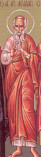 One of the Seventy, he was a Jew living in Italy with his wife
Priscilla. When the Emperor Claudius decreed the exile of all Jews from Rome and Italy, Aquila
moved to Corinth, where the Apostle Paul first made his acquaintance, staying eighteen months in
his house and baptising him and his wife. Burning with zeal for the Christian Faith, Aquila and
Priscilla accompanied Paul to Ephesus and helped him in his apostolic work. From Ephesus, Paul
wrote his first Epistle to the Corinthians, in which he says at the end: ‘Aquila and
Priscilla salute you much in the Lord, with the church that is in their house’ (16:19).
After the death of Claudius, Jews were permitted to return to Italy, and Aquila and Priscilla
went back to Rome. Writing the Epistle to the Romans from Corinth after this, the apostle sends
greetings to his old friends and fellow-workers: ‘Greet Priscilla and Aquila my helpers in
Christ Jesus, who have for my life laid down their own necks, unto whom not only I give thanks,
but also all the churches of the Gentiles. Likewise greet the church that is in their
house’ (16:3-5). We later see Aquila again in Ephesus, where he is working with St.
Timothy. In chains in Rome, Paul wrote to Timothy in Ephesus: ‘Greet Priscilla and
Aquila’ (II Tim. 4:19). As a bishop, Aquila baptized many and consecrated them to the
Faith, destroyed idols, built churches, made priests and spread among the people the glory of the
incarnate Son of God. He was finally murdered by wicked pagans, and went to the kingdom of
Christ.
One of the Seventy, he was a Jew living in Italy with his wife
Priscilla. When the Emperor Claudius decreed the exile of all Jews from Rome and Italy, Aquila
moved to Corinth, where the Apostle Paul first made his acquaintance, staying eighteen months in
his house and baptising him and his wife. Burning with zeal for the Christian Faith, Aquila and
Priscilla accompanied Paul to Ephesus and helped him in his apostolic work. From Ephesus, Paul
wrote his first Epistle to the Corinthians, in which he says at the end: ‘Aquila and
Priscilla salute you much in the Lord, with the church that is in their house’ (16:19).
After the death of Claudius, Jews were permitted to return to Italy, and Aquila and Priscilla
went back to Rome. Writing the Epistle to the Romans from Corinth after this, the apostle sends
greetings to his old friends and fellow-workers: ‘Greet Priscilla and Aquila my helpers in
Christ Jesus, who have for my life laid down their own necks, unto whom not only I give thanks,
but also all the churches of the Gentiles. Likewise greet the church that is in their
house’ (16:3-5). We later see Aquila again in Ephesus, where he is working with St.
Timothy. In chains in Rome, Paul wrote to Timothy in Ephesus: ‘Greet Priscilla and
Aquila’ (II Tim. 4:19). As a bishop, Aquila baptized many and consecrated them to the
Faith, destroyed idols, built churches, made priests and spread among the people the glory of the
incarnate Son of God. He was finally murdered by wicked pagans, and went to the kingdom of
Christ.
2. Our Holy Father Hellius.
An Egyptian monk of the fourth century, he devoted himself from early youth to monastic asceticism in the desert. He made monks and lay-folk marvel by his life and great miracles, and although he fled from human praise, he could not hide himself. He had fierce struggles with diabolical delusion, most especially during a long fast. The devil set before him sometimes honey and sometimes delicious apples, but he would not be enticed. He had insight into the hearts of men, revealing their passions and thoughts, and this not to make a parade of his inner knowledge but to set them on the right path.
FOR CONSIDERATION
Christians must arm themselves against the immorality of this world. They must be armed against every assault and temptation, so that all that is evil may rebound from them. Armour is not made in a day or two, but is carefully and laboriously forged by a lengthy process. What are all our virtues worth if we succumb at the first temptation? Speaking of this, St. Gregory of Nyssa cites as an example a monkey in Alexandria, saying: ‘In Alexandria, an expert taught a monkey to perform a very nimble parody of a dancer on the stage. Visitors to the theater praised the monkey which, dressed as a dancer, danced to the tempo of the music. But, while the audience was occupied in watching this new spectacle, some comic decided to show everyone that the monkey was nothing but a monkey. While all were applauding the trained animal, the comic threw onto the stage the sort of sweets that a monkey especially loves. As soon as the monkey set eyes on them, it forgot the dance, the applause and its fine clothes and hurried with outstretched paw for the sweets. When its skirts hindered it, it began to tear at them with its nails, frenziedly ridding itself of them. And, in place of the praise and wonder, the audience was convulsed with laughter.’ The monkey was revealed under the torn mask of the ‘dancer’.
Daily Scripture Readings taken from The Orthodox New Testament, translated and published by Holy Apostles Convent, Buena Vista, Colorado, copyright © 2000, used with permission, all rights reserved.
Daily Prologue Readings taken from The Prologue of Ochrid, by Bishop Nikolai Velimirovic, translated by Mother Maria, published by Lazarica Press, Birmingham, England, copyright © 1985, all rights reserved. Edited by Dormition Skete.