

Daily Devotional
Saturday, May 24, 2025 (NS), May 11, 2025 (OS)
No Fasting.
Saturday of the Fifth Week
11. The commemoration of the founding of Constantinople, and Hieromartyr Mokios, presbyter of Amphipolis in Macedonia, and the holy Kyril and Methodios, Equals-to-the-apostles, and Hieromartyr Joseph, Metropolitan of Astrakhan.
Scripture Readings
Paschalion — Movable Calendar
Saturday of the Fifth Week
Epistle
The Reading is from the Acts of the Apostles [§ 37]. In those days:
15 35Paul and Barnabas were spending time in Antioch, teaching and preaching as good tidings the word of the Lord, with many others also. 36And after some days Paul said to Barnabas, “Let us return now and visit our brethren in every city in which we proclaimed the word of the Lord, and see how they are holding fast.” 37And Barnabas determined to take with them John, who is called Mark. 38But Paul kept on thinking it not meet to take along that one, since he withdrew from them from Pamphylia, and went not with them to the work. 39Then a sharp contention arose, so as to separate them from one another: and Barnabas, having taken Mark, sailed away to Cyprus; 40and Paul, having chosen for himself Silas, went forth, having been commended to the grace of God by the brethren. 41And he passed through Syria and Cilicia, rendering more firm the churches.
Gospel
The Reading is from the Holy Gospel according to Saint John [§ 38]. The Lord said to those Jews who had come to Him:
10 27“The sheep, those that are Mine, hear My voice, and I know them, and they follow Me. 28“And I give them eternal life, and in no wise shall they ever perish, and neither shall anyone snatch them out of My hand. 29“My Father, Who hath given them to Me, is greater than all; and no one is able to snatch them out of My Father’s hand. 30“I and the Father are one.” 31Then the Jews took up stones again that they might stone Him. 32Jesus answered them, “Many good works I showed you from My Father. For what kind of work among these are ye trying to stone Me?” 33The Jews answered Him, saying, “For a good work we are not about to stone Thee, but for blasphemy, and because Thou, being a man, makest Thyself God.” 34Jesus answered them, “Is it not written in your law, ‘I said, “Ye are gods [Ps. 81(82):6]”’? 35“If He called them gods, to whom the word of God came to pass—and the Scripture is not able to be broken— 36“do ye say of Him, Whom the Father sanctified and sent forth into the world, ‘Thou blasphemest,’ because I said, ‘I am God’s Son’? 37“If I do not the works of My Father, cease believing Me. 38“But if I do, even if ye believe Me not, believe the works, that ye might come to know and believe that the Father is in Me, and I in Him.”
Menaion — Fixed Calendar
11. The commemoration of the founding of Constantinople, and Hieromartyr Mokios, presbyter of Amphipolis in Macedonia, and the holy Kyril and Methodios, Equals-to-the-apostles, and Hieromartyr Joseph, Metropolitan of Astrakhan.
Epistle
For the Hieromartyr Mokios:
The Reading is from the Epistle of Saint Paul to the Colossians [§ 258]. Brethren:
3 12Put on for yourselves, as elect of God, holy and beloved, compassion from your inward parts, kindness, humbleness of mind, meekness, long-suffering, 13bearing with one another, and graciously forgiving one another, if anyone hath a complaint against someone; even as the Christ graciously forgave you, thus also do ye. 14And over all these things, put on love, which is the bond of perfection. 15And let the peace of God be presiding in your hearts, to which also ye were called in one body; and keep on becoming thankful. 16Let the word of Christ dwell in you richly, in all wisdom, teaching and admonishing one another in psalms and hymns and spiritual odes, singing with grace in your heart to the Lord.
for Sl. usage, see [2 Tim. 2:1-10].
For the Equals-to-the-apostles:
The Reading is from the Epistle of Saint Paul to the Hebrews [§ 318]. Brethren:
7 26Such a High Priest was fitting for us: holy, guileless, undefiled, Who hath been separated from the sinners and hath become higher than the heavens, 27Who hath no need daily, even as the high priests, to offer up sacrifices, first for his own sins, then for those of the people; for this He did once for all after He offered up Himself. 28For the law appointeth men high priests who have weakness; but the word of the oath, which is after the law, appointeth the Son, Who hath been perfected forever.
8 1Now in reference to the things being spoken of, the chief point is: We have such a High Priest, Who sat down on the right of the throne of the majesty in the heavens, 2a Liturgist of the holies and of the tabernacle, the true one, which the Lord pitched, and not man.
For the Hieromartyr Joseph:
The Reading is from the Epistle of Saint Paul to the Hebrews [§ 334]. Brethren:
13 7Be remembering those who lead you, who spoke to you the word of God, whose faith keep on imitating, observing attentively the end of their conduct: 8Jesus Christ, the same yesterday and today and to the ages. 9Cease being carried about by various and strange teachings. For it is good for the heart to be confirmed by grace, not by foods, in which those walking therein were not profited. 10We have an altar from which those serving the tabernacle have no authority to eat; 11for the bodies of those animals, “whose blood is being brought into the holies for sins” by the high priest, “are being burned outside of the encampment [cf. Lev. 16:27].” 12Wherefore Jesus also, that He might sanctify the people by His own blood, suffered outside of the gate. 13Let us be going forth therefore to Him outside of the encampment, bearing His reproach; 14for we have no abiding city here, but we seek the coming one. 15Through Him, then, let us be offering up a “sacrifice of praise [Lev. 7:2(12)]” continually to God, that is, “the fruit of the lips [cf. Hos. 14:3(2); Is. 57:19],” giving thanks to His name. 16But cease being forgetful of doing good and of contributing; for God is well pleased with such sacrifices.
Gospel
For the Hieromartyr Mokios:
The Reading is from the Holy Gospel according to Saint John [§ 51]. The Lord said to His disciples:
159“Even as the Father loved Me, I also loved you; abide in the love, that which is Mine. 10“If ye keep My commandments, ye shall abide in My love, even as I have kept the commandments of My Father, and abide in His love. 11“These things I have spoken to you, that My joy might remain in you, and that your joy might be made full. 12“This is My commandment, that ye be loving one another, even as I loved you. 13“Greater love hath no one than this, that one should lay down his life for his friends. 14“Ye are My friends if ye be doing whatsoever I command you. 15“I no longer call you slaves, for the slave knoweth not what his lord is doing; but I have called you friends, for all things which I heard from My Father I made known to you. 16“Ye did not choose Me for yourselves, but I chose you for Myself, and I appointed you that ye be going and bearing fruit, and that your fruit be abiding, in order that whatsoever ye ask the Father in My name He might give you.”
For the Equals-to-the-apostles:
The Reading is from the Holy Gospel according to Saint Matthew [§ 11]. The Lord said to His disciples:
5 14“Ye are the light of the world. A city situated on the top of a mountain cannot be hid. 15“Nor do they light a lamp and put it under the bushel, but upon the lampstand, and it giveth light to all those in the house. 16“Thus, let your light shine before men, that they might see your good works, and might glorify your Father Who is in the heavens.
17“Do not begin to think that I came to abolish the law or the prophets; I came not to abolish, but to fulfill. 18“For verily I say to you, until the heaven and the earth shall have passed away, one iota or one tittle in no wise shall pass away from the law, until all shall have taken place. 19“Whosoever then shall break one of the least of these commandments, and shall teach men so, he shall be called least in the kingdom of the heavens; but whosoever shall do and teach them, this one shall be called great in the kingdom of the heavens.”
For the Hieromartyr Joseph:
The Reading is from the Holy Gospel according to Saint Luke [§ 67]. The Lord said:
12 32“Cease being afraid, little flock, for your Father is well pleased to give you the kingdom. 33“Sell your possessions and give alms. Make for yourselves purses which do not become old, an unfailing treasure in the heavens, where no thief draweth near nor moth destroyeth; 34“for where your treasure is, there your heart will be also. 35“Let your loins be girded about and the lamps be kept burning; 36“and be ye like to men waiting for their own lord—whenever he should depart from the wedding festivities—that when he cometh and knocketh, straightway, they might open to him. 37“Happy are those slaves whom the lord, after he cometh, shall find watching. Verily I say to you that he shall gird himself about and shall have them recline at table, and will come forth and minister to them. 38“And if he should come in the second watch, and in the third watch should he come, and find them thus, happy are those slaves. 39“But know ye this, that if the master of the house had known in what hour the thief was coming, he would have watched and not let his house be broken into. 40“Ye therefore also keep on becoming ready, for in the hour ye think not, the Son of Man cometh.”
Lives of the Saints (Prologue)
May 24th – Civil Calendar
May 11th – Church Calendar
1. Ss. Kyril and Methodius, Equal to the Apostles.
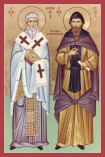 They were brothers from Thessalonica, of eminent and wealthy
parents, Leo and Maria. The elder brother, Methodius, spent ten years as an officer among the
Slavs in Macedonia, and thus learned the Slavic language. After that, Methodius went off to
Olympus and gave himself to monastic asceticism, and Kyril (Constantine) later joined him there.
When the Khazarite king, Kagan, sought preachers of the Christian Faith from the Emperor Michael,
the emperor commanded that these two brothers be found and sent to the Khazars. They converted
Kagan to the Christian Faith and baptized him, together with a great number of his nobles and an
even greater number of the people. After some time, they returned to Constantinople, where they
compiled a Slavic alphabet of 38 letters and began to translate the service books from Greek into
Glagolitic (the precursor of Slavonic). At the invitation of Prince Rastislav, they went to
Moravia, where, with great devotion, they spread and confirmed the Faith, made more copies of the
books, brought them priests and taught the young. They went to Rome at the invitation of the
pope, and Kyril fell ill and died there, on February 14th, 869. Then Methodius returned to
Moravia and labored at the confirming of the Faith among the Slavs until his death. After his
death, he entered into rest in the Lord on April 6th, 885—his disciples, the Five Followers, with
St. Clement as bishop at the beginning, crossed the Danube and moved towards the south, to
Macedonia, where, from Ochrid, they continued the work among the Slavs that Kyril and Methodius
had begun in the north.
They were brothers from Thessalonica, of eminent and wealthy
parents, Leo and Maria. The elder brother, Methodius, spent ten years as an officer among the
Slavs in Macedonia, and thus learned the Slavic language. After that, Methodius went off to
Olympus and gave himself to monastic asceticism, and Kyril (Constantine) later joined him there.
When the Khazarite king, Kagan, sought preachers of the Christian Faith from the Emperor Michael,
the emperor commanded that these two brothers be found and sent to the Khazars. They converted
Kagan to the Christian Faith and baptized him, together with a great number of his nobles and an
even greater number of the people. After some time, they returned to Constantinople, where they
compiled a Slavic alphabet of 38 letters and began to translate the service books from Greek into
Glagolitic (the precursor of Slavonic). At the invitation of Prince Rastislav, they went to
Moravia, where, with great devotion, they spread and confirmed the Faith, made more copies of the
books, brought them priests and taught the young. They went to Rome at the invitation of the
pope, and Kyril fell ill and died there, on February 14th, 869. Then Methodius returned to
Moravia and labored at the confirming of the Faith among the Slavs until his death. After his
death, he entered into rest in the Lord on April 6th, 885—his disciples, the Five Followers, with
St. Clement as bishop at the beginning, crossed the Danube and moved towards the south, to
Macedonia, where, from Ochrid, they continued the work among the Slavs that Kyril and Methodius
had begun in the north.
2. The Hieromartyr Mokios.
A Roman by birth, and a priest in Amphipolis in Macedonia, he suffered in the time of Diocletian. He destroyed a statue of the god Dionysos by his prayers, which roused some of the pagans to fury against him but brought others to the Faith. He was beheaded for Christ in 295.
3. St. Nikodim of Peć, Archbishop of Serbia.
This great hierarch was a Serb by birth. He lived in asceticism on the Holy Mountain, and was abbot of Hilandar. After the death of Sava the Third, he was chosen as archbishop of ‘all the Serbian lands and those bordering the sea,’ in 1317. He crowned King Milutin in 1321. He also translated the Jerusalem Typikon* into Serbian. In the Preface of this book he says: ‘Almighty God, Who knows our weaknesses, will give us spiritual strength, but only if we first make an effort.’ He sincerely loved the ascetic life, and labored to deepen it in the land of Serbia. He labored tirelessly to uproot the Bogomil heresy and confirm the Orthodox Faith. He entered into rest in the Lord in 1325 and his wonder-working relics are preserved in the monastery at Peć.
* A Typikon is a book of rubrics for the ordering of church services and of monastic life—Translator.
FOR CONSIDERATION
They asked St. Kyril in the Saracen camp: ‘As a Christian, is it possible to wage war and also to fulfill Christ’s command to pray to God for your enemies?’ To this St. Kyril replied: ‘If, in one law, there are two commandments written and given to men to fulfill, which man would the better fulfill the law—he who fulfills one commandment or he who fulfills both?’ To this the Saracens replied: ‘Undoubtedly, he who fulfills both.’ St. Kyril continued: ‘Christ our God commands us to pray to God for all those who persecute us, and to do good to them, but He has also said to us: “Greater love hath no man than this: that a man lay down his life for his friends.” And we therefore submit to the insults that our enemies cast at us individually, and pray to God for them, but as a group we defend one another and lay down our lives for one another, so that you wouldn’t, by enslaving our brothers, take away their souls along with their bodies and kill them off completely.’
Daily Scripture Readings taken from The Orthodox New Testament, translated and published by Holy Apostles Convent, Buena Vista, Colorado, copyright © 2000, used with permission, all rights reserved.
Daily Prologue Readings taken from The Prologue of Ochrid, by Bishop Nikolai Velimirovic, translated by Mother Maria, published by Lazarica Press, Birmingham, England, copyright © 1985, all rights reserved. Edited by Dormition Skete.