

Daily Devotional
Sunday, February 23, 2025 (NS), February 10, 2025 (OS)
No Fasting.
Meatfare Sunday
Last day for Meat until Pascha.
Sunday of the Meatfare or Sunday of the Last Judgment.
Mode Two — Second Eothinon
The commemoration of our holy father among the saints, Haralampos, Bishop of Magnesia in Thessaly.
Scripture Readings
Paschalion — Movable Calendar
Sunday of the Meatfare or Sunday of the Last Judgment.
Mode Two — Second Eothinon
Epistle
The Reading is from the First Epistle of Saint Paul to the Corinthians [§ 140]. Brethren:
8 8Meat commendeth us not to God; for neither if we eat have we an advantage, nor if we eat not are we behind. 9But be taking heed, lest this license of yours should become a stumbling block to those who are weak. 10For if one should see thee who hast knowledge reclining at table in an idol’s temple, shall not the conscience of him who is weak be built up so as to eat the things sacrificed to idols? 11And on thy knowledge the brother who is weak shall destroy himself, for whom Christ died. 12But when ye sin thus against the brethren and wound their conscience which is weak, ye sin against Christ. 13On which very account, if meat causeth my brother to stumble, I will not at all eat flesh forever, lest I should cause my brother to stumble.
9 1I am an apostle, am I not? I am free, am I not? I have seen Jesus Christ our Lord, have I not? Ye are my work in the Lord, are ye not? 2If I am not an apostle to others, yet at least I am to you; for ye are the seal of mine apostleship in the Lord.
Gospel
The Reading is from the Holy Gospel according to Saint Matthew [§ 106]. The Lord said:
25 31“Whenever the Son of Man should come in His glory, and all the holy angels with Him, then shall He sit upon the throne of His glory. 32“And before Him shall be gathered all the nations; and He shall separate them from one another, even as the shepherd separateth the sheep from the young kids. 33“And indeed He shall set the sheep on His right, but the young kids on the left. 34“Then shall the King say to those on His right, ‘Come, ye who are blessed of My Father, inherit the kingdom which hath been prepared for you from the foundation of the world. 35“‘For I hungered and ye gave Me to eat; I thirsted and ye gave Me to drink; I was a stranger and ye brought Me in; 36“‘naked and ye clothed Me; I was sick and ye visited Me; I was in prison and ye came to Me.’ 37“Then shall the righteous answer Him, saying, ‘Lord, when did we see Thee hungering and fed Thee, or thirsting and gave Thee to drink? 38“‘And when did we see Thee a stranger and brought Thee in? Or naked and we clothed Thee? 39“‘And when did we see Thee sick, or in prison, and came to Thee?’ 40“And the King shall answer and say to them, ‘Verily I say to you, insofar as ye did it to one of the least of these My brethren, ye did it to Me.’ 41“Then shall He say also to those on the left, ‘Go from Me, ye who have been cursed, into the fire, the everlasting one, which hath been prepared for the devil and his angels: 42“‘For I hungered and ye did not give Me anything to eat; I thirsted and ye did not give Me anything to drink; 43“‘I was a stranger and ye did not bring Me in, naked and ye did not clothe Me, sick, and in prison, and ye did not visit Me.’ 44“Then shall they also answer Him, saying, ‘Lord, when did we see Thee hungering, or thirsting, or a stranger, or naked, or sick, or in prison, and we did not minister to Thee?’ 45“Then shall He answer them, saying, ‘Verily I say to you, insofar as ye did it not to one of the least of these, neither did ye do it to Me.’ 46“And these shall go away into everlasting punishment, but the righteous into life eternal.”
Menaion — Fixed Calendar
The commemoration of our holy father among the saints, Haralampos, Bishop of Magnesia in Thessaly.
No readings given.
Synaxarion Readings
Meatfare Sunday
When Thou shalt sit to judge the world, O Judge of all, count me worthy of Thy summons to Thy right hand.
On this day we commemorate the inescapable second coming of Christ, ordained by the most divine fathers to be observed after the second parable of the prodigal, so that no one who has learned of the love of God for mankind from it will live in laziness, saying, “God loves mankind, and when I am separated from Him by sin, all is prepared for my restoration.” This fearsome day of judgment has been designated for commemoration at this point in time, that through fear of death and the expectation of future torment, those who live in laziness may be encouraged to the virtues, not trusting only in the love of God, but also realizing that He is the righteous Judge who will judge all men according to their deeds. In other words those souls who have passed over are obliged to undergo judgment. And this present feast is a type of symbol of this in that it is presented now as a final celebration just as it will be the last event after our death. For it behooves us to contemplate that as the beginning of the world and Adam’s fall from Paradise are commemorated on the following Sunday, so this day is the end of all days and of the world itself.
The commemoration is appointed for this day of Meatfare, that in awe of this event we should limit our intake of earthly food, not giving ourselves over to gluttony, and be encouraged to love our neighbor. In other words, since we were banished from Eden, cursed and condemned through eating of the fruit, so the present event has been ordained at this time, as next Sunday we will be banished through Adam, until Christ comes again to raise us up to Paradise. It is called the Second Coming, since Christ appeared to us at His first coming in the flesh and delivered the human race, and He will come again to judge whether that which He commanded us has been observed. And when will this Second Coming occur? No one knows; for although He mentioned several preceding signs, the Lord concealed it from His apostles. Before His coming the Antichrist will appear. He will live his life after the manner of Christ, performing miracles like those which Christ performed, and raising the dead. Yet all that he does will be an illusion. After this, suddenly like lightning from heaven the Lord will come, going before His holy Cross, and a river of boiling fire will go before Him, cleansing the earth of its defilement. The Antichrist will be seized immediately along with his servants and will be committed to eternal fire. And when the angels sound the trumpets, all the nations of mankind will gather from all places and from all the ends of the earth in Jerusalem, for it is the center of the earth. And there the thrones will be set for judgment. Then all souls will be reunited with their bodies and clothed in incorruptible beauty, transformed into one likeness. And with one word the Lord will separate the righteous from the sinners. Those who have done good will receive eternal life, and the sinners will be once more sent to eternal and everlasting torment. Let it be noted that Christ will not ask who fasted, or who was naked, or who performed miracles, for although these things are good, mercy and compassion are far better. He will question both the righteous and the sinners on six commandment-like virtues, of which everyone is capable: “For I was hungry, and ye gave Me to eat. I was thirsty, and ye gave Me drink. I was a stranger, and ye took Me in; naked, and ye clothed Me. I was sick, and ye visited Me. I was in prison, and ye came to Me. Inasmuch as ye have done it to one of the least of these My brethren, ye have done it to Me.” Then all will confess the Lord Jesus Christ in the glory of God the Father.
Now the torments, according to the Holy Gospel are weeping and the gnashing of teeth, where their worm dies not and the fire is not quenched, and he shall be cast into outer darkness. For all the Church of God will joyfully delight in attaining the kingdom of the heavens, being close to God in His holy place, and receiving everlasting glory and exaltation. But those who are separated from God through wasting the life of their souls in laziness and temporal nourishment will receive torment and darkness, and be eternally deprived of the divine radiance.
In Thine ineffable love for mankind, O Christ our God, make us worthy of Thy voice, which we long to hear, number us among those at Thy right hand, and have mercy on us. Amen.
Translated from Triodion, siest ‘Tripesnets: Triod’ Postnaya, Moscow, 1904, by Robert Parent.
Lives of the Saints (Prologue)
February 23rd – Civil Calendar
February 10th – Church Calendar
1. The Hieromartyr Haralambos (Charalampus).
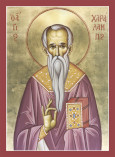 This great saint was a priest in Magnesia, and suffered for
Christ at the age of 113. When a violent persecution broke out under Emperor Septimus Severus,
the aged Haralambos did not hide from his persecutors, but freely and openly preached the
Christian Faith. He endured all tortures as though not in the body, and when they flayed the
living flesh from him, the godly saint said to the emperor’s soldiers: ‘Thank you, my
brethren, for scraping off the old body and renewing my soul for new and eternal life.’ He
performed many wonders and brought many to the Faith. Even the emperor’s daughter, Gallina,
repudiated the paganism of her father and became a Christian. Condemned to death and led to the
place of execution, St. Haralambos raised his arms to heaven and prayed for all men, that God
would give them bodily health and salvation of soul, and that He would grant them the fruits of
the earth in abundance: ‘Lord, Thou knowest that men are flesh and blood; forgive them
their sins and pour out Thy blessing on all.’ After praying thus, the saintly elder gave
his soul to God before the executioner had laid his sword to his neck. He suffered in 202.
Gallina took his body and buried it.
This great saint was a priest in Magnesia, and suffered for
Christ at the age of 113. When a violent persecution broke out under Emperor Septimus Severus,
the aged Haralambos did not hide from his persecutors, but freely and openly preached the
Christian Faith. He endured all tortures as though not in the body, and when they flayed the
living flesh from him, the godly saint said to the emperor’s soldiers: ‘Thank you, my
brethren, for scraping off the old body and renewing my soul for new and eternal life.’ He
performed many wonders and brought many to the Faith. Even the emperor’s daughter, Gallina,
repudiated the paganism of her father and became a Christian. Condemned to death and led to the
place of execution, St. Haralambos raised his arms to heaven and prayed for all men, that God
would give them bodily health and salvation of soul, and that He would grant them the fruits of
the earth in abundance: ‘Lord, Thou knowest that men are flesh and blood; forgive them
their sins and pour out Thy blessing on all.’ After praying thus, the saintly elder gave
his soul to God before the executioner had laid his sword to his neck. He suffered in 202.
Gallina took his body and buried it.
2. Our Holy Father Prochorus the Orach-Eater.
A wonder-worker of the Monastery of the Caves in Kiev, he was named the Orach-eater because the whole time he lived in the monastery he never tasted bread, but fed himself on orach prepared according to his own particular method as a sort of bread. When he gave someone some of this bread with his blessing, it was as sweet as honey, but if anyone stole some, it was as bitter as wormwood.
Once, when there was a dearth of salt in Russia, Prochorus distributed ashes to the people for salt. The ashes that he distributed with his blessing became salt; however, ashes that anyone took for himself remained ordinary ashes. Prince Svyatopolk ordered that all the ashes from Prochorus’ cell be brought to the court without his permission, let alone his blessing. When the ashes were brought there, it was obvious to everyone that they were ashes and not salt. Then Prochorus told all the people who came to him for salt to go to the prince’s court, and when the prince threw the ashes away, to take them and use them as salt. This they did, and the ashes again became salt. The prince himself, learning of this, was filled with a deep respect and love for him. When Prochorus died in 1107, Prince Svyatopolk placed him with his own hands in a grave near the great Russian Saints Anthony and Theodosius.
FOR CONSIDERATION
Many of the great infirmities to which man is subject have their origin, known or unknown, in his past. The origins of these great infirmities, such as madness for example, are none other than violations of the moral law of God. While St. Haralambos was undergoing martyrdom, the royal torturer learned of his wonder-working power and ordered that a madman be brought before him, to find out if Haralambos could heal him. The devil had tormented this man for 35 years, driving him into the deserts and mountains and casting him into mires and abysses. When this madman drew near to Haralambos, the demon smelled the fragrance of the holy man and cried out: ‘I beg thee, O servant of God, do not torment me before the time, but order me and I will come out; and if thou desirest, I will tell thee how I entered into the man.’ And the saint ordered him to speak. The demon said: ‘This man desired to rob his neighbor, and thought within himself: “If I don’t first kill the man, I shall not be able to take all his goods.” So he went and killed his neighbor. Catching him in such an act. I entered into him and have been residing here these 35 years.’ Hearing this, the saint of God ordered the demon to come out of the man at once and leave him in peace, and the man was healed and became calm.
Daily Scripture Readings taken from The Orthodox New Testament, translated and published by Holy Apostles Convent, Buena Vista, Colorado, copyright © 2000, used with permission, all rights reserved.
Daily Prologue Readings taken from The Prologue of Ochrid, by Bishop Nikolai Velimirovic, translated by Mother Maria, published by Lazarica Press, Birmingham, England, copyright © 1985, all rights reserved. Edited by Dormition Skete.