

Daily Devotional
Friday, February 7, 2025 (NS), January 25, 2025 (OS)
Fast Day, but Wine and Olive Oil Allowed.
Friday of the Thirty-Third Week
25. The commemoration of our father among the saints, Gregory the Theologian, Archbishop of Constantinople.
Scripture Readings
Paschalion — Movable Calendar
Friday of the Thirty-Third Week
Epistle
The Reading is from the Second General Epistle of Saint Peter [§ 64].
1 1Symeon Peter, a slave and apostle of Jesus Christ, to those who obtained as their portion a faith equal in honor to us in the righteousness of our God and Savior Jesus Christ. 2Grace to you and peace be multiplied in a full knowledge of God and of Jesus our Lord:
3Inasmuch as His divine power hath freely given to us all the things for life and piety, through the full knowledge of Him Who called us by glory and virtue, 4by which He hath freely given to us the very great and precious promises, that through these ye might become partakers of the divine nature, having escaped the corruption which is in the world by desire. 5But also for this very thing, besides having brought in all diligence, supply virtue in your faith, and knowledge in virtue, 6and self-control in knowledge, and patience in self-control, and piety in patience, 7and brotherly affection in piety, and love in brotherly affection. 8For if these things are in you and abounding, they render you neither barren nor unfruitful in the full knowledge of our Lord Jesus Christ. 9For to whom these things are not present he is blind, being shortsighted, having forgotten the purification of old of his sins. 10Wherefore, brethren, rather give the more diligence to make sure for yourselves your calling and election; for if ye do these things, in no wise shall ye ever stumble.
Gospel
The Reading is from the Holy Gospel according to Saint Mark [§ 53]. The Lord said this parable:
12 1“A man planted a vineyard, and put a hedge around it, and dug a trough underneath the winepress, and built a tower. And he let it out to vinedressers and went abroad. 2“And at the season he sent forth a slave to the vinedressers, in order that he might receive from the vinedressers of the fruit of the vineyard. 3“And they took him and beat him and sent him away empty. 4“And again he sent forth to them another slave, and that one they stoned, and smote him on the head; and sent him away having suffered dishonor. 5“And again he sent forth another, and that one they killed, and many others—some, on the one hand, beating, and others, on the other hand, killing. 6“Having yet therefore one son, his own beloved, he also sent him forth to them last, saying, ‘They will respect my son.’ 7“But those vinedressers, having seen him coming, said among themselves, ‘This is the heir. Come, let us kill him, and the inheritance shall be ours.’ 8“And they took him and killed him and cast him out of the vineyard. 9“What therefore shall the lord of the vineyard do? He will come and destroy the vinedressers, and will give the vineyard to others. 10“Did ye not even read this Scripture? ‘The stone which the builders rejected, this became the head of the corner; 11“‘this came to be from the Lord, and it is marvellous in our eyes [Ps. 117(118):22, 23; cf. Is. 28:16]’?” 12And they were seeking to lay hold of Him, but were afraid of the crowd; for they knew that He spoke the parable against them. And they left Him and went away.
Menaion — Fixed Calendar
25. The commemoration of our father among the saints, Gregory the Theologian, Archbishop of Constantinople.
Epistle
The Reading is from the Epistle of Saint Paul to the Hebrews [§ 318]. Brethren:
7 26Such a High Priest was fitting for us: holy, guileless, undefiled, Who hath been separated from the sinners and hath become higher than the heavens, 27Who hath no need daily, even as the high priests, to offer up sacrifices, first for his own sins, then for those of the people; for this He did once for all after He offered up Himself. 28For the law appointeth men high priests who have weakness; but the word of the oath, which is after the law, appointeth the Son, Who hath been perfected forever.
8 1Now in reference to the things being spoken of, the chief point is: We have such a High Priest, Who sat down on the right of the throne of the majesty in the heavens, 2a Liturgist of the holies and of the tabernacle, the true one, which the Lord pitched, and not man.
for Sl. usage, see [1 Cor. 12:7-11].
Gospel
The Reading is from the Holy Gospel according to Saint John [§ 36]. The Lord said to the Jews who had come to Him:
10 9“I am the door; by Me if anyone should enter, he shall be saved, and shall go in and go out and find pasture. 10“The thief cometh not, except that he might steal, and slay, and destroy. I came that they may have life, and may have it abundantly. 11“I am the good shepherd. The good shepherd layeth down his life for the sheep. 12“But the hireling, who indeed is not a shepherd, whose own the sheep are not, seeth the wolf coming, and leaveth the sheep and fleeth; and the wolf seizeth them and scattereth the sheep. 13“Now the hireling fleeth, because he is a hireling and careth not about the sheep. 14“I am the good shepherd; and I know those that are Mine, and am known of those that are Mine. 15“Even as the Father knoweth Me, I also know the Father; and I lay down My life for the sheep. 16“And I have other sheep which are not of this fold; them also it is needful for Me to bring, and they shall hear My voice; and there shall be one flock and one Shepherd.”
Lives of the Saints (Prologue)
February 7th – Civil Calendar
January 25th – Church Calendar
1. St. Gregory the Theologian, Archbishop of Constantinople.
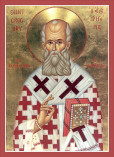 Born in Nazianzus of a Greek
father (who later became a Christian and a bishop) and a Christian mother, he studied in Athens
before his Baptism with St. Basil the Great and Julian the Apostate. He often foretold to Julian
that he would be an apostate and a persecutor of the Church, and so it came to pass. Gregory was
especially influenced by his mother, Nonna. He was baptized when he had completed his studies.
St. Basil consecrated him bishop of Sasima, and Emperor Theodosios called him to the vacant
archiepiscopal throne of Constantinople. His works were manifold, the best-known being his
theological writings, for which he received the title ‘the Theologian’. He is
particularly famed for the depth of his Sermons on the Holy Trinity. He also wrote against the
heretic Macedonius, who taught wrongly that the Spirit was a creature of God, and against
Apollinarius who taught that Christ did not have a human soul but that His divinity was in place
of His soul. He also wrote against the Emperor Julian the Apostate, his one time school-fellow.
In the year 381, when a quarrel broke out in the council concerning his election as archbishop,
he withdrew himself, declaring: ‘Those who deprive us of the (archiepiscopal) throne cannot
deprive us of God.’ He then left Constantinople and went to Nazianzus, remaining there in
retirement, prayer and the writing of instructive books until his death. And, although he was in
weak health all his life due to the ceaseless attacks of the heretics, he lived to the age of
seventy. His relics were later taken to Rome, and his head to the Cathedral of the Dormition in
Moscow. He was, and remains, a great and wonderful light of the Orthodox Church, as much for the
meekness and purity of his character as for the unsurpassable depth of his mind. He entered into
rest in the Lord in the year 389.
Born in Nazianzus of a Greek
father (who later became a Christian and a bishop) and a Christian mother, he studied in Athens
before his Baptism with St. Basil the Great and Julian the Apostate. He often foretold to Julian
that he would be an apostate and a persecutor of the Church, and so it came to pass. Gregory was
especially influenced by his mother, Nonna. He was baptized when he had completed his studies.
St. Basil consecrated him bishop of Sasima, and Emperor Theodosios called him to the vacant
archiepiscopal throne of Constantinople. His works were manifold, the best-known being his
theological writings, for which he received the title ‘the Theologian’. He is
particularly famed for the depth of his Sermons on the Holy Trinity. He also wrote against the
heretic Macedonius, who taught wrongly that the Spirit was a creature of God, and against
Apollinarius who taught that Christ did not have a human soul but that His divinity was in place
of His soul. He also wrote against the Emperor Julian the Apostate, his one time school-fellow.
In the year 381, when a quarrel broke out in the council concerning his election as archbishop,
he withdrew himself, declaring: ‘Those who deprive us of the (archiepiscopal) throne cannot
deprive us of God.’ He then left Constantinople and went to Nazianzus, remaining there in
retirement, prayer and the writing of instructive books until his death. And, although he was in
weak health all his life due to the ceaseless attacks of the heretics, he lived to the age of
seventy. His relics were later taken to Rome, and his head to the Cathedral of the Dormition in
Moscow. He was, and remains, a great and wonderful light of the Orthodox Church, as much for the
meekness and purity of his character as for the unsurpassable depth of his mind. He entered into
rest in the Lord in the year 389.
2. Our Holy Father Publius.
A senator at first, Publius came to know the light of Christ, left his honors and gave his goods to the poor and himself to the ascetic life in the vicinity of his town, Zeugma, on the Euphrates. He founded two communities and entered into rest in the Lord in the year 380.
3. Our Holy Father Mares.
He was distinguished by external beauty and a sweet singing voice. He retired from the world and lived in a hut for thirty-seven years in fasting and prayer and in cleansing his heart from thoughts. He entered into rest in the Lord as an elderly man of ninety in the year 430.
4. The Holy Martyr Felicitas and her seven sons.
She, together with her seven sons, was condemned to death for her Christian Faith in 164, in the reign of the Emperor Antoninus. She begged God only that she should not be killed before her sons, so that she might be able to encourage them in their torture and death not to deny Christ. And so it came to pass, by the providence of God. This mother joyfully bade her sons farewell one after the other, until she had seen all seven executed. Then she also, with thanksgiving to God, embraced a martyr’s death. They all suffered in Rome, where their relics are preserved.
FOR CONSIDERATION
They deceive themselves who self-confidently assert that they know men well and that no one can deceive them. Who, but the one God Who knows the secrets of the heart, can guess what kind of spiritual being any man is? Even the great saints were mistaken in people. For example: St. Basil for a long time considered a hypocritical heretic to be a holy man, and defended him against his many attackers until he was in the end, in bitter disappointment, convinced of the other’s deceit. St. Gregory the Theologian baptized a philosopher called Maximus and loved him so greatly that he shared his house and table with him. But this Maximus was as wicked and cunning as a snake, and after a while he managed by intrigues and bribes to be accepted by the citizens of Constantinople as patriarch in place of St. Gregory. When, after many intrigues, this trial was removed, Gregory was upbraided for having kept his greatest enemy at his side. ‘We are not to blame,’ replied the saint, ‘if we cannot see through a man’s wickedness. God alone knows man’s inner secrets. And we are told by the commandments to open our hearts with fatherly love to anyone who approaches us.’ The good, kindly man cannot easily comprehend the wickedness of the wicked man.
Daily Scripture Readings taken from The Orthodox New Testament, translated and published by Holy Apostles Convent, Buena Vista, Colorado, copyright © 2000, used with permission, all rights reserved.
Daily Prologue Readings taken from The Prologue of Ochrid, by Bishop Nikolai Velimirovic, translated by Mother Maria, published by Lazarica Press, Birmingham, England, copyright © 1985, all rights reserved. Edited by Dormition Skete.