

Daily Devotional
Tuesday, February 4, 2025 (NS), January 22, 2025 (OS)
No Fasting.
Tuesday of the Thirty-Third Week
The commemoration of the holy Apostle Timothy of the Seventy, and the holy Martyr Anastasios the Persian.
Scripture Readings
Paschalion — Movable Calendar
Tuesday of the Thirty-Third Week
Epistle
The Reading is from the First General Epistle of Saint Peter [§ 60]. Beloved:
3 10“The one who doth wish to love life and to see good days, let him stop his tongue from evil, and his lips that they speak no guile [cf. Ps. 33(34):12, 13]. 11“Let him turn away from evil and do good. Let him seek peace and pursue it [cf. Ps. 33(34):14]. 12“For the eyes of the Lord are upon the righteous, and His ears are toward their entreaty; but the face of the Lord is against those who do evil [Ps. 33(34):15, 16].” 13And who is the one who will ill-treat you if ye should become imitators of that which is good? 14But even if ye should suffer for righteousness’ sake, happy are ye. “And be not afraid of their fear, neither be troubled [cf. Is. 8:12].” 15But “sanctify the Lord [Is. 8:13]” God in your hearts, and be ready always to give a defense to everyone who asketh you a reason concerning the hope in you, with meekness and fear, 16having a good conscience, that while they may speak against you as evildoers, those who speak disparagingly of your good manner of life in Christ might be put to shame. 17For it is better, if the will of God should so will, to suffer for doing good than for doing evil. 18For Christ also once for all suffered for sins—the just One for the unjust ones—that He might bring us up to God, after He indeed was put to death in the flesh, but made alive in the Spirit, 19in Whom also He went and preached to the spirits in prison, 20who once were disobedient, when the long-suffering of God was waiting in the days of Noah, while an ark was being constructed, in which a few, that is, eight souls, were saved by means of water. 21There is also an antitype which now saveth us—baptism (not a putting away of the filth of the flesh, but the examination of a good conscience toward God), through the resurrection of Jesus Christ, 22Who went into heaven and is at the right of God, and angels and authorities and powers have been made subject to Him.
Gospel
The Reading is from the Holy Gospel according to Saint Mark [§ 50]. At that time:
11 11Jesus entered into Jerusalem and into the temple. And after He looked about for Himself at all things, as it was already the evening hour, He went out to Bethany with the twelve.
12And on the morrow, after they came out from Bethany, He hungered. 13And having seen from afar a fig tree having leaves, He came, if perhaps He might find something on it. And after He came to it, He found nothing except leaves; for it was not the season of figs. 14And Jesus began to speak and said to it, “May no one any more eat fruit of thee forever.” And His disciples were listening. 15And they came to Jerusalem. And having entered into the temple, Jesus began to cast out those who sold and bought in the temple. And He overturned the tables of the money changers and the seats of those who sold the doves. 16And He did not permit that anyone should carry a vessel through the temple. 17And He was teaching, saying to them, “It hath been written, hath it not, that ‘My house shall be called a house of prayer for all the nations [Is. 56:7]’? But ye made it ‘a den of robbers [cf. Jer. 7:11].’” 18And the scribes and the Pharisees and the chief priests heard it, and they sought how they might destroy Him; for they were fearing Him, because all the crowd was astonished at His teaching. 19And when it came to be evening, He went forth out of the city. 20And in the morning, as they passed by, they saw the fig tree dried up from the roots. 21And Peter, having remembered, saith to Him, “Rabbi, behold, the fig tree which Thou cursedst hath been withered.” 22And Jesus answered, saying to them, “Be having faith in God. 23“For verily I say to you, that whosoever shall say to this mountain, ‘Be thou taken away and be thou cast into the sea,’ and doubt not in his heart, but shall believe that what he saith is coming to pass, it shall be to him whatsoever he shall say.”
Menaion — Fixed Calendar
The commemoration of the holy Apostle Timothy of the Seventy, and the holy Martyr Anastasios the Persian.
Epistle
The Reading is from the Second Epistle of Saint Paul to Saint Timothy [§ mid 290]. Child Timothy:
1 3I have gratitude toward God, Whom I worship from my forefathers in a pure conscience, as without ceasing I have the remembrance of thee in mine entreaties night and day, 4longing to see thee, having been reminded of thy tears, in order that I might be filled full of joy, 5when I am put in remembrance of the unhypocritical faith in thee, which dwelt first in thy grandmother Lois and in thy mother Evnike, and I have been persuaded that it is in thee also. 6For which cause I remind thee to rekindle the gracious gift of God which is in thee by the laying on of my hands; 7for God gave us not a spirit of cowardice, but of power, and of love, and of a sound mind. 8Therefore do thou not become ashamed of the testimony of our Lord, nor me His prisoner, but suffer hardship with the Gospel, according to God’s power, 9Who saved us and called us with a holy calling, not according to our works, but according to His own purpose and grace which was given to us in Christ Jesus before the ages of time.
Gospel
The Reading is from the Holy Gospel according to Saint Matthew [§§ 38, mid 79]. The Lord said to his disciples:
10 32“Everyone who shall confess in Me before men, I also will confess in him before My Father Who is in the heavens. 33“But whosoever shall deny Me before men, him will I also deny before My Father Who is in the heavens.... 37“The one who loveth father or mother more than Me is not worthy of Me; and the one who loveth son or daughter more than Me is not worthy of Me. 38“And whosoever taketh not his cross and followeth after Me is not worthy of Me.”...
19 27Peter answered and said to Him, “Behold, we left all things and followed Thee; what then shall be for us?” 28And Jesus said to them, “Verily I say to you, that ye who followed Me, in the regeneration, whenever the Son of Man shall have taken His seat upon the throne of His glory, ye also shall sit upon twelve thrones, judging the twelve tribes of Israel. 29“And everyone who leaveth houses, or brothers, or sisters, or father, or mother, or wife, or children, or lands, on account of My name, shall receive a hundredfold, and shall inherit life everlasting. 30“But many who are first shall be last, and the last first.”
for Sl. usage, see [Lk. 10:1-15].
Lives of the Saints (Prologue)
February 4th – Civil Calendar
January 22nd – Church Calendar
1. The Holy Apostle Timothy.
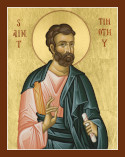 One of the Seventy, he was born in Lystra of Lykaonia
of a Greek father and a Jewish mother. His mother and grandmother were praised by the Apostle
Paul for their sincere faith (2 Tim. 1:4-5). He met the great apostle for the first time in
Lystra, and was the only witness of Paul’s healing of the man lame from birth. Later,
Timothy was an almost constant travelling companion of Paul’s, visiting Achaia, Macedonia,
Italy and Spain with him. A great zealot for the Faith, a superb preacher and of a gentle spirit,
Timothy contributed greatly to the spreading and establishing of the Christian Faith. St. Paul
called him his own son in the faith (I Tim. 1:2). After Paul’s martyrdom, Timothy had St.
John the Evangelist as his teacher. But when the Emperor Domitian exiled John from Ephesus to the
island of Patmos, Timothy remained in Ephesus as bishop. At the time of an idolatrous feast
called Katagogium, pagans wearing masks, resentful of the Christians, made a merciless attack on
St. Timothy and killed him, in about the year 93. His honored relics were later taken to
Constantinople and buried in the Church of the Holy Apostles by the graves of St. Luke the
Evangelist and St. Andrew the First-Called.
One of the Seventy, he was born in Lystra of Lykaonia
of a Greek father and a Jewish mother. His mother and grandmother were praised by the Apostle
Paul for their sincere faith (2 Tim. 1:4-5). He met the great apostle for the first time in
Lystra, and was the only witness of Paul’s healing of the man lame from birth. Later,
Timothy was an almost constant travelling companion of Paul’s, visiting Achaia, Macedonia,
Italy and Spain with him. A great zealot for the Faith, a superb preacher and of a gentle spirit,
Timothy contributed greatly to the spreading and establishing of the Christian Faith. St. Paul
called him his own son in the faith (I Tim. 1:2). After Paul’s martyrdom, Timothy had St.
John the Evangelist as his teacher. But when the Emperor Domitian exiled John from Ephesus to the
island of Patmos, Timothy remained in Ephesus as bishop. At the time of an idolatrous feast
called Katagogium, pagans wearing masks, resentful of the Christians, made a merciless attack on
St. Timothy and killed him, in about the year 93. His honored relics were later taken to
Constantinople and buried in the Church of the Holy Apostles by the graves of St. Luke the
Evangelist and St. Andrew the First-Called.
2. Our Holy Father, the Martyr Anastasius.
He was a Persian by birth, with the pagan name of Magundat. When the Emperor Herakleios waged war against the Persians, Magundat deserted to the Christians and went to Jerusalem. There he was baptized and given the name Anastasius. It was not enough for him to be baptized; he also became a monk in order to give himself entirely to the service of God. Among other ascetic practices, he very early read the lives of the holy martyrs, and reading this, wetted the book with his tears, greatly yearning for martyrdom himself. The Lord finally crowned him with the wreath of martyrdom. He lay long in prison and was horribly tortured until King Chozroes condemned him to death. After this condemnation, Anastasius was drowned, then taken out of the water and beheaded by the executioner, who sent his head to the king. Anastasius suffered on January 22nd, 628, in the town of Bethsaloe near Nineveh.
FOR CONSIDERATION
The Orthodox Church possesses an inexhaustible treasure in the evidence of life after death. To note one example among many, one which at the same time witnesses that the spirit of man lives after bodily death and that voluntary obedience brings blessed immortality: when St. Theodosios the Great had founded a monastery, he had at first only seven monks. To establish them well in remembrance of death, he ordered them to dig a grave. When the grave was ready, Theodosios stood over it, gathered the seven of them together and said: ‘Well, my children; the grave is now ready! Is there among you one who is ready for death, to be buried in this grave?’ One of them, a priest called Basil, fell to his knees and besought Theodosios’ blessing to die. Theodosios ordered that the memorial services be held for Basil on the third, ninth and fortieth day, as is the custom for the departed. When the fortieth memorial was finished, Basil, in full health, lay down and died. And he was buried in the new grave. On the fortieth day after his burial, Basil appeared in the morning among the brethren in church and sang with them. At first only Theodosios saw him, but he prayed to God that He would open the eyes of the others. Then all the brethren looked and saw Basil among them. One of the brethren, Letius, joyfully spread his arms wide, intending to embrace Basil, but the latter disappeared. Basil’s voice was heard: ‘Save yourselves, my fathers and brethren, save yourselves!’
Daily Scripture Readings taken from The Orthodox New Testament, translated and published by Holy Apostles Convent, Buena Vista, Colorado, copyright © 2000, used with permission, all rights reserved.
Daily Prologue Readings taken from The Prologue of Ochrid, by Bishop Nikolai Velimirovic, translated by Mother Maria, published by Lazarica Press, Birmingham, England, copyright © 1985, all rights reserved. Edited by Dormition Skete.