

Daily Devotional
Monday, February 3, 2025 (NS), January 21, 2025 (OS)
No Fasting.
Monday of the Thirty-Third Week
21. The commemoration of our venerable Father Maximos the Confessor, the holy Martyr Neophytos of Nicæa, and the holy Martyrs Evgenios, Candidos, Valerian, and Aquila at Trebizond.
Scripture Readings
Paschalion — Movable Calendar
Monday of the Thirty-Third Week
Epistle
The Reading is from the First General Epistle of Saint Peter [§ 59]. Beloved:
2 21Christ also suffered for us, leaving behind for you an example, that ye should follow His footsteps: 22“Who did no sin, neither was guile found in His mouth [cf. Is. 53:9]”; 23Who, when He was reviled, reviled not in return; when He suffered, He threatened not, but kept on giving Himself over to Him Who judgeth righteously; 24Who “Himself carried up our sins [cf. Is. 53:4]” in His body on the tree, that we, having died to sins, should live to righteousness—by Whose bruise “ye were healed [cf. Is. 53:5].” 25For ye were “as sheep being led astray [cf. Is. 53:6],” but were turned about now to the Shepherd and Bishop of your souls.
3 1In like manner, wives, be subordinate to your own husbands, in order that even if any disobey the word, through the behavior of the wives, they might be gained without a word, 2having watched your pure behavior which is in fear; 3whose adorning let it not be the outward one of braiding of hair, and placing around of gold, or putting on of apparel, 4but the hidden man of the heart, in the incorruptible adorning of a meek and quiet spirit, which is of great value before God. 5For thus also, at one time, the holy women—those who hoped upon God—used to adorn themselves, being subordinate to their own husbands, 6as Sarra obeyed Abraham, calling him lord, of whom ye became children, if ye do good and fear not any terror. 7In like manner, husbands, dwell with them according to knowledge, assigning honor to the woman as to a weaker vessel, and as joint-heirs of the grace of life, that your prayers be not hindered. 8And finally, be ye all of the same mind, sympathetic, loving the brethren, compassionate, kindly, 9not rendering evil for evil or reviling for reviling; but on the contrary, blessing, knowing that to this ye were called, that ye should inherit a blessing.
Gospel
The Reading is from the Holy Gospel according to Saint Mark [§ 48]. At that time:
10 46As Jesus went out from Jericho, and His disciples and a considerable crowd, Bartimæos the blind man, the son of Timæos, was sitting by the wayside begging. 47And having heard, “It is Jesus the Nazaræan,” he began to cry out and to say, “Son of David, Jesus, have mercy on me.” 48And many were rebuking him in order that he should keep silent; but he kept on crying out much more, “Son of David, have mercy on me.” 49And Jesus stood still and said, “Call him.” And they called the blind man, saying to him, “Be of good courage, arise; He calleth thee.” 50And he, having cast off his outer garment, rose up and came to Jesus. 51And Jesus answered, saying to him, “What dost thou wish that I should do to thee?” And the blind man said to Him, “Rabboni, that I might recover my sight.” 52And Jesus said to him, “Go thy way; thy faith hath made thee well.” And straightway he recovered his sight and followed Jesus on the way.
Menaion — Fixed Calendar
21. The commemoration of our venerable Father Maximos the Confessor, the holy Martyr Neophytos of Nicæa, and the holy Martyrs Evgenios, Candidos, Valerian, and Aquila at Trebizond.
Epistle
For the Confessor:
The Reading is from the Epistle of Saint Paul to the Philippians [§ 237].
1 12Brethren, I wish you to know that the things concerning me have come rather to the advancement of the Gospel, 13so that my bonds in Christ have become manifest in all the Prætorium, and to all the rest; 14and the majority of the brethren in the Lord, having become confident by my bonds, more abundantly dare to speak the word without fear. 15Some on the one hand proclaim Christ even because of envy and strife, but some on the other hand also because of good will: 16The former announce Christ out of factiousness, not purely, supposing to bring affliction to my bonds; 17but the latter out of love, knowing that I am set for the defense of the Gospel. 18What then? Only that in every way, whether in pretense or in truth, Christ is announced. And in this I rejoice. Yes, and I will be rejoicing. 19For I know that this shall turn out to my salvation through your entreaty, and the supply of the Spirit of Jesus Christ, 20according to mine earnest expectation and hope, that in nothing shall I be ashamed, but in all boldness, as always, also now Christ shall be magnified in my body, whether by life or by death.
for Sl. usage, see [Heb. 11:33-40].
For the Martyrs:
The Reading is from the Epistle of Saint Paul to the Hebrews [§§ 330, 331]. Brethren:
11 33All the saints through faith struggled against kingdoms, wrought righteousness, attained to promises, stopped mouths of lions, 34quenched the power of fire, escaped the edges of the sword, were empowered out of weakness, became strong in battle, turned back encampments of aliens. 35Women received their dead by resurrection. And others were tortured, not accepting release, that they might attain a better resurrection. 36And others received trial of mockings and of scourgings, and, moreover, of bonds and of imprisonment. 37They were stoned, they were sawn asunder, were tempted; they died, murdered by the sword. They went about in sheepskins, in goatskins, being in need, afflicted, ill-treated— 38of whom the world was not worthy. They were made to wander in deserts, and in mountains, and in caves, and in the holes of the earth. 39And these all, having been approved by testimony through faith, received not for themselves the promise, 40God having foreseen some better thing concerning us, that they should not be made perfect without us.
12 1Therefore we also, having so great a cloud of witnesses which is set around us, and having laid aside every weight and sin that is easily circumvented, let us by means of patience be running the course which is set before us, 2looking to Jesus, the originator and accomplisher of our faith, Who, in exchange for the joy set before Him, endured a cross, having despised the shame, and hath sat down on the right of the throne of God.
Gospel
The Reading is from the Holy Gospel according to Saint Luke [§ 64]. The Lord said to His disciples:
12 8“Everyone who shall confess in Me before men, the Son of Man also shall confess in him before the angels of God. 9“But the one who denieth Me before the face of men shall be denied before the face of the angels of God. 10“And everyone who shall speak a word against the Son of Man, it shall be forgiven him; but to the one who blasphemeth against the Holy Spirit it shall not be forgiven. 11“And whenever they bring you in before the synagogues and the rulers and the authorities, cease being anxious how or what ye should speak in defense, or what ye should say; 12“for the Holy Spirit shall teach you in the same hour what things it is needful to say.”
Lives of the Saints (Prologue)
February 3rd – Civil Calendar
January 21st – Church Calendar
1. Our Holy Father Maximus the Confessor.
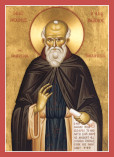 By birth a citizen of Constantinople and at first a
high-ranking courtier at the court of the Emperor Herakleios, he then became a monk and the abbot
of a monastery not far from the capital. He was the greatest defender of Orthodoxy against the
Monothelite heresy, which developed from the heresy of Eftyches. That is to say: as Eftyches
asserted that there is in Christ only one nature, so the Monothelites asserted that there is in
Him only one will. Maximus resisted this assertion and found himself in opposition to both the
emperor and the patriarch. But he was unafraid, and persevered to the end in proving that there
are in the Lord two wills and also two natures. By his efforts, one council in Carthage and one
in Rome stood firm, and both these councils anathematized the Monothelite teaching.
Maximus’ sufferings for Orthodoxy cannot be described: he was tortured by hierarchs, spat
upon by the mass of the people, beaten by soldiers, persecuted, imprisoned; until finally, with
his tongue cut out and one hand cut off, he was condemned to exile for life in Skhimaris, where
he gave his soul into God’s hands in the year 662. Even with his tongue cut out, he was,
through God’s grace, able to speak even more clearly in defense of the Faith.
By birth a citizen of Constantinople and at first a
high-ranking courtier at the court of the Emperor Herakleios, he then became a monk and the abbot
of a monastery not far from the capital. He was the greatest defender of Orthodoxy against the
Monothelite heresy, which developed from the heresy of Eftyches. That is to say: as Eftyches
asserted that there is in Christ only one nature, so the Monothelites asserted that there is in
Him only one will. Maximus resisted this assertion and found himself in opposition to both the
emperor and the patriarch. But he was unafraid, and persevered to the end in proving that there
are in the Lord two wills and also two natures. By his efforts, one council in Carthage and one
in Rome stood firm, and both these councils anathematized the Monothelite teaching.
Maximus’ sufferings for Orthodoxy cannot be described: he was tortured by hierarchs, spat
upon by the mass of the people, beaten by soldiers, persecuted, imprisoned; until finally, with
his tongue cut out and one hand cut off, he was condemned to exile for life in Skhimaris, where
he gave his soul into God’s hands in the year 662. Even with his tongue cut out, he was,
through God’s grace, able to speak even more clearly in defense of the Faith.
2. Blessed Maximus the Greek.
He was born in Greece, whence he was called to the court of the Russian Tsar Vasily Ivanovitch as Imperial librarian and translator. He labored much and also suffered much for the truth. He spent a long time in prison, where he wrote the well-known Canon to the Holy Spirit which is still used in church, and entered into rest in the Lord in the year 1556.
3. The Holy Martyr Neophytos.
Nicaean by birth, he was even in childhood a worker of great wonders by the grace of God. He brought forth water from rocks and raised his dead mother to life. Led by a white dove to Mount Olympus, he chased a lion out of its cave and himself settled there. He was martyred for Christ in Nicaea under Diocletian at the age of fifteen, refusing to deny Christ in any way. After beatings and imprisonment, he was thrown into fire, but God preserved him alive. Then he was put before a hungry lion, but the lion fawned around him. The saint recognized this lion as the same one in whose cave he had lived in asceticism, so he pardoned it and ordered it to return to the cave. Then Neophytos was run through with a spear and his soul went to the courts of the Lord.
4. The Holy Martyr Agnes.
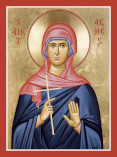 As a girl of thirteen, she was thrown into the fire for her
faith in Christ, then beheaded with the sword. She showed great wonder-working power, both
in her lifetime and after her death. She suffered in the reign of Diocletian, in the year
305. As a girl of thirteen, she was thrown into the fire for her
faith in Christ, then beheaded with the sword. She showed great wonder-working power, both
in her lifetime and after her death. She suffered in the reign of Diocletian, in the year
305.
|
FOR CONSIDERATION
The Christian Faith uniquely in the world has one fixed and unchanging scale of values. St. John Chrysostom speaks clearly about this: ‘There are,’ he says, ‘three kinds of category; the first are good and can never be evil; for example, wisdom, mercy and so forth; the second are evil and can never be good; for example, debauchery, inhumanity, cruelty. The third are sometimes the one and sometimes the other, according to the disposition of those who make use of them.’ And, with this explanation by that godly teacher, one sees how riches and poverty, freedom and slavery, power and sickness and death itself fall into this neutral category, which are in themselves neither good nor evil, but are the one or the other according to the disposition of men and the use men make of them. For example, if riches were good and poverty were evil, then all the rich would be good and all the poor would be evil. However, we are daily convinced that, as there are good and evil rich people, so there are good and evil poor people. This can also be noted in relation to the healthy and the sick, the free and the enslaved, the fed and the hungry, those in power and those in subjection. Even death is not evil, for ‘the martyrs became through death the happiest of all’.
Daily Scripture Readings taken from The Orthodox New Testament, translated and published by Holy Apostles Convent, Buena Vista, Colorado, copyright © 2000, used with permission, all rights reserved.
Daily Prologue Readings taken from The Prologue of Ochrid, by Bishop Nikolai Velimirovic, translated by Mother Maria, published by Lazarica Press, Birmingham, England, copyright © 1985, all rights reserved. Edited by Dormition Skete.