

Daily Devotional
Tuesday, January 28, 2025 (NS), January 15, 2025 (OS)
No Fasting.
Tuesday of the Thirty-Second Week
The commemoration of our venerable Fathers Paul of Thebes and John the Hut-dweller (Kalyvites).
Scripture Readings
Paschalion — Movable Calendar
Tuesday of the Thirty-Second Week
Epistle
The Reading is from the General Epistle of Saint Iakovos [§ 54].
3 1Brethren, cease becoming many teachers, knowing that we shall receive a greater judgment; 2for in many things we all stumble. If anyone stumble not in word, this one is a perfect man, able also to bridle the whole body. 3Behold, we put bits in the mouths of the horses, in order that they may obey us, and we turn about their whole body. 4Behold also the ships, though they are so great and are driven by strong winds, yet are they turned about by a very small rudder, wheresoever the impulse of him who steereth may will. 5Thus also the tongue is a little member and boasteth great things. Behold, how great a forest a little fire kindleth! 6And the tongue is a fire, the world of injustice. So the tongue, the one which defileth the body, is being set in our members and setteth on fire the wheel of birth; and it is set on fire by Gehenna. 7For every species, not only of beasts and of birds, but also of reptiles and things of the sea as well, is being tamed and hath been tamed by the human species. 8But not one of mankind is able to tame the tongue; it is an unrestrainable evil, full of death-bearing poison. 9With it we bless the God and Father, and with it we curse men who have come into being according to the similitude of God. 10Out of the same mouth cometh forth blessing and cursing. My brethren, these things ought not thus to be happening.
Gospel
The Reading is from the Holy Gospel according to Saint Mark [§ 28]. At that time:
7 5The Pharisees and the scribes questioned Jesus, “Why do Thy disciples not walk according to the tradition of the elders, but eat bread with unwashed hands?” 6And He answered and said to them, “Well did Esaias prophesy concerning you, the hypocrites, as it hath been written: ‘This people honoreth Me with their lips, but their heart is far away from Me. 7“‘And in vain they revere Me, teaching as precepts the commandments of men [Is. 29:13].’ 8“For having left the commandment of God, ye keep on holding the tradition of men—dippings of pitchers and cups, and many other such like things ye do.” 9And He was saying to them, “Ye set at nought altogether the commandment of God, that ye might keep your own tradition. 10“For Moses said, ‘Be honoring thy father and thy mother [Ex. 20:12; Deut. 5:16]’; and, ‘The one who speaketh evil of father or mother, let him come to an end by death [cf. Ex. 21:16; Lev. 20:9].’ 11“But ye say, ‘If a man should say to his father or his mother, “Whatsoever thou mightest be profited by me is Corban”’ (that is, a votive gift); 12“then ye no longer permit him to do anything for his father or for his mother, 13“because ye invalidated the word of God by your tradition which ye delivered; and many such like things ye do.” 14And after He called to Himself all the crowd, He was saying to them, “Be ye hearing Me, everyone, and understanding: 15“There is nothing from outside the man, when it entereth into him, which is able to defile him; but the things which go out from him, those are the things which defile the man. 16“If anyone hath ears to hear, let him hear.”
Menaion — Fixed Calendar
The commemoration of our venerable Fathers Paul of Thebes and John the Hut-dweller (Kalyvites).
Epistle
The Reading is from the Epistle of Saint Paul to the Galatians [§ 213]. Brethren:
5 22The fruit of the Spirit is love, joy, peace, long-suffering, kindness, goodness, faith, 23meekness, self-control; against such things there is no law. 24But they who are of the Christ crucified the flesh with the passions and the lusts. 25If we live by the Spirit, let us also be walking by the Spirit. 26Let us not become vainglorious, provoking one another, envying one another.
6 1Brethren, even if a man should be overtaken in some transgression, ye, the spiritual ones, be restoring such a one in the spirit of meekness, looking out for thyself, lest thou also be tempted. 2Keep on bearing one another’s burdens, and thus fill up the law of the Christ.
Gospel
The Reading is from the Holy Gospel according to Saint Luke [§ 67]. The Lord said:
12 32“Cease being afraid, little flock, for your Father is well pleased to give you the kingdom. 33“Sell your possessions and give alms. Make for yourselves purses which do not become old, an unfailing treasure in the heavens, where no thief draweth near nor moth destroyeth; 34“for where your treasure is, there your heart will be also. 35“Let your loins be girded about and the lamps be kept burning; 36“and be ye like to men waiting for their own lord—whenever he should depart from the wedding festivities—that when he cometh and knocketh, straightway, they might open to him. 37“Happy are those slaves whom the lord, after he cometh, shall find watching. Verily I say to you that he shall gird himself about and shall have them recline at table, and will come forth and minister to them. 38“And if he should come in the second watch, and in the third watch should he come, and find them thus, happy are those slaves. 39“But know ye this, that if the master of the house had known in what hour the thief was coming, he would have watched and not let his house be broken into. 40“Ye therefore also keep on becoming ready, for in the hour ye think not, the Son of Man cometh.”
for Sl. usage, see [Mt. 11:27-30].
Lives of the Saints (Prologue)
January 28th – Civil Calendar
January 15th – Church Calendar
1. Our Holy Father Paul of Thebes.
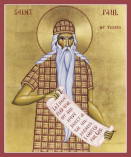 Born of wealthy parents in Lower Thebes in Egypt in the
reign of the Emperor Decius, he and a sister of his together inherited all their parents’
property. But his brother-in-law, an idol-worshipper, plotted to seize Paul’s half of the
inheritance. He therefore threatened Paul that he would betray him to the authorities as a
Christian if he did not hand over his share of the property. This misfortune, coupled with the
examples of self-sacrifice by the Christian martyrs that Paul saw with his own eyes, induced him
to give his half of the property to his sister and go off into the desert, where he lived in
asceticism until his death. The spiritual heights attained by this giant of a monk are testified
to by no less a person than St. Anthony the Great, who once visited Paul and saw how the wild
animals and birds of the air ministered to him. Returning from this visit, Anthony said to his
monks: ‘Woe is me, my children, a sinful and false monk, who am a monk in name only. I have
seen Elias, I have seen John in the desert, and I have seen Paul—in Paradise!’ St. Paul
lived 113 years, and entered peacefully into rest in the Lord in the year 342.
Born of wealthy parents in Lower Thebes in Egypt in the
reign of the Emperor Decius, he and a sister of his together inherited all their parents’
property. But his brother-in-law, an idol-worshipper, plotted to seize Paul’s half of the
inheritance. He therefore threatened Paul that he would betray him to the authorities as a
Christian if he did not hand over his share of the property. This misfortune, coupled with the
examples of self-sacrifice by the Christian martyrs that Paul saw with his own eyes, induced him
to give his half of the property to his sister and go off into the desert, where he lived in
asceticism until his death. The spiritual heights attained by this giant of a monk are testified
to by no less a person than St. Anthony the Great, who once visited Paul and saw how the wild
animals and birds of the air ministered to him. Returning from this visit, Anthony said to his
monks: ‘Woe is me, my children, a sinful and false monk, who am a monk in name only. I have
seen Elias, I have seen John in the desert, and I have seen Paul—in Paradise!’ St. Paul
lived 113 years, and entered peacefully into rest in the Lord in the year 342.
2. Our Holy Father John (The Hut-Dweller).
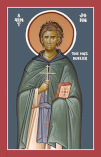 He was born in
Constantinople in the early part of the 5th century, and was the only child of rich and eminent
parents. Drawn by inclination to the spiritual life, the young John fled with a monk to a
monastery in Asia Minor. He spent six years in this monastery in the greatest restraint, prayer
and obedience to the superior. Then the devil attacked him with the temptation to leave the
monastery and return to his parents, to live with them as a nobleman. He indeed returned to his
parents’ home, but dressed as a beggar. He saw his parents, but not wishing to reveal
himself to them as their son, remained as a beggar in their courtyard, living off the crumbs that
the servants threw to him and enduring much ridicule from all. He lived thus for three years,
praying to God that He would save the souls of his father and mother. When he fell ill and felt
death approaching, he revealed himself to his parents. They recognized him by a precious
Gospel-book which they had given him in childhood and which he had kept with him as his sole
possession. And so this young man, albeit so rich, saved his soul and those of his parents,
overcame the devil, and entered into rest in the Lord in about the year 450.
He was born in
Constantinople in the early part of the 5th century, and was the only child of rich and eminent
parents. Drawn by inclination to the spiritual life, the young John fled with a monk to a
monastery in Asia Minor. He spent six years in this monastery in the greatest restraint, prayer
and obedience to the superior. Then the devil attacked him with the temptation to leave the
monastery and return to his parents, to live with them as a nobleman. He indeed returned to his
parents’ home, but dressed as a beggar. He saw his parents, but not wishing to reveal
himself to them as their son, remained as a beggar in their courtyard, living off the crumbs that
the servants threw to him and enduring much ridicule from all. He lived thus for three years,
praying to God that He would save the souls of his father and mother. When he fell ill and felt
death approaching, he revealed himself to his parents. They recognized him by a precious
Gospel-book which they had given him in childhood and which he had kept with him as his sole
possession. And so this young man, albeit so rich, saved his soul and those of his parents,
overcame the devil, and entered into rest in the Lord in about the year 450.
3. Our Holy Father Gabriel of Lesnov.
A Slav and a friend of St. Prochorus of Pchinja and St. John of Rila, he lived a life of asceticism in the 10th century at Kratov on the mountain of Lesnov, where he built a church to the Archangel Michael. He was a wonder-worker both during his lifetime and after his death. The present beautiful church in this place was built by King Dušan’s commander-in-chief, Jovan Oliver. St. Gabriel entered into rest in the Lord at the end of the tenth century.
4. The Holy Martyr Pansophios.
The son of the Alexandrian proconsul, Nilus, he laid aside worldly honor and riches as a young man and embraced the monastic state. He lived in great asceticism for 27 years, lifting up his soul to the higher world. In the reign of Decius, he was dragged before the judge, where he was flogged for the name of Christ until, under great torture, he delivered his soul to God.
FOR CONSIDERATION
Never think that God does not hear you when you pray to Him. He hears our thoughts as we hear one another’s voices and words. And if He does not act at once in response to your prayer, that is either because your prayer was unworthy, or you were seeking something that would be dangerous for you, or, again, because He, by His wisdom and providence, delays the fulfilling of your request until the right moment. Saint John of Kronstadt writes: ‘As we are able to communicate quickly by means of the electric telegraph with people far away from us, so, through a living faith, as through such a telegraph, we are quickly in contact with God, the angels and the saints. Send your requests to God and the saints by the telegraph of faith, and you will immediately get an answer.’ And again, in another place: ‘God and His created souls and spirits, the living and the dead, are thinking beings, and thought is swift and somehow omnipresent. Think about them with your whole heart, and they will be present with you. God will ever be with you, and by His gift and power, the others will be also.’
Daily Scripture Readings taken from The Orthodox New Testament, translated and published by Holy Apostles Convent, Buena Vista, Colorado, copyright © 2000, used with permission, all rights reserved.
Daily Prologue Readings taken from The Prologue of Ochrid, by Bishop Nikolai Velimirovic, translated by Mother Maria, published by Lazarica Press, Birmingham, England, copyright © 1985, all rights reserved. Edited by Dormition Skete.