

Daily Devotional
Thursday, January 23, 2025 (NS), January 10, 2025 (OS)
No Fasting.
Thursday of the Thirty-First Week
The commemoration of the Afterfeast of Theophany, and our father among the saints, Gregory, Bishop of Nyssa.
Scripture Readings
Paschalion — Movable Calendar
Thursday of the Thirty-First Week
Epistle
The Reading is from the General Epistle of Saint Iakovos [§ 51 B].
1 19My beloved brethren, let every man be swift to hear, slow to speak, slow to wrath; 20for man’s wrath doth not work out God’s righteousness. 21Wherefore lay aside all filthiness and surplus of wickedness, and receive in meekness the implanted word, which is able to save your souls. 22But keep on becoming doers of the word, and not only hearers, falsely reasoning for yourselves. 23For if anyone is a hearer of the word, and not a doer, this one is like a man observing carefully the face he was born with in a mirror; 24for he observed himself well, and hath gone away, and straightway forgetteth of what sort he was. 25But the one who looketh into the perfect law, that of freedom, and remaineth therein—because this one did not become a hearer of forgetfulness, but a doer of work—this one shall be happy in his doing. 26If anyone among you seem to be religious, while he bridleth not his tongue, but deceiveth his heart, the religion of this one is vain. 27Religion pure and undefiled before the God and Father is this: to visit orphans and widows in their affliction, and to keep oneself unspotted from the world.
Gospel
The Reading is from the Holy Gospel according to Saint Mark [§ 25]. At that time:
6 30The apostles were gathered together to Jesus, and related to Him all things, both as much as they did and as much as they taught. 31And He said to them, “Come ye yourselves privately to a desolate place, and rest yourselves a little.” For those coming and those going were many, and they did not even have an opportunity to eat. 32And they went away by the ship privately to a desolate place. 33And the crowds saw them going, and many recognized Him, and ran together there on foot from all the cities, and went before them, and came together to Him. 34And Jesus, after He came out, saw a great crowd and was moved with compassion toward them, because they were as sheep not having a shepherd; and He began to teach them many things. 35And much time already having elapsed, His disciples came to Him and said, “The place is desolate, and already it is a late hour. 36“Dismiss them in order that they might go away into the fields and villages round about, and buy bread for themselves; for they have not what they might eat.” 37But He answered and said to them, “Give ye them to eat.” And they say to Him, “Shall we go away and buy bread worth two hundred denarii and give them to eat?” 38But He saith to them, “How many loaves have ye? Go and see.” And having known, they say, “Five, and two fish.” 39And He enjoined them to make all recline by companies upon the green grass. 40And they laid back in rows, like beds in a garden, up to a hundred and up to fifty. 41And having taken the five loaves and the two fish, He looked up to the heaven and blessed and broke the loaves, and kept on giving them to His disciples that they might set them before them; and the two fish He divided to all. 42And all ate and were filled. 43And they took up twelve baskets full of fragments, and from the fish. 44And they who ate of the loaves were five thousand men.
45And straightway He constrained His disciples to embark into the ship, and to go before to the other side toward Bethsaida, until He should dismiss the crowd.
Menaion — Fixed Calendar
The commemoration of the Afterfeast of Theophany, and our father among the saints, Gregory, Bishop of Nyssa.
Epistle
The Reading is from the First Epistle of Saint Paul to the Corinthians [§ 151]. Brethren:
12 7To each one the manifestation of the Spirit is given to the profit of all: 8for to one is given by the Spirit a word of wisdom; and to another a word of knowledge according to the same Spirit; 9and to another faith in the same Spirit; and to another free gifts of healings in the same Spirit; 10and to another operations of works of power; and to another prophecy; and to another discerning of spirits; and to another kinds of tongues; and to another interpretation of tongues; 11but the one and the same Spirit energizeth all these things, distributing to each separately as He will.
Gospel
For the Mid-feast:
The Reading is from the Holy Gospel according to Saint Luke [§ 10]. At that time:
3 19Herod the tetrarch, being reproved by John for Herodias, the wife of his brother Philip, and for all the evils which Herod did, 20added also this above all, he even shut up John in the prison.
21Now it came to pass, as all the people were being baptized, Jesus also was baptized; and while He prayed, the heaven was opened. 22And the Holy Spirit descended in a bodily shape as a dove upon Him; and there came to be a voice out of heaven, saying, “Thou art My Son, the Beloved; in Thee I am well pleased.”
For the Hierarch:
For Gk. usage, see hereunder:
The Reading is from the Holy Gospel according to Saint Matthew [§ 10]. At that time:
4 25Great crowds followed Jesus from Galilee, and Decapolis, and Jerusalem, and Judæa, and beyond the Jordan.
5 1And seeing the crowds, He went up into the mountain; and after He sat down, His disciples came to Him. 2And He opened His mouth and began to teach them, saying:
3“Blessed are the poor in spirit, for theirs is the kingdom of the heavens.
4“Blessed are they who mourn, for they shall be comforted.
5“Blessed are the meek, for they shall inherit the earth.
6“Blessed are they who hunger and thirst after righteousness, for they shall be filled.
7“Blessed are the merciful, for they shall find mercy.
8“Blessed are the pure in heart, for they shall see God.
9“Blessed are the peacemakers, for they shall be called sons of God.
10“Blessed are they who have been persecuted on account of righteousness, for theirs is the kingdom of the heavens.
11“Blessed are ye whenever they reproach you and persecute you, and say every evil word against you falsely on account of Me.
12“Be rejoicing and be exceedingly glad, for your reward is great in the heavens. For so they persecuted the prophets who were before you.”
For Sl. usage, see [Mt. 10:1, 5-8].
Lives of the Saints (Prologue)
January 23rd – Civil Calendar
January 10th – Church Calendar
1. St. Gregory, Bishop of Nyssa.
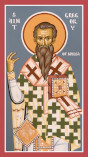 The brother of St. Basil the Great, he was at first a married
priest, but when his wife, the blessed Theosevia, died, he was chosen and consecrated as Bishop
of Nyssa. He was distinguished by great secular learning and spiritual experience, and was a
great preacher, a translator of the Scriptures and a theologian. As a result of his opposition to
the Arians, they did everything in their power to crush him, regarding him as their chief enemy.
They were so successful in this that, in the reign of the Emperor Valens, their confederate, they
managed to depose him from his episcopal seat and drive him into exile. This was in 376. The holy
father spent several years in patient exile, enduring poverty and humiliation. In 381, he took
part in the Second Ecumenical Council, and it is thought that he formulated the final part of the
Creed concerning the Holy Spirit. Finally, finishing his life at a great age in about the year
395, he entered into the kingdom of God and has been commemorated through all succeeding ages as
a great light in the Church.
The brother of St. Basil the Great, he was at first a married
priest, but when his wife, the blessed Theosevia, died, he was chosen and consecrated as Bishop
of Nyssa. He was distinguished by great secular learning and spiritual experience, and was a
great preacher, a translator of the Scriptures and a theologian. As a result of his opposition to
the Arians, they did everything in their power to crush him, regarding him as their chief enemy.
They were so successful in this that, in the reign of the Emperor Valens, their confederate, they
managed to depose him from his episcopal seat and drive him into exile. This was in 376. The holy
father spent several years in patient exile, enduring poverty and humiliation. In 381, he took
part in the Second Ecumenical Council, and it is thought that he formulated the final part of the
Creed concerning the Holy Spirit. Finally, finishing his life at a great age in about the year
395, he entered into the kingdom of God and has been commemorated through all succeeding ages as
a great light in the Church.
2. Our Holy Father Ammon of Egypt.
He was an Egyptian ascetic. At the age of fourteen, he strove and prayed to God to kill all anger in him. He achieved such perfection of goodness that he was no longer aware of the existence of evil in the world. He was an outstanding expert in the Scriptures, and entered into rest at the beginning of the fifth century.
3. St. Marcian.
He was born in Rome, but lived as a priest in Constantinople to the end of his life, during the greater part of the reign of Marcian and Pulcheria. The inheritor of great wealth from his parents, he spent it unstintingly on two objects: the building or restoring of churches, and charity to the poor. He built two new churches in Constantinople dedicated to St. Anastasia and St. Irene and famed as beautiful and holy places. When asked why he spent so much of his wealth on churches, he replied, “If I had a daughter and was giving her in marriage to some nobleman, would I not expend much gold to adorn her as a worthy bride? Here, I am adorning the Church, the Bride of Christ.” This great man, while being so generous to the churches and the poor, was very hard towards himself, following the evangelical counsel: “Having food and raiment, let us therewith be content” (I Tim. 6:8). It was written of him: “He was utterly in God and God in him”, and he went to God, full of years and good works, in the year 471.
FOR CONSIDERATION
Vanity in dress has a particularly free reign in our day. He who has nothing else of which to be proud takes pride in his attire. He who might have something else, of more value than dress, in which to take pride, does not in fact do so. As gold is not found lying on the surface of the ground, so the spiritual worth of a man does not appear on the outside. There is a story of how a famous philosopher, on seeing a young man flaunting his attire, moved up to him and whispered in his ear: “You know, my boy, the ram got there first, with a fleece like that, but he’s still just a ram!” To be a Christian and take pride in one’s apparel is more foolish than to be a king and take pride in the dust beneath one’s feet. While St. Arsenius wore golden clothing in the royal palace, he never received the title ‘the Great’. He received it when he unhesitatingly gave himself to the service of God and clothed himself in tatters.
Daily Scripture Readings taken from The Orthodox New Testament, translated and published by Holy Apostles Convent, Buena Vista, Colorado, copyright © 2000, used with permission, all rights reserved.
Daily Prologue Readings taken from The Prologue of Ochrid, by Bishop Nikolai Velimirovic, translated by Mother Maria, published by Lazarica Press, Birmingham, England, copyright © 1985, all rights reserved. Edited by Dormition Skete.