

Daily Devotional
Thursday, July 13, 2028 (NS), June 30, 2028 (OS)
No Fasting.
Thursday of the Sixth Week
| The commemoration of the Synaxis of the holy, glorious, and all-praised Twelve Apostles. |
Scripture Readings
Paschalion — Movable Calendar
Thursday of the Sixth Week
Epistle
The Reading is from the First Epistle of Saint Paul to the Corinthians [§ 129]. Brethren:
3 18Let no one be deceiving himself. If anyone among you think himself to be wise in this age, let him become foolish, in order that he might become wise. 19For the wisdom of this world is foolishness with God. For it hath been written: “He taketh the wise in their own craftiness [cf. Job 5:13]”; 20and again, “The Lord knoweth the reasonings of the wise, that they are vain [cf. Ps. 93(94):11].” 21Therefore let no one boast in men. For all things are yours: 22whether Paul, or Apollos, or Kephas, or the world, or life, or death, or things present, or things coming—all are yours. 23And ye are Christ’s, and Christ is God’s.
Gospel
The Reading is from the Holy Gospel according to Saint Matthew [§ 54]. At that time:
13 36Jesus sent the crowds away and went into the house. And His disciples came to Him, saying, “Declare to us the parable of the darnel of the field.” 37And He answered and said to them, “The One Who soweth the good seed is the Son of Man. 38“And the field is the world, and the good seed, these are the sons of the kingdom; but the darnel are the sons of the evil one. 39“And the enemy who sowed them is the devil, and the harvest is the consummation of the age, and the reapers are the angels. 40“Therefore even as the darnel is gathered together and burned completely, thus it shall be in the consummation of this age. 41“The Son of Man shall send forth His angels, and they shall gather together out of His kingdom all the stumbling blocks, and those doing lawlessness; 42“and they shall cast them into the furnace of the fire. There shall be there the weeping and the gnashing of the teeth. 43“Then the righteous shall shine forth as the sun in the kingdom of their Father. The one who hath ears to hear, let him hear.”
Menaion — Fixed Calendar
The commemoration of the Synaxis of the holy, glorious, and all-praised Twelve Apostles.
Epistle
The Reading is from the First Epistle of Saint Paul to the Corinthians [§ 131]. Brethren:
4 9I think that God showed forth us the apostles last, as condemned to death; for we became a spectacle to the world, both to angels and to men. 10We are fools for Christ’s sake, but ye are wise in Christ. We are weak, but ye are strong. Ye are held in honor, but we are dishonored. 11Until the present hour, we both hunger and thirst, and are naked, and are being buffeted, and never at rest. 12And we toil working with our own hands. Being reviled, we bless; being persecuted, we bear up; 13being evilly spoken of, we beseech. We became as the filth of the world, the off-scouring of all until now. 14I do not write these things shaming you, but admonishing you as my beloved children. 15For if ye have myriads of tutors in Christ, yet ye have not many fathers; for in Christ Jesus I begot you through the Gospel. 16Therefore, I beseech you, keep on becoming imitators of me.
Gospel
The Reading is from the Holy Gospel according to Saint Matthew [§ 34]. At that time:
9 36Jesus, having seen the crowds, was moved with compassion for them, because they were wearied and cast down, as sheep not having a shepherd. 37Then He saith to His disciples, “The harvest indeed is great, but the workers are few. 38“Entreat therefore the Lord of the harvest that He would send forth workers into His harvest.”
10 1And after He called to Himself His twelve disciples, He gave to them authority over unclean spirits, so as to cast them out, and to cure every disease and every weakness. 2Now the names of the twelve apostles are these: first, Simon, who is called Peter, and Andrew his brother; Iakovos the son of Zebedee, and John his brother; 3Philip and Bartholomew; Thomas and Matthew the tax collector; Iakovos the son of Alphæos, and Lebbæos, who was surnamed Thaddæos; 4Simon the Cananite, and Judas the Iscariote, who also delivered Him up. 5These twelve Jesus sent forth, and commanded them, saying, “Do not begin to go into the way of the nations, and do not begin to enter into a city of the Samaritans. 6“But go rather to the sheep, the lost of the house of Israel. 7“And as ye go, be preaching, saying, ‘The kingdom of the heavens hath drawn near.’ 8“Be healing the sick, cleansing lepers, raising the dead, casting out demons; freely ye received, freely give.”
For Sl. usage, see [Mk. 3:13-19].
Lives of the Saints (Prologue)
July 13th – Civil Calendar
June 30th – Church Calendar
1. The Assembly of the Holy, Glorious and All-praised Apostles.
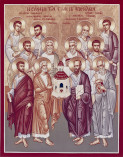 Although each of the Twelve
Apostles has his own feast day during the year, the Church has set aside this day for a general
feast of all of them together, including St. Paul. The names and feast days of the Twelve
are:
Although each of the Twelve
Apostles has his own feast day during the year, the Church has set aside this day for a general
feast of all of them together, including St. Paul. The names and feast days of the Twelve
are:
Peter—June 29th and January 16th.
Andrew—November 30th.
Iakovos the Son of Zebedee—April 30th.
John the Theologian—September 26th and May 8th.
Philip—November 14th.
Bartholomew—June 11th and August 25th.
Thomas—October 6th.
Matthew the Evangelist—November 16th.
Iakovos the Son of Alphaeus—October 9th.
Thaddeus (or Jude the brother of Iakovos)—June 19th.
Simon the Zealot—May 10th.
Matthias—August 9th.
Paul—June 29th.
Let us also remember here how these most holy and selfless men in the history of the world died and finished their earthly course:
Peter was crucified upside-down.
Andrew was crucified.
Iakovos was beheaded.
John the Theologian died peacefully in a miraculous way.
Philip was crucified.
Bartholomew was crucified, then flayed and beheaded.
Thomas was pierced with five spears.
Matthew was burned by fire.
Iakovos the Son of Alphaeus was crucified.
Thaddeus was crucified.
Simon the Zealot was crucified.
Matthias was stoned, then beheaded with an axe when dead.
Paul was beheaded.
2. Blessed Peter the Heir.
A Tartar by race and the nephew of the Tartar King Berkai, he once listened to a sermon on salvation by Kiril, Bishop of Rostov, and the words embedded themselves deeply in his heart. When he saw the miraculous healing of Berkai’s son by Kiril’s prayers, he secretly left the Cossack (Golden) Horde and ran off to Rostov, where he was baptized and devoted himself heart and soul to the ascetic life and to training himself in faith and devotion. Once he spent the night on the shore of a lake, and the Apostles Peter and Paul appeared to him in his sleep and told him to build a church dedicated to their memory on that spot, giving him the money he would need to accomplish this. Peter built a beautiful church there, and was there made a monk in old age, after the death of his wife. He finished his earthly course peacefully on June 29th, 1290, and his church became and remains the Petrovski monastery.
3. Our Holy Father George the Georgian.
Born in Iberia or Georgia in 1014, he was a kinsman of the Georgian king, Bagrat. He received a good classical education in his early years, but his heart ever drew him towards the spiritual life. He labored in asceticism under the renowned spiritual teacher George on the Black Mountain. He then went off to the Holy Mountain and continued his asceticism in the monastery of Iviron, becoming the abbot of that monastery. With the assistance of the Byzantine emperor, Constantine Monomachus, he restored Iviron and roofed the church with lead. This same leaden roof remains to this day. He translated the holy Scriptures, the Prologue and the books for divine services into Georgian. Bagrat summoned him back to Georgia to teach the people, and he received a royal welcome in his homeland. He travelled far and wide, instructing the clergy and the people. Reaching old age, he desired to depart this life on the Holy Mountain and set out on the road, but death overtook him in Constantinople in 1067. His relics were taken to Iviron. Although he died on May 24th, the Georgians celebrate his memory on June 30th, counting him as equal to the apostles.
FOR CONSIDERATION
Concern for the good of all men. Such concern filled the exalted spirits and noble hearts of the apostles to overflowing. St. John Chrysostom wrote about the Apostle Paul, calling him ‘the father of all the world, as if he himself had given birth to all men, for he was so concerned and strove so greatly to bring all into the kingdom’. ‘Father of all the world’ is indeed a very high title, and if there is anyone, under God, to whom this title should be given, it is the apostles of Christ. Having the concern of a parent for the whole world, they were truly ‘fathers of all the world’. There are many mothers in the world who care less for their own children than did the apostles for the good of their persecutors and adversaries. The Apostle Peter twice saved his most bitter adversary, Simon the Magician, from death; once when the crowd wanted to set fire to him and once when a dog tried to tear him to pieces. Just think of the way that the world paid its debt to these workers of good! As if they were the greatest robbers and evil-doers! How true are St. Cyprian’s words: ‘While we are in the body, we Christians look the same on the surface as pagans. The difference lies in the spirit.’
Daily Scripture Readings taken from The Orthodox New Testament, translated and published by Holy Apostles Convent, Buena Vista, Colorado, copyright © 2000, used with permission, all rights reserved.
Daily Prologue Readings taken from The Prologue of Ochrid, by Bishop Nikolai Velimirovic, translated by Mother Maria, published by Lazarica Press, Birmingham, England, copyright © 1985, all rights reserved. Edited by Dormition Skete.