

Daily Devotional
Sunday, May 7, 2028 (NS), April 24, 2028 (OS)
No Fasting.
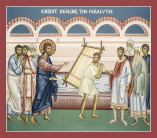
| The Fourth Sunday of Pascha, or the Sunday of the Paralytic Mode Three — Fifth Eothinon |
The commemoration of our venerable Mother Elisabeth the Wonder-worker of Constantinople, and the Martyr Savvas the General of Rome and 70 soldiers with him.
Scripture Readings
Paschalion — Movable Calendar
The Fourth Sunday of Pascha, or the Sunday of the Paralytic
Mode Three — Fifth Eothinon
Epistle
The Reading is from the Acts of the Apostles [§ 23]. In those days:
9 32It came to pass, as Peter passed through all quarters, he went down also to the saints that dwelt at Lydda. 33And there he found a certain man, by name Æneas, who kept his bed for eight years, and was paralyzed. 34And Peter said to him, “Æneas, Jesus the Christ healeth thee; rise up and make up thy bed for thyself.” And straightway he rose up. 35And all those inhabiting Lydda and the Sharon Plain, who saw him, turned to the Lord. 36Now there was in Joppa a certain disciple, by name Tabitha, which, being interpreted, is called Dorcas. She was full of good works and of alms which she used to do. 37And it came to pass in those days she fell sick and died. And after they washed her, they laid her in an upper room. 38And since Lydda was near to Joppa, and the disciples heard that Peter was in it, they sent forth two men to him, beseeching him not to delay to come over to them. 39And Peter, having risen up, went with them, whom after he came, they brought him into the upper room. And all the widows stood by him weeping, and showing howsoever many tunics and garments Dorcas used to make while she was with them. 40But Peter put them all forth, and kneeled down, and prayed. And turning to the body, he said, “Tabitha, rise up.” And she opened her eyes; and after she saw Peter she sat up. 41And he gave her his hand and raised her up; and after he called the saints and the widows, he presented her alive. 42And it became known throughout all of Joppa; and many believed on the Lord.
Gospel
The Reading is from the Holy Gospel according to Saint John [§ 14]. At that time:
5 1Jesus went up to Jerusalem. 2Now there is in Jerusalem by the gate a sheep pool, which is surnamed in Hebrew, Bethesda, having five porches. 3In these was lying a great multitude of the infirm, blind, lame, withered, awaiting the moving of the water. 4For an angel used to come down from time to time into the pool and trouble the water; then after the troubling of the water, the one who first entered became well of whatsoever disease he was held by. 5And a certain man was there, who had been thirty and eight years in his infirmity. 6Jesus saw this one lying there, and knew that he had already been much time in that condition, and He said to him, “Dost thou wish to become well?” 7The sick man answered Him, “Sir, I have no man in order that whenever the water is troubled he may put me into the pool; but while I am coming, another goeth down before me.” 8Jesus saith to him, “Rise, take up thy bed and be walking.” 9And straightway the man became well, and took up his bed, and went on walking. And on that day it was a sabbath. 10The Jews therefore were saying to him who had been healed, “It is a sabbath; it is not lawful for thee to take up the bed.” 11He answered them, “The One Who made me well, the same said to me, ‘Take up thy bed and be walking.’” 12Then they asked him, “Who is the Man Who said to thee, ‘Take up thy bed and be walking?’” 13But the one who was healed knew not Who it was, for Jesus turned aside, because a crowd was in the place. 14After these things Jesus findeth him in the temple, and said to him, “Behold, thou hast become well; no longer go on sinning, lest a worse thing should befall thee.” 15The man went away, and told the Jews that Jesus was the One Who made him well.
Menaion — Fixed Calendar
The commemoration of our venerable Mother Elisabeth the Wonder-worker of Constantinople, and the Martyr Savvas the General of Rome and 70 soldiers with him.
No readings given.
Lives of the Saints (Prologue)
May 7th – Civil Calendar
April 24th – Church Calendar
1. The Holy Martyr Savvas Stratelates.
This famous Savvas lived in Rome in the time of the Emperor Aurelian, and held a general’s rank. He was of a noble Gothic family. He often visited Christians in prison, helping them from his abundance. Through his great purity and fasting, God gave him power over unclean spirits. When he was charged with being a Christian, he stood courageously before the emperor, cast his officer’s belt before him and publicly confessed Christ the Lord. He was tortured in various ways: flogged, flailed with iron rods, burned with torches. But he did not succumb to these deadly tortures, and was seen to be alive and well. His comrades, the soldiers, seeing clearly that God was helping Savvas, accepted the Christian Faith, and seventy of them were immediately beheaded at the emperor’s command. Christ the Lord Himself appeared to Savvas in the prison in great light, and strengthened His martyr. Then Savvas was condemned to death by drowning. He was thrown into a deep river, where he gave his soul to God in the year 272. And his soul went to the Lord to Whom he had remained faithful under many tortures.
2. Our Holy Mother Elisabeth
She embraced monasticism in early youth in the monastery of Ss. Kosmas and Damian in Constantinople, and took on herself a heavy asceticism for the sake of Christ the Lord and of her soul. She regarded herself as the bride of Christ, and this world as illusory. From her great love for God flowed a great compassion for people, especially for the sick and suffering. By the gift she had received from God, she healed many diseases and much distress among the people. At her nightly prayers she was seen all illuminated with heavenly light. And after her death, her relics had the power of healing, and many of the sick and suffering have come to her grave through the ages. She entered peacefully into rest and went to the eternal joy of her Lord in the year 540.
3. The Holy Martyrs Evsevios, Neon, Leontios and Longinos.
These four were army comrades of St. George. Seeing the courageous endurance and marvels of the saint, they became Christians and were consequently beheaded.
4. The Holy Martyrs Pasikratees and Valention.
When the judge urged Pasikratees (Pasicrates), and also the martyr’s brother, Papianos (who had fallen away from Christ through fear of torture) to offer sacrifice to idols, Pasikratees put his hand into the fire and cried: ‘The body is dead and burned by fire, but the soul is immortal and does not feel visible torture.’ His mother upheld him and greatly encouraged him to endure to the end. He was beheaded along with Valention (Valentine), and they both went to the kingdom of Christ in about 302.
5. Our Holy Father Thomas the Fool for Christ.
Whenever, in his monastic work, he had to go into the city of Antioch, Thomas feigned madness for the sake of Christ. A certain Anastasios, refusing to give him the requested alms for the monastery, gave him a blow instead. Then Thomas prophesied: ‘From now on, I shall receive nothing from Anastasios, nor will Anastasios be able to give anything.’ One day later, Anastasios died; and Thomas also, about to return to the monastery, gave up the spirit. And so the prophecy of this holy man was fulfilled. St. Thomas departed this life in Laphnis near Antioch, in the time of Patriarch Domnos (546-560).
6. The Holy New-Martyrs Luke and Nicholas
The young man Luke (or Doukas), a tailor by profession, suffered for Christ in 1546, and Nicholas in 1776.
FOR CONSIDERATION
Exhorting Christians to come to church for prayer, St. John Chrysostom says: ‘If a messenger brings an imperial or princely document to a subject citizen, the citizen does not examine the life of the bearer, whether he is rich or poor, righteous or sinful, but listens carefully to what he reads. If anyone has not heard him, he asks someone who has. So, if you have such enormous respect for an earthly ruler, how necessary it is to listen to us priests, here where the Creator of the heavenly powers speaks through us sinners.’ And, indeed, what are the holy Scriptures but documents of the King of heaven? How can it not interest us every day and every hour, that unique and saving document, when the least decree of the lowest authority in the state interests us? St. Anthony says: ‘Let all that you do be justified in holy Scripture.’ But how can you have justification from holy Scripture if you do not know the Scriptures?
Daily Scripture Readings taken from The Orthodox New Testament, translated and published by Holy Apostles Convent, Buena Vista, Colorado, copyright © 2000, used with permission, all rights reserved.
Daily Prologue Readings taken from The Prologue of Ochrid, by Bishop Nikolai Velimirovic, translated by Mother Maria, published by Lazarica Press, Birmingham, England, copyright © 1985, all rights reserved. Edited by Dormition Skete.