

Daily Devotional
Friday, April 21, 2028 (NS), April 8, 2028 (OS)
No Fasting.
Bright Week - No Fasting All Week
Friday of the Renewal Week
The commemoration of the holy Apostles Herodion, Agavos, Rufus, Phlegon, Asyncritos, and Hermes of the Seventy, and those with them.
Scripture Readings
Paschalion — Movable Calendar
Friday of the Renewal Week
Epistle
The Reading is from the Acts of the Apostles [§ 7]. In those days:
3 1Peter and John were going up together into the temple during the hour of prayer, the ninth hour. 2And a certain man, lame from his mother’s womb, was being carried, whom they used to lay daily at the door of the temple which is called Beautiful, to ask alms from those going into the temple; 3who, seeing Peter and John being about to go into the temple, began asking alms. 4And Peter, looking intently upon him with John, said, “Look on us.” 5And he began to give heed to them, expecting to receive something from them. 6But Peter said, “Silver and gold have I none; but what I have, this I give to thee: in the name of Jesus Christ the Nazaræan, rise up and be walking.” 7And he took him by the right hand and raised him up; and immediately his feet and ankle bones were strengthened. 8And leaping up, he stood and went on walking and entered with them into the temple—walking and leaping and praising God.
Gospel
The Reading is from the Holy Gospel according to Saint John [§ 7]. At that time:
2 12Jesus went down to Capernaum, He, and His Mother, and His brethren, and His disciples; and they did not stay there many days. 13And the passover of the Jews was near, and Jesus went up to Jerusalem. 14And He found in the temple those who sell oxen and sheep and doves, and the money changers sitting. 15And after He made a scourge out of cords, He cast out all from the temple, both the sheep and the oxen; and He poured out the small pieces of money, and turned upside down the tables of the money changers. 16And He said to those who sold doves, “Take away these things from this place. Cease making the house of My Father a house of merchandise.” 17And His disciples were reminded that it is written: “The zeal for Thy house shall eat me up [cf. Ps. 68(69):12(9)].” 18Then the Jews answered and said to Him, “What sign showest Thou to us, seeing that Thou doest these things?” 19Jesus answered and said to them, “Destroy this temple, and in three days I will raise it.” 20Then the Jews said, “In forty and six years was this temple built, and wilt Thou raise it up in three days?” 21But He was speaking about the temple of His body. 22When therefore He was raised from the dead, His disciples were reminded that He was saying this to them, and they believed the Scripture and the word which Jesus said.
Menaion — Fixed Calendar
The commemoration of the holy Apostles Herodion, Agavos, Rufus, Phlegon, Asyncritos, and Hermes of the Seventy, and those with them.
No readings given.
Lives of the Saints (Prologue)
April 21st – Civil Calendar
April 8th – Church Calendar
1. The Holy Apostles Herodion, Agabus, Rufus, Asyncritus, Phlegon and Hermas.
They were all among the Seventy, and are all mentioned by St. Paul in his Epistles. Herodion was a kinsman of Paul’s: ‘Salute Herodion my kinsman,’ he writes to the Romans (16:11). Herodion suffered greatly at the hands of the Jews as Bishop of Neoparthia; he was beaten about the head, stoned on the mouth and stabbed in the legs. When they had left him for dead, St. Herodion arose and continued to serve the apostles. He helped the Apostle Peter in Rome, and was beheaded along with many other Christians on the same day that St. Peter was crucified.
St. Agabus had a spirit of prophecy. Two of his prophecies are recorded in the Acts of the Apostles. First, he prophesied a great famine throughout the world, which came to pass in the time of Claudius Caesar (Acts 11:28). The second was when he met the Apostle Paul in Caesarea. Paul was on his way to Jerusalem, and Agabus took St. Paul’s girdle and bound himself hand and foot, saying: ‘Thus saith the Holy Spirit: so shall the Jews at Jerusalem bind the man that owneth this girdle’ (21:11).
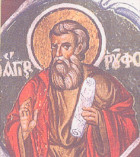 St. Rufus was Bishop of Thebes in Greece. The Apostle Paul
mentions him also: ‘Salute Rufus, chosen in the Lord’ (Rom. 16:13). St. Rufus was Bishop of Thebes in Greece. The Apostle Paul
mentions him also: ‘Salute Rufus, chosen in the Lord’ (Rom. 16:13).
|
St. Asyncritus (Rom. 16:14) was Bishop of Hyrcania in Asia.
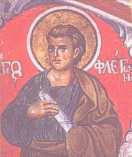 St. Phlegon, who is mentioned in the same place as St.
Rufus, was bishop in the Thracian city of Marathon. St. Phlegon, who is mentioned in the same place as St.
Rufus, was bishop in the Thracian city of Marathon.
|
St. Hermas, mentioned with the others, was bishop in Dalmatia.
All these, with bee-like industry, spread the Gospel, suffering greatly for the love of Christ. They all went to the eternal kingdom of their beloved Christ.
2. St. Niphon, Bishop of Novgorod.
He was adorned with zeal in the building and repairing of churches and with great courage in opposing tyrannical princes. Thirteen days before his death, St. Theodosius appeared to him and predicted his imminent departure to the other world. He entered into rest in 1156.
3. St. Celestine, Bishop of Rome.
A great zealot for the Orthodox Faith, he wrote an epistle against the Nestorian heresy at the time of the Third Ecumenical Council. He entered peacefully into rest in 432.
FOR CONSIDERATION
There is a heroism that is more than heroism, and an asceticism that is more than asceticism. St. Epiphanios of Cyprus once invited Hilarion the Great to lunch, and to show even greater honor to his guest, brought baked chicken to the table and offered it to him. Hilarion said to him: ‘Please excuse me; from the time I became a monk I have eaten nothing slaughtered.’—to which Epiphanios retorted: ‘And I, since becoming a monk, have never lain down on my bed without forgiving all my enemies!’ Hilarion exclaimed in wonder: ‘Yours, holy bishop, is a greater virtue than mine.’ This is an important teaching for us all. Fasting is a thing of primary importance, but forgiveness of insults is greater. A man trains himself by fasting for greatness of soul, and shows this greatness of soul by forgiveness. The latter surpasses the former, but is not attained without the former.
Daily Scripture Readings taken from The Orthodox New Testament, translated and published by Holy Apostles Convent, Buena Vista, Colorado, copyright © 2000, used with permission, all rights reserved.
Daily Prologue Readings taken from The Prologue of Ochrid, by Bishop Nikolai Velimirovic, translated by Mother Maria, published by Lazarica Press, Birmingham, England, copyright © 1985, all rights reserved. Edited by Dormition Skete.