

Daily Devotional
Sunday, April 16, 2028 (NS), April 3, 2028 (OS)
No Fasting.
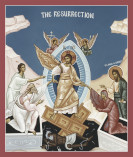
| The Holy and Great Sunday of Pascha |
The commemoration of our venerable Father Niketas the Confessor, Abbot of Medikion, and our holy Father Joseph the Hymnographer (commemorated on Sl. calendar on the 4th of April).
Scripture Readings
Paschalion — Movable Calendar
The Holy and Great Sunday of Pascha
Epistle
The Reading is from the Acts of the Apostles [§ 1].
1 1The first account indeed I made for myself concerning all which, O Theophilos, Jesus began both to do and teach, 2until the day in which He was taken up, after He gave command to the apostles whom He chose for Himself through the Holy Spirit, 3to whom also He presented Himself alive after He had suffered by many proofs, being seen by them during forty days and speaking the things concerning the kingdom of God. 4And being assembled together with them, He ordered them not to depart from Jerusalem, but to wait for the promise of the Father, “which,” He said, “ye heard of Me; 5“for John indeed baptized with water, but ye shall be baptized in the Holy Spirit not many days after these.” 6Indeed therefore, after they came together, they kept on questioning, saying, “Lord, dost Thou at this time restore the kingdom to Israel?” 7And He said to them, “It is not yours to know times or seasons which the Father Himself put in His own authority. 8“But ye shall receive power, after the Holy Spirit is come upon you; and ye shall be witnesses to Me both in Jerusalem, and in all Judæa and Samaria, and unto the ends of the earth.”
Gospel
In the Liturgy
The Reading is from the Holy Gospel according to Saint John [§ 1].
1 1In the beginning was the Logos, and the Logos was with God, and the Logos was God. 2This One was in the beginning with God. 3All things came into being through Him, and without Him not even one thing came into being that hath come to be. 4In Him was life, and the Life was the light of men. 5And the light shineth in the darkness, and the darkness overcame it not.
6There came to be a man who was sent forth from God, whose name was John. 7This same came for a witness, in order that he might bear witness concerning the Light, that all might believe through Him. 8He was not that One, the Light, but was sent that he might bear witness concerning the Light. 9That was the true Light, which giveth light to every man coming into the world. 10He was in the world, and the world came into being through Him, and the world knew Him not. 11He came to His own, and His own received Him not. 12But as many as received Him, to them He gave power to become children of God, to those who believe in His name: 13who were begotten not of blood, nor of the will of the flesh, nor of the will of man, but of God. 14And the Logos became flesh and tabernacled among us, and we beheld His glory, the glory as of an only-begotten from the Father, full of grace and truth. 15John beareth witness concerning Him, and hath cried out, saying, “This One was He of Whom I said, ‘The One Who cometh after me hath come to be before me, for He was before me.’” 16And of His fullness we all received, and grace for grace; 17for the law was given through Moses, but the grace and the truth came to be by Jesus Christ.
In Vespers
The Reading is from the Holy Gospel according to Saint John [§ 65].
20 19When it was evening on that day, the first of the week—and the doors were closed where the disciples were gathered together for fear of the Jews—Jesus came and stood in the midst, and saith to them, “Peace be to you.” 20And after He said this, He showed them His hands and His side. Then were the disciples glad, after they saw the Lord. 21Then Jesus said to them again, “Peace be to you; even as the Father hath sent Me forth, I also send you.” 22And after He said this, He breathed on them, and saith to them, “Receive ye the Holy Spirit: 23“if ye forgive the sins of any, they are forgiven to them; if ye retain the sins of any, they are retained.” 24But Thomas, one of the twelve, who is called Didymos, was not with them when Jesus came. 25The other disciples therefore were saying to him, “We have seen the Lord.” But he said to them, “Unless I should see in His hands the mark of the nails, and put my finger into the mark of the nails, and put my hand into His side, in no wise will I believe.”
Menaion — Fixed Calendar
The commemoration of our venerable Father Niketas the Confessor, Abbot of Medikion, and our holy Father Joseph the Hymnographer (commemorated on Sl. calendar on the 4th of April).
No readings given.
Lives of the Saints (Prologue)
April 16th – Civil Calendar
April 3rd – Church Calendar
1. St. Niketas the Confessor.
He was born in Bithynia, in the town of Caesarea. His father, Philaret, losing his wife, became a monk. Niketas remained with his paternal grandmother. After he had grown up and finished his schooling, he went to a monastery in Medikion, where Nikephoros, the abbot, tonsured him as a monk. After seven years of toil and asceticism, he was ordained hieromonk by Patriarch Tarasios. After the deaths of Nikephoros and Niketas’ great friend, Athanasius, the brethren chose Niketas as abbot, much against his will. St. Niketas was a holy example of life and asceticism to his brethren for many years. But when Leo V, the Armenian, came to the throne, following the devout Empress Irene and the pious Emperors Nikephoros and Michael, the iconoclast heresy sprang up again. The emperor deposed Patriarch Nikephoros and sent him into exile, and in his place put a heretic, Theodotus Kassiteras, a man of impure life. Niketas was imprisoned and tortured, but remained unwavering in his Orthodoxy. He was taken from prison to prison and tortured by hunger and thirst, by cold and heat and malice. But he remained utterly unwavering. A certain Nicholas pestered him particularly with his derision and malice. But one night the dead father of this Nicholas appeared to him in a dream and said: ‘Leave that servant of God alone!’ From that moment Nicholas repented, and not only refrained from pestering him but prevented others doing likewise. When the Emperor Leo the Armenian had made an evil end, the throne passed to the Orthodox Emperor Michael Balbus, who freed all the Orthodox sufferers. Niketas retired to a lonely place near Constantinople, where he spent the remaining days of his earthly life in prayer and thanksgiving to God. When he died, his body was taken to his monastery, and during that journey, many of the sick, on touching his body, were healed. His relics were placed close to the graves of his spiritual father, Nikephoros, and his friend Athanasius. This great hierarch entered into rest in 824.
2. St. Paul the Wretched.
A Russian by birth, he was enslaved by the Turks as a boy. Refusing to betray the Christian Faith and embrace Islam, he was tortured and beheaded in Constantinople in 1683.
3. The Holy Martyr Ulphianos.
A young man from the city of Tyre, he was tortured for Christ by the governor, Urban, the torturer of St. Amphianos (April 2nd). He was finally sewn into a sack, together with a dog and a snake, and thrown into the sea. He suffered and was glorified in 306.
FOR CONSIDERATION
‘I look to die a thousand deaths’—thus wrote St. Athanasius the Great to his flock in Egypt in the time of the terrible Arian heresy. Every spiritual man can say the same thing when he looks in spirit and sees the net in which the whole world is caught. The more spiritual the man, the thicker the net is seen to be. This is the will of God: that the most spiritual be saved by the narrowest path. And the psalmist himself said: ‘Many are the afflictions of the righteous.’ But, in the end, victory and glory fall to their lot. They only need to be armed with faith and patience. He who believes, understands his sufferings. He who arms himself with patience will see victory and glory. To those who love God, the narrowest way is sufficiently spacious, the greatest pains are the light yoke and the bitterest death is the joy of the wedding.
Daily Scripture Readings taken from The Orthodox New Testament, translated and published by Holy Apostles Convent, Buena Vista, Colorado, copyright © 2000, used with permission, all rights reserved.
Daily Prologue Readings taken from The Prologue of Ochrid, by Bishop Nikolai Velimirovic, translated by Mother Maria, published by Lazarica Press, Birmingham, England, copyright © 1985, all rights reserved. Edited by Dormition Skete.