

Daily Devotional
Wednesday, April 12, 2028 (NS), March 30, 2028 (OS)
Fast Day. No Meat, Fish, Dairy, Eggs, Alcohol or Olive Oil Allowed.
Holy Week
| Holy and Great Wednesday |
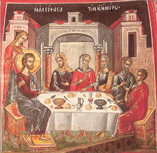
The commemoration of our venerable Father John, the author of The Ladder, and the holy Apostles Sosthenes, Apollos, Kephas, Cæsar, and Epaphroditos of the Seventy, and our holy father among the saints, Sophronios the Wonder-worker, Bishop of Irkutsk.
Scripture Readings
Paschalion — Movable Calendar
Holy and Great Wednesday
Epistle
There is no Epistle Reading this day because of Holy Week.
Gospel
In the Orthros
The Reading is from the Holy Gospel according to Saint John [§ mid 41]. At that time:
12 17The crowd that was with Jesus when He called Lazarus out of the grave and raised him from the dead bore witness. 18On this account the crowd also went to meet Him, because it heard that He had done this sign. 19The Pharisees therefore said among themselves, “Observe ye that ye profit nothing? Behold, the world hath gone away after Him.”
20And there were certain Greeks from among those going up that they might do reverence at the feast. 21Then these came to Philip, who was from Bethsaida of Galilee, and asked him, saying, “Sir, we wish to see Jesus.” 22Philip cometh and telleth Andrew, and again Andrew and Philip tell Jesus. 23But Jesus answered them, saying, “The hour hath come that the Son of Man should be glorified. 24“Verily, verily, I say to you, unless the grain of the wheat that falleth into the earth should die, it abideth alone; but if it should die, it beareth much fruit. 25“The one who loveth his life shall lose it; and the one who hateth his life in this world shall keep it to life eternal. 26“If anyone serve Me, let him keep on following Me; and where I am, there My servant shall be also. And if anyone serve Me, the Father shall honor him. 27“Now My soul hath been troubled; and what shall I say? ‘Father, save Me from this hour’; but on this account I came to this hour. 28“Father, glorify Thy name.” Then a voice came out of the heaven: “I both glorified it and will glorify it again.” 29The crowd then that stood by and heard it was saying that thunder had occurred; others were saying, “An angel hath spoken to Him.” 30Jesus answered and said, “This voice hath not occurred for My sake, but for your sakes. 31“Now is a judgment of this world; now the ruler of this world shall be cast out. 32“And I, if I be lifted up from the earth, will draw all to Myself.” 33But He was saying this, signifying by what manner of death He was about to die. 34The crowd answered Him, “We heard out of the law that the Christ abideth forever; and how sayest Thou, ‘The Son of Man must be lifted up’? Who is this Son of Man?” 35Then Jesus said to them, “Yet a little while is the light with you. Be walking while ye have the light, that darkness might not overtake you; and indeed the one who walketh in the darkness knoweth not where he goeth. 36“While ye have the light, keep on believing in the light, that ye might become sons of light.” Jesus spoke these things, and departed, and was hidden from them.
37But though He had done so many signs before them, yet they kept on not believing in Him, 38that the word of Esaias the prophet might be fulfilled, which he spoke, “Lord, who believed our report? And to whom was the arm of the Lord revealed [Is. 53:1]?” 39On this account they were not able to believe, because Esaias said again, 40“He hath blinded their eyes and hardened their heart, that they should not see with their eyes and understand with their heart and should be converted; and I shall heal them [cf. Is. 6:9, 10].” 41These things said Esaias when he saw His glory and spoke concerning Him. 42Yet, nevertheless, from among the rulers also many believed in Him, but because of the Pharisees they were not confessing Him, lest they should be expelled from the synagogue; 43for they loved the glory of men more than the glory of God. 44But Jesus cried and said, “The one who believeth in Me, believeth not in Me, but in the One Who sent Me; 45“and the one who seeth Me, seeth the One Who sent Me. 46“I have come a light into the world, that everyone who believeth in Me should not abide in the darkness. 47“And if anyone hear My words and believe not, I judge him not; for I came not that I might judge the world, but that I might save the world. 48“The one who rejecteth Me and receiveth not My words, hath that which judgeth him—the word which I spoke, that shall judge him in the last day. 49“For I spoke not of Myself, but the Father Who sent Me, He Himself gave a commandment to Me, what I should say and what I should speak. 50“And I know that His commandment is life everlasting. Therefore, what things I speak, as the Father hath said to Me, so I speak.”
In the Liturgy of the Presanctified Gifts
The Reading is from the Holy Gospel according to Saint Matthew [§ 108]. At that time:
26 6When Jesus was in Bethany, in the house of Simon the leper, 7a woman came to Him having an alabaster flask of very costly perfumed ointment, and she poured it upon His head as He reclined at table. 8But His disciples, having seen it, became indignant, saying, “For what is this loss? 9“For it was possible for this perfumed ointment to have been sold for much and to have been given to the poor.” 10But Jesus, perceiving it, said to them, “Why do ye cause trouble to the woman? For she wrought a good work toward Me. 11“For ye have the poor among yourselves always, but Me ye have not always. 12“For in putting this perfumed ointment upon My body, she did it for My burial. 13“Verily I say to you, wheresoever this Gospel shall be proclaimed in all the world, also what she did shall be spoken of for a memorial of her.” 14Then one of the twelve, who was called Judas Iscariote, went to the chief priests, 15and said, “What are ye willing to give to me, and I will deliver Him up to you?” And they fixed by agreement with him for thirty pieces of silver. 16And from that time he sought an opportunity that he might deliver Him up.
Menaion — Fixed Calendar
The commemoration of our venerable Father John, the author of The Ladder, and the holy Apostles Sosthenes, Apollos, Kephas, Cæsar, and Epaphroditos of the Seventy, and our holy father among the saints, Sophronios the Wonder-worker, Bishop of Irkutsk.
Epistle
For the venerable Father:
The Reading is from the Epistle of Saint Paul to the Galatians [§ 213]. Brethren:
5 22The fruit of the Spirit is love, joy, peace, long-suffering, kindness, goodness, faith, 23meekness, self-control; against such things there is no law. 24But they who are of the Christ crucified the flesh with the passions and the lusts. 25If we live by the Spirit, let us also be walking by the Spirit. 26Let us not become vainglorious, provoking one another, envying one another.
6 1Brethren, even if a man should be overtaken in some transgression, ye, the spiritual ones, be restoring such a one in the spirit of meekness, looking out for thyself, lest thou also be tempted. 2Keep on bearing one another’s burdens, and thus fill up the law of the Christ.
For the Hierarch:
The Reading is from the Epistle of Saint Paul to the Hebrews [§ 318]. Brethren:
7 26Such a High Priest was fitting for us: holy, guileless, undefiled, Who hath been separated from the sinners and hath become higher than the heavens, 27Who hath no need daily, even as the high priests, to offer up sacrifices, first for his own sins, then for those of the people; for this He did once for all after He offered up Himself. 28For the law appointeth men high priests who have weakness; but the word of the oath, which is after the law, appointeth the Son, Who hath been perfected forever.
8 1Now in reference to the things being spoken of, the chief point is: We have such a High Priest, Who sat down on the right of the throne of the majesty in the heavens, 2a Liturgist of the holies and of the tabernacle, the true one, which the Lord pitched, and not man.
Gospel
For the venerable Father:
The Reading is from the Holy Gospel according to Saint Luke [§ 51]. The Lord said to His disciples:
10 16“The one who heareth you heareth Me, and the one who rejecteth you rejecteth Me, and the one who rejecteth Me rejecteth the One Who sent Me forth.”
17And the seventy returned with joy, saying, “Lord, even the demons are being made subject to us in Thy name.” 18And He said to them, “I was beholding Satan as lightning having fallen out of the heaven. 19“Behold, I give you the authority to tread upon serpents and scorpions, and upon all the power of the enemy; and nothing in anywise shall injure you. 20“However cease rejoicing in this, that the spirits are being made subject to you; but be rejoicing that your names were written in the heavens.” 21In the same hour Jesus rejoiced in the Spirit, and said, “I give thanks to Thee, O Father, Lord of the heaven and of the earth, that Thou didst hide these things from the wise and intelligent, and didst reveal them to babes. Yea, Father, for thus it was well-pleasing before Thee.”
For the Hierarch:
The Reading is from the Holy Gospel according to Saint Matthew [§ 11]. The Lord said to His disciples:
5 14“Ye are the light of the world. A city situated on the top of a mountain cannot be hid. 15“Nor do they light a lamp and put it under the bushel, but upon the lampstand, and it giveth light to all those in the house. 16“Thus, let your light shine before men, that they might see your good works, and might glorify your Father Who is in the heavens.
17“Do not begin to think that I came to abolish the law or the prophets; I came not to abolish, but to fulfill. 18“For verily I say to you, until the heaven and the earth shall have passed away, one iota or one tittle in no wise shall pass away from the law, until all shall have taken place. 19“Whosoever then shall break one of the least of these commandments, and shall teach men so, he shall be called least in the kingdom of the heavens; but whosoever shall do and teach them, this one shall be called great in the kingdom of the heavens.”
Lives of the Saints (Prologue)
April 12th – Civil Calendar
March 30th – Church Calendar
1. Our Holy Father John Climacus (of the Ladder).
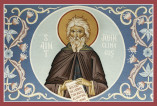 The author of the famous
‘Ladder,’ he came from an unknown place to Mount Sinai as a sixteen-year-old boy and
remained there, first as a novice, then as a hermit and finally as abbot of Sinai, until he died
at the age of eighty, in about 649. His biographer, the monk Daniel, says of him: ‘He
brought his body up to Mount Sinai, but his spirit he brought to the Mount of Heaven’. He
spent nineteen years in obedience to his spiritual father, Martyrios. Anastasios of Mount Sinai,
who saw John once as a young man, foretold that he would be abbot of Mount Sinai. After the death
of his spiritual father, John took himself off to a cave, where he lived for twenty years in
strict asceticism. His disciple, Moses, fell asleep one day in the cool shade of a huge rock.
John was at prayer in his cell, and perceiving that his disciple was in danger, began to pray for
him. Moses came up to him later, fell to his knees and began to thank him for saving him from
certain death. And he related how he had heard John calling him in his sleep and had jumped up at
the very moment that a rock fell. Had he not jumped out of the way, the rock would certainly have
killed him. At the importunate urging of the brethren, John accepted the abbacy, and guided their
souls to salvation with loving zeal. He once heard a monk reproach him for being too verbose. He
was not in the least angered, but was silent for an entire year, not uttering a single word until
the brethren begged him to speak. He then began to instruct them with the wisdom with which God
had endowed him. Once 600 pilgrims came to Mount Sinai. At supper they all noticed an agile young
man dressed as a Jew who was serving at table and giving orders to the other servants, taking
charge of everything. Suddenly, he disappeared. While everyone was pondering this and asking
questions among themselves, John said: ‘Do not bother to look for him; that was the prophet
Moses serving you in his own home.’ During the time that he was silent in his cave, John
wrote many instructive books, of which the most famous, ‘The Ladder,’ is much read to
this day. It describes the way to raise the soul to God as if on a ladder. Before his death, John
appointed his own brother, George, to the abbacy, but George began to grieve greatly at the
approaching parting with John. Then John said that, if he were found worthy to stand close to God
in the next world, he would pray that George be taken up to heaven in the same year. And so it
came to pass. After ten months, George also fell asleep and departed to take his place among
heaven’s citizens alongside his brother John.
The author of the famous
‘Ladder,’ he came from an unknown place to Mount Sinai as a sixteen-year-old boy and
remained there, first as a novice, then as a hermit and finally as abbot of Sinai, until he died
at the age of eighty, in about 649. His biographer, the monk Daniel, says of him: ‘He
brought his body up to Mount Sinai, but his spirit he brought to the Mount of Heaven’. He
spent nineteen years in obedience to his spiritual father, Martyrios. Anastasios of Mount Sinai,
who saw John once as a young man, foretold that he would be abbot of Mount Sinai. After the death
of his spiritual father, John took himself off to a cave, where he lived for twenty years in
strict asceticism. His disciple, Moses, fell asleep one day in the cool shade of a huge rock.
John was at prayer in his cell, and perceiving that his disciple was in danger, began to pray for
him. Moses came up to him later, fell to his knees and began to thank him for saving him from
certain death. And he related how he had heard John calling him in his sleep and had jumped up at
the very moment that a rock fell. Had he not jumped out of the way, the rock would certainly have
killed him. At the importunate urging of the brethren, John accepted the abbacy, and guided their
souls to salvation with loving zeal. He once heard a monk reproach him for being too verbose. He
was not in the least angered, but was silent for an entire year, not uttering a single word until
the brethren begged him to speak. He then began to instruct them with the wisdom with which God
had endowed him. Once 600 pilgrims came to Mount Sinai. At supper they all noticed an agile young
man dressed as a Jew who was serving at table and giving orders to the other servants, taking
charge of everything. Suddenly, he disappeared. While everyone was pondering this and asking
questions among themselves, John said: ‘Do not bother to look for him; that was the prophet
Moses serving you in his own home.’ During the time that he was silent in his cave, John
wrote many instructive books, of which the most famous, ‘The Ladder,’ is much read to
this day. It describes the way to raise the soul to God as if on a ladder. Before his death, John
appointed his own brother, George, to the abbacy, but George began to grieve greatly at the
approaching parting with John. Then John said that, if he were found worthy to stand close to God
in the next world, he would pray that George be taken up to heaven in the same year. And so it
came to pass. After ten months, George also fell asleep and departed to take his place among
heaven’s citizens alongside his brother John.
2. Commemoration of an Uncondemning Monk.
This monk died joyfully because he had never in his life condemned anyone. He was lazy, careless, disinclined to prayer, but throughout his entire life he had never judged anyone. And when he lay dying, he was full of joy. The brethren asked him how he could die so joyfully with all his sins, and he replied: ‘I have just seen the angels, and they showed me a page with all my many sins. I said to them: “The Lord said: ‘Judge not, that ye be not judged.’ I have never judged anyone and I hope in the mercy of God, that He will not judge me.” And the angels tore up the sheet of paper.’ Hearing this, the monks wondered at it and learned from it.
FOR CONSIDERATION
If the humbling of oneself before men is needful that one might be exalted before God, and temporal toil is the prerequisite of immortal life, what does it matter if some shake their heads and laugh at your self-abasement? John the Hesychast was ten years bishop on Ascalon, after which time he realized that worldly honors were hindering him, so he disguised himself as a simple monk and went to the Monastery of St. Sava the Sanctified. He was given the task of collecting and carrying wood and cooking lentils for the workmen. When he was discovered there also, he shut himself in his cell and lived there for forty-seven years on cabbage. You see how the fathers fled earthly honors. Yet, how many people in our day engage in a foolhardy struggle for them, squandering their souls for the sake of dust and ashes.
Daily Scripture Readings taken from The Orthodox New Testament, translated and published by Holy Apostles Convent, Buena Vista, Colorado, copyright © 2000, used with permission, all rights reserved.
Daily Prologue Readings taken from The Prologue of Ochrid, by Bishop Nikolai Velimirovic, translated by Mother Maria, published by Lazarica Press, Birmingham, England, copyright © 1985, all rights reserved. Edited by Dormition Skete.