

Daily Devotional
Monday, March 13, 2028 (NS), February 29, 2028 (OS)
Fast Day. No Meat, Fish, Dairy, Eggs, Alcohol or Olive Oil Allowed.
Holy & Great Fast
Monday of the Third Week of the Great Fast
There is No Divine Liturgy This Day Because of the Great Fast.
The commemoration of our venerable Father John Cassian the Roman.
[Commemorated on the 28th of February in non-leap years.]
Scripture Readings
Movable Calendar (Paschalion)
Monday of the Third Week of the Great Fast
There is No Divine Liturgy This Day Because of the Great Fast.
No readings given.
Menaion — Fixed Calendar
The commemoration of our venerable Father John Cassian the Roman.
[Commemorated on the 28th of February in non-leap years.]
No readings given.
Lives of the Saints (Prologue)
March 13th – Civil Calendar: Leap Year
February 29th – Church Calendar
1. Our Holy Father John Cassian.
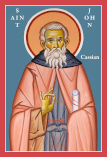 This great spiritual guide was born
in Rome of eminent parents. In his youth he studied the secular disciplines, especially
philosophy and astronomy. After that, he gave himself entirely to the study of holy Scripture. He
moved from the good to the better, and desiring higher and higher steps to perfection, Cassian
left Rome for the East, to learn more and attain this greater perfection. He went to Bethlehem,
then lingered in Egypt, at Nitria, among outstanding spiritual athletes from whom he learned to
exercise himself in all the virtues. In Constantinople, he became a pupil of St. John Chrysostom
and was ordained by him to the diaconate. He finally returned to the West and settled near
Marseilles, there founding two monasteries, one for monks and one for nuns. At the request of the
monks, Cassian wrote many books, among which the ones on the lovers of the spiritual life are
especially helpful: ‘Eight books on the struggle against the eight chief passions’
(The Institutes). His book against the Nestorian heresy (On the Incarnation of the Lord), which
he wrote at the request of Archdeacon (later Pope) Leo, is very important. He served the Lord
faithfully and enriched many by his wisdom, then entered into eternal rest in 435. St.
Cassian’s relics are preserved to this day in Marseilles.
This great spiritual guide was born
in Rome of eminent parents. In his youth he studied the secular disciplines, especially
philosophy and astronomy. After that, he gave himself entirely to the study of holy Scripture. He
moved from the good to the better, and desiring higher and higher steps to perfection, Cassian
left Rome for the East, to learn more and attain this greater perfection. He went to Bethlehem,
then lingered in Egypt, at Nitria, among outstanding spiritual athletes from whom he learned to
exercise himself in all the virtues. In Constantinople, he became a pupil of St. John Chrysostom
and was ordained by him to the diaconate. He finally returned to the West and settled near
Marseilles, there founding two monasteries, one for monks and one for nuns. At the request of the
monks, Cassian wrote many books, among which the ones on the lovers of the spiritual life are
especially helpful: ‘Eight books on the struggle against the eight chief passions’
(The Institutes). His book against the Nestorian heresy (On the Incarnation of the Lord), which
he wrote at the request of Archdeacon (later Pope) Leo, is very important. He served the Lord
faithfully and enriched many by his wisdom, then entered into eternal rest in 435. St.
Cassian’s relics are preserved to this day in Marseilles.
2. Our Holy Father Barsanuphius.
Born a pagan in Palestine, he was baptized at the age of eighteen and immediately became a monk, receiving the name John. When his virtuous life became known, he was chosen as Archbishop of Damascus, but did not stay long in that position. Yearning after a solitary spiritual asceticism, he secretly left Damascus and went to the desert of Nitria. There he presented himself as the monk Barsanuphius, and was immediately given the obedience of water-carrier to the monastery. The one-time archbishop joyfully received this obedience. By his learned discourses, his meekness and his zeal, he quickly became a model example to all the monks. Only at the time of his death was it revealed to the monks who Barsanuphius was. And so this saint used his own example as a lesson to the proud and to lovers of power, and as a comfort to the humble and meek. He entered peacefully into rest and went to the Lord in the year 457.
FOR CONSIDERATION
St. John Cassian writes thus on the struggle with a spirit of lust: ‘The struggle with a spirit of lust is a fierce struggle, longer than others, a daily struggle, and only a small number of people come to total victory. This struggle begins with the first ripe growth and does not finish until all the other passions have been mastered. In this struggle, it is necessary to use two weapons. For the achievement of a perfect and pure chastity, bodily fasting is not enough (though it is of the utmost necessity). On top of that, compunction of soul and unremitting prayer against that most unclean spirit; then, constant study of the Scriptures together with prudent works, physical labor and hand-work. These things keep the heart from unchastity and bring it back to itself. Above all, deep and true humility is needed, without which one will never attain victory over any passion. Victory over this passion is a freeing for the perfect purifying of the heart, from which, according to the words of the Lord, flow forth poison and grave ills: “For out of the heart proceed evil thoughts,...adulteries, fornications” and so forth (Matt. 15:19). One must have patience and constant humility of heart, and keep oneself carefully during each day from anger and other passions. For as far as the fire of anger penetrates into us, so afterwards there penetrate more easily the live coals of lust.’ It is interesting that many other spiritual guides link causally the passion of anger and the passion of unchaste lust, from which it follows that those prone to anger are the most prone to lust.
Daily Scripture Readings taken from The Orthodox New Testament, translated and published by Holy Apostles Convent, Buena Vista, Colorado, copyright © 2000, used with permission, all rights reserved.
Daily Prologue Readings taken from The Prologue of Ochrid, by Bishop Nikolai Velimirovic, translated by Mother Maria, published by Lazarica Press, Birmingham, England, copyright © 1985, all rights reserved. Edited by Dormition Skete.