

Daily Devotional
Sunday, February 6, 2028 (NS), January 24, 2028 (OS)
No Fasting.
The commemoration of the holy New-martyrs and Confessors of the Russian Land.
If the 25th of January falls on Monday, Tuesday, or Wednesday, chant the service of the New-martyrs on the preceding Sunday. If the 25th of January falls on Thursday, Friday, or Saturday, chant the service on the following Sunday. If the 25th of January falls on Sunday, chant the service for the New-martyrs that day, and the service to St. Gregory the Theologian on the 27th of January, in conjunction with that of St. John Chrysostom; in which case the hymns to St. Gregory precede those of St. John's. Thus the service can occur as early as the 22nd of January or as late as the 28th of that month.
If the service coincides with the Sunday of the Publican and the Pharisee, or with that of the Sunday of the Prodigal Son, or with Meatfare Sunday, the service of the New-martyrs is then chanted in conjunction with the Triodion and its Prokeimenon.
If a service to a major saint should fall on the same Sunday, we chant the service to the major saint on the closest Saturday, or on some other day.
If the church's feast day should fall on such a Sunday, chant the church's feast day in conjunction with the Triodion, with no further alteration. The service of the New-martyrs is then moved to the following Sunday.
| Sunday of the Thirty-Third Week or Sunday of the Publican and the Pharisee Mode Plagal Four — Eleventh Eothinon |
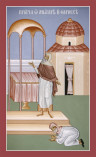
24. The commemoration of our venerable Mother Xene of Rome, and our venerable Mother Xenia of St. Petersburg.
Scripture Readings
Special Commemorations
The commemoration of the holy New-martyrs and Confessors of the Russian Land.
If the 25th of January falls on Monday, Tuesday, or Wednesday, chant the service of the New-martyrs on the preceding Sunday. If the 25th of January falls on Thursday, Friday, or Saturday, chant the service on the following Sunday. If the 25th of January falls on Sunday, chant the service for the New-martyrs that day, and the service to St. Gregory the Theologian on the 27th of January, in conjunction with that of St. John Chrysostom; in which case the hymns to St. Gregory precede those of St. John's. Thus the service can occur as early as the 22nd of January or as late as the 28th of that month.
If the service coincides with the Sunday of the Publican and the Pharisee, or with that of the Sunday of the Prodigal Son, or with Meatfare Sunday, the service of the New-martyrs is then chanted in conjunction with the Triodion and its Prokeimenon.
If a service to a major saint should fall on the same Sunday, we chant the service to the major saint on the closest Saturday, or on some other day.
If the church's feast day should fall on such a Sunday, chant the church's feast day in conjunction with the Triodion, with no further alteration. The service of the New-martyrs is then moved to the following Sunday.
Epistle
The Reading is from the Epistle of Saint Paul to the Romans [§ 99]. Brethren:
8 28We know that to those who love God all things work together for good, to those who are called according to purpose. 29For whom He foreknew, He also foreordained to be conformable to the image of His Son, in order for Him to be the firstborn among many brethren. 30But whom He foreordained, these also He called; and whom He called, these also He justified; and whom He justified, these also He glorified. 31What then shall we say to these things? If God is for us, who can be against us? 32He Who indeed spared not His own Son, but delivered Him up for us all, how shall He not with Him also graciously give us all things? 33Who shall bring an accusation against the elect of God? God is the One Who justifieth. 34Who is the one who condemneth? Christ is the One Who died, but much more is He the One also Who was raised, Who also is at the right of God, Who also intercedeth for us. 35Who shall separate us from the love of Christ? Shall affliction, or distress, or persecution, or famine, or nakedness, or danger, or sword? 36Even as it hath been written: “For on account of Thee, we are being put to death the whole day; we were counted as sheep of slaughter [Ps. 43(44):23(22)].” 37But in all these things we more than conquer through the One Who loved us. 38For I have been persuaded that neither death, nor life, nor angels, nor principalities, nor powers, nor things present, nor things coming, 39nor height, nor depth, nor any other created thing, shall be able to separate us from the love of God, which is in Christ Jesus our Lord.
Gospel
The Reading is from the Holy Gospel according to Saint Luke [§ 106]. The Lord said to His disciples, “Be taking heed of men:
21 12“For they shall lay their hands upon you and persecute you, delivering you up to synagogues and prisons, bringing you before kings and governors on account of My name; 13“but it shall prove to be a testimony for you. 14“Therefore settle it for yourselves in your hearts not to premeditate to make a defense; 15“for I will give you a mouth and wisdom, which all those who oppose you shall not be able to contradict nor withstand. 16“And ye shall be delivered up also by parents, and kinfolk, and friends, and brethren; and they shall put some of you to death. 17“And ye shall be hated by all for My name’s sake. 18“But a hair of your head in no wise shall perish. 19“In your patience win your souls.”
Paschalion — Movable Calendar
Sunday of the Thirty-Third Week or Sunday of the Publican and the Pharisee
Mode Plagal Four — Eleventh Eothinon
Epistle
The Reading is from the Second Epistle of Saint Paul to Saint Timothy [§ 296]. Child Timothy:
3 10Thou hast closely followed my teaching, conduct, purpose, faith, long-suffering, love, patience, 11persecutions, sufferings, such as happened to me in Antioch, in Iconium, in Lystra—what persecutions I endured! And out of them all the Lord delivered me. 12Yes, and all those who wish to live piously in Christ Jesus shall be persecuted. 13But evil men and cheats shall advance to the worse, leading astray and being led astray. 14But thou, keep on abiding in what thou didst learn and wast assured of, knowing from whom thou didst learn, 15and that from a babe thou hast known the sacred writings, which are able to make thee wise in regard to salvation through faith which is in Christ Jesus.
Gospel
The Reading is from the Holy Gospel according to Saint Luke [§ 89]. The Lord said this parable:
18 10“Two men went up into the temple to pray, the one a Pharisee and the other a tax collector. 11“The Pharisee, having assumed a stance, was praying these things to himself, ‘God, I thank Thee that I am not as the rest of men—rapacious, unjust, adulterers, or even as this one, the tax collector. 12“‘I fast twice a week; I tithe all things, as much as I acquire.’ 13“And the tax collector, having stood afar off, was not willing even to lift up his eyes to the heaven, but kept beating upon his breast, saying, ‘God, be gracious to me the sinner.’ 14“I say to you, this one went down to his house having been justified rather than that one; for everyone who exalteth himself shall be humbled, and the one who humbleth himself shall be exalted.”
Menaion — Fixed Calendar
24. The commemoration of our venerable Mother Xene of Rome, and our venerable Mother Xenia of St. Petersburg.
Epistle
For St. Xene of Rome:
The Reading is from the Epistle of Saint Paul to the Galatians [§ 213]. Brethren:
5 22The fruit of the Spirit is love, joy, peace, long-suffering, kindness, goodness, faith, 23meekness, self-control; against such things there is no law. 24But they who are of the Christ crucified the flesh with the passions and the lusts. 25If we live by the Spirit, let us also be walking by the Spirit. 26Let us not become vainglorious, provoking one another, envying one another.
6 1Brethren, even if a man should be overtaken in some transgression, ye, the spiritual ones, be restoring such a one in the spirit of meekness, looking out for thyself, lest thou also be tempted. 2Keep on bearing one another’s burdens, and thus fill up the law of the Christ.
For St. Xenia of St. Petersburg:
The Reading is from the Epistle of Saint Paul to the Galatians [§ 208]. Brethren:
3 23Before faith came, we were being guarded under the law, having been closed up to the faith about to be revealed. 24Therefore the law hath become our tutor until Christ, in order that we might be justified by faith. 25But faith having come, we are no longer under a tutor. 26For all are sons of God through faith in Christ Jesus. 27For as many as were baptized into Christ, ye put on Christ. 28There is neither Jew nor Greek, there is neither slave nor free, there is neither male and female; for ye are all one in Christ Jesus. 29And if ye are Christ’s, then are ye Abraham’s seed, and heirs according to promise.
Gospel
The Reading is from the Holy Gospel according to Saint Matthew [§ 104]. The Lord said this parable:
25 1“The kingdom of the heavens shall be likened to ten virgins, who took their lamps and went forth to meet the bridegroom. 2“And five of them were prudent, and five were foolish. 3“Those who were foolish took lamps for themselves and took no oil with them; 4“but the prudent took oil in their vessels with their lamps. 5“But while the bridegroom tarried, they all dozed and went on sleeping. 6“But in the middle of the night, there came to pass a cry, ‘Behold, the bridegroom cometh; go ye out to meet him!’ 7“Then all those virgins were wakened and trimmed their lamps. 8“And the foolish said to the prudent, ‘Give us of your oil, for our lamps are going out.’ 9“But the prudent answered, saying, ‘Peradventure there might not be enough for us and you, but go rather to those who sell, and buy for yourselves.’ 10“But while they went away to buy, the bridegroom came, and they who were ready went in with him to the wedding festivities; and the door was shut. 11“And afterwards the remaining virgins came also, saying, ‘Lord, lord, open to us.’ 12“But he answered and said, ‘Verily I say to you, I know ye not.’ 13“Be watching then, for ye know not the day nor the hour in which the Son of Man cometh.”
Synaxarion Readings
Sunday of the Publican and the Pharisee
O Creator of all above and below, as Thou receivest the thrice-holy hymn from the angels, so also from mankind receive the Triodion. He who lives like a Pharisee is far from the Church, for Christ is received within, O ye humble of heart.
With God on this present day we begin the Triodion, the hymns of which were composed by many of our holy and God-bearing fathers, inspired by the Holy Spirit according to their worthiness. The first of all was the great author St. Cosmas of Maiuma, who composed the three odes (symbolic of the Holy and life-creating Trinity) for the Great and Holy Week of the Passion of our Lord and God and Savior Jesus Christ. After him, others of the fathers, including Saints Theodore and Joseph of the Studite Monastery, following his zealous example, arranged the services of the other weeks of the Holy and Great Forty-day Fast, reserving them at first for the use of the Studite Monastery. Furthermore they composed and arranged hymns, seeking them and collecting them from other books of the fathers. Since, according to the Triodion, Sunday, the celebration of the Resurrection, is the first day of the week as well as the last or eighth day, they prescribed the first ode (canticle) of the canon to be sung on the second day of the week, i.e. Monday. The second ode was prescribed for Tuesday, the third day of the week, the third ode for Wednesday, the fourth ode for Thursday, the fifth ode for Friday, and the sixth and seventh odes for Saturday. The rest, the eighth and ninth odes, are prescribed for every day.
It must be known, however, that although it is called the Triodion, it does have services with other than three-ode canons. It is so named because the majority of the services have three-ode canons, especially during Holy Week. For it was our holy fathers’ idea that through the entire Triodion would be commemorated in a concise form all God’s benefits to us from the beginning, using it as a reminder for all of us that we were created by Him, and were exiled from Paradise through the tasting of the fruit, rejecting the commandment that was given to us for our knowledge, and we were cast out through the envy of the arch villain serpent and enemy, who was made to crawl for his arrogance; that we remained cut off from the benefits of Paradise and were led by the devil; that the Son and Logos of God, having suffered in His mercy, bowing the heavens, descended and made His abode in the Virgin and became man for our sake, showing us through His life the ascent into the heavens, through humility first of all, then by fasting and the rejection of evil, and through His other deeds; that He suffered and rose from the dead and ascended once more into heaven, and He sent down the Holy Spirit upon His holy disciples and apostles, who all proclaimed Him to be the Son of God and the most perfect God. And that once more the divine apostles acted through the grace of the most Holy Spirit and gathered all the saints from the ends of the earth through their preaching, filling the world on high, which was the intention of the Creator from the beginning.
Now the purpose of the Triodion intended by the holy fathers on these three present feasts of the Publican and the Pharisee, the Prodigal Son, and the Second Coming is a kind of preparatory lesson and stimulation to prepare ourselves for the spiritual labors of the Fast, having put aside our usual corrupt habits. First of all they present to us the parable of the Publican and the Pharisee, and they call the week following precursory. For those who desire to go off to do military battle first ascertain the time of the battle from the leaders, so that having cleaned and polished their weapons, and preparing well all their other matters, and having removed all obstacles from their path, they earnestly go forth to their labors, taking the necessary supplies. Often before battle they tell anecdotes and tales and parables to incite their hearts to zeal, driving off idleness, fear, despair, and other unworthy feelings. So the divine fathers herald the coming fast against the armies of demons as a struggle which constrains our souls to cleanse ourselves of the poison accumulated over a long period of time. Not yet possessing those benefits, let us strive to obtain them, and arming ourselves properly, so let us embark on the labors of the Fast.
Now the first weapon among the virtues is repentance and humility. And the adversary of attaining the greatest humility is pride and arrogance. So they place before us first of all this present trustworthy parable from the divine Gospel. It encourages us to shun the desire for the pride and arrogance of the Pharisee and to cultivate the opposite desire of the Publican for humility and repentance. For the greatest and most grievous passion is pride and arrogance, since this is how the devil fell from the heavens before the morning star and was cast into darkness. Because of this Adam, the father of our race, was driven from Paradise through partaking of the fruit. Through this example the holy fathers encourage all not to be proud of their successes, but to always be humble. For the Lord sets Himself against the proud, but He gives grace to the humble. Better a man who has sinned, if he knows that he has sinned and repents, than a man who has not sinned and thinks of himself as righteous. For Christ said, “I say to you that the publican went down to his house justified rather than the Pharisee.” This parable reveals that no one should exalt himself, even though he has done good deeds, but rather should always be humble and pray from his heart to God, for even if he should fall into the most serious sin, salvation is not far off.
Through the prayers of all Thy holy hymnographers, O Christ our God, have mercy on us. Amen.
Translated from Triodion, siest ‘Tripesnets: Triod’ Postnaya, Moscow, 1904, by Robert Parent.
Lives of the Saints (Prologue)
February 6th – Civil Calendar
January 24th – Church Calendar
1. Our Holy Mother Xenia.
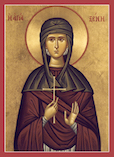 Born in Rome, she was the only daughter of a famous senator. Drawn by
the love of Christ, she refused to marry as her parents desired. In order to escape this, she
fled from her home with two of her slaves and came to the island of Kos, to a place called
Mylassa, where she started a community for virgins, remaining there in asceticism till her death.
Though she was a woman, she had a man’s perseverance in fasting, prayer and vigils. She
often spent entire nights standing in prayer, was dressed more poorly than her sisters, and when
she ate she often put ashes from the censer on her bread. At the hour of her death (in 450), a
wonderful sign appeared over the monastery: a wreath of stars encircling a cross more resplendent
than the sun. Many of the sick were healed by her relics. Her two slave girls followed the
example of their abbess in all things, and when they died, they were buried, by their wish, at
the feet of blessed Xenia.
Born in Rome, she was the only daughter of a famous senator. Drawn by
the love of Christ, she refused to marry as her parents desired. In order to escape this, she
fled from her home with two of her slaves and came to the island of Kos, to a place called
Mylassa, where she started a community for virgins, remaining there in asceticism till her death.
Though she was a woman, she had a man’s perseverance in fasting, prayer and vigils. She
often spent entire nights standing in prayer, was dressed more poorly than her sisters, and when
she ate she often put ashes from the censer on her bread. At the hour of her death (in 450), a
wonderful sign appeared over the monastery: a wreath of stars encircling a cross more resplendent
than the sun. Many of the sick were healed by her relics. Her two slave girls followed the
example of their abbess in all things, and when they died, they were buried, by their wish, at
the feet of blessed Xenia.
2. The Holy Martyr Babylas.
A Sicilian priest who suffered for Christ with two of his disciples in the third century.
3. Our Holy Father Makedonios.
He was a Syrian hermit. Only in old age did he feed himself with baked bread. Before that, he ate only barley grain soaked in water. He finished his earthly course in the year 418.
4. Our Holy Father Phylon, Bishop of Cyprus.
When St. Epiphanios was called to Rome to support his sister, the Empress Honoria, by his prayers he chose Phylon to be bishop. Phylon wrote a commentary on the Pentateuch and the Song of Songs. He entered peacefully into rest in the fifth century.
5. Our Holy Father Dionysius of Olympus, the Wonder-worker.
He lived the ascetic life on Olympus. He received the monastic tonsure on the Holy Mountain, where he later became abbot of Philotheou. Before the end of his life, he withdrew again to the solitude of Olympus, where he entered into rest in the 16th century.
FOR CONSIDERATION
In our day, we often hear parents say that they want to insure the lives of their children. To this end they make such great efforts, amass riches (often illicit riches), educate their children for that vocation which brings the surest physical security and material help. And so-called Christians do the same. They do this because their concept of real life and real security of life is faulty. But this is how a true Christian prepares his son for real life: At her death, blessed Ephrosyne said to her son, Clement of Ankyra: ‘Do me honor, my son, and stand for Christ as a man, and confess Him with strength and steadfastness. I hope, dear heart, that the crown of martyrdom will soon flower upon you, to the salvation of many.... Fear neither threats nor the sword, nor wounds nor fire. Nothing can separate you from Christ. But look into the heavens and await thence the great and eternal and rich reward of God. Fear God’s majesty, fear His judgment, tremble before His all-seeing Eye, for those who deny Him will suffer the unquenched fire and the ever vigilant worm. May this be my reward from you, my sweet son, for the pain of giving you birth and for the care of your upbringing that I may be known as the mother of a martyr. The blood that you received from me do not spare, but shed it, that it too may give me honor. Give your body to martyrdom, that I may rejoice at that before the Lord, as though I myself alone suffered for Him.’
Daily Scripture Readings taken from The Orthodox New Testament, translated and published by Holy Apostles Convent, Buena Vista, Colorado, copyright © 2000, used with permission, all rights reserved.
Daily Prologue Readings taken from The Prologue of Ochrid, by Bishop Nikolai Velimirovic, translated by Mother Maria, published by Lazarica Press, Birmingham, England, copyright © 1985, all rights reserved. Edited by Dormition Skete.