

Daily Devotional
Saturday, January 29, 2028 (NS), January 16, 2028 (OS)
No Fasting.
Saturday of the Thirty-Second Week
The commemoration of the veneration of the precious chains of the holy Apostle Peter.
Scripture Readings
Paschalion — Movable Calendar
Saturday of the Thirty-Second Week
Epistle
The Reading is from the First Epistle of Saint Paul to the Thessalonians [§ 273].
5 14Brethren, we exhort you, be admonishing the disorderly, be consoling the fainthearted, be supporting the weak, be long-suffering toward all. 15See ye that no one render evil for evil to anyone, but always be pursuing the good both toward one another and toward all. 16Be rejoicing always; 17be praying unceasingly. 18In everything be giving thanks, for this is the will of God in Christ Jesus for you. 19Cease quenching the Spirit. 20Cease setting at nought prophecies. 21Be testing all things, holding fast to the good. 22Abstain from every form of evil. 23Now may the God of peace Himself sanctify you wholly; and may your whole spirit and soul and body be preserved blameless at the coming of our Lord Jesus Christ.
Gospel
The Reading is from the Holy Gospel according to Saint Matthew [§ 101]. The Lord said:
24 34“Verily I say to you, in no wise shall this generation pass away until all these things shall have taken place. 35“The heaven and the earth shall pass away, but My words in no wise shall pass away. 36“But concerning that day and hour, no one knoweth, not even the angels of the heavens, except My Father only. 37“But even as the days of Noah were, so also shall be the coming of the Son of Man. 38“For even as in the days which were before the flood, they were eating and drinking, marrying and giving in marriage, until the day that Noah entered into the ark— 39“and they knew not until the flood came and took all away—so also shall be the coming of the Son of Man. 40“Then two shall be in the field: the one is taken and the one is left. 41“Two women shall be grinding at the mill: one is taken and one is left. 42“Be watching then, for ye know not in what hour your Lord cometh. 43“But know ye this, that if the master of the house had known in what watch the thief was coming, he would have watched and not let his house be broken into. 44“On this account, ye also keep on becoming ready, for in what hour ye think not, the Son of Man cometh.”
Menaion — Fixed Calendar
The commemoration of the veneration of the precious chains of the holy Apostle Peter.
Epistle
The Reading is from the Acts of the Apostles [§ 29].
12 1At that time, Herod the king put forth his hands to maltreat some of those from the Church. 2And he killed Iakovos the brother of John with a sword. 3And because he saw that it pleased the Jews, he in addition went on to seize Peter also—and they were the days of unleavened bread— 4whom after he laid hold of, he also put in prison, and delivered him up to four sets of four soldiers to guard him, purposing after the passover to bring him forth to the people. 5Peter, therefore, on the one hand, was being guarded in the prison, but on the other hand, earnest prayer was being made by the Church to God on his behalf. 6And when Herod was about to bring him forth, on that very night Peter was sleeping, bound with two chains between two soldiers; and guards also were before the door keeping the prison. 7And behold, an angel of the Lord stood by him, and a light shone in the chamber; and he struck the side of Peter, and woke him up, saying, “Rise up quickly.” And the chains from his hands fell off of him. 8And the angel said to him, “Gird thyself about, and bind on thy sandals.” And so he did. And he saith to him, “Cast about thee thine outer garment, and follow thou me.” 9And he went out and kept on following him, and did not know that it was real that which was happening by means of the angel, but he kept on thinking he saw a vision. 10And after they passed a first guard and a second, they came up to the gate, the iron one, which leadeth into the city, which was opened to them of itself; and having gone out, they advanced one street, and straightway the angel departed from him. 11And after Peter came to himself, he said, “Now I know of a truth, that the Lord sent forth His angel, and took me out of the hand of Herod and all the expectation of the people of the Jews.”
Gospel
The Reading is from the Holy Gospel according to Saint John [§ 67]. At that time:
21 14Jesus was made manifest to His disciples after He was raised from the dead.
15When therefore they ate breakfast, Jesus saith to Simon Peter, “Simon, son of Jonas, lovest thou Me more than these?” He saith to Him, “Yes, Lord, Thou knowest that I have affection for Thee.” He saith to him, “Be feeding My little lambs.” 16He saith to him again a second time, “Simon, son of Jonas, lovest thou Me?” He saith to Him, “Yes, Lord, Thou knowest that I have affection for Thee.” He saith to him, “Be shepherding My sheep.” 17He saith to him the third time, “Simon, son of Jonas, hast thou affection for Me?” Peter was grieved because He said to him the third time, “Hast thou affection for Me?” And he said to Him, “Lord, Thou knowest all things; Thou knowest that I have affection for Thee.” He saith to him, “Be feeding My sheep. 18“Verily, verily, I say to thee, when thou wast younger, thou used to gird thyself and walk about where thou wouldest; but whenever thou growest old, thou shalt stretch forth thy hands, and another shall gird thee, and bring thee where thou wouldest not.” 19But this He said signifying by what kind of death he shall glorify God. And having said this, He saith to him, “Follow thou Me.” 20And Peter, having turned about, seeth the disciple, whom Jesus loved, following—who also leaned back on His breast at the supper—and said, “Lord, who is the one who is delivering Thee up?” 21After Peter saw him, he saith to Jesus, “But Lord, this man—what?” 22Jesus saith to him, “If I wish him to tarry while I am coming, what is that to thee? Do thou be following Me.” 23Then this saying went out among the brethren that “that disciple dieth not”; and yet Jesus did not say that “he dieth not,” but, “If I wish him to tarry while I am coming, what is that to thee?”
24This is the disciple who beareth testimony concerning these things, and wrote these things; and we know that his testimony is true. 25And there are also many other things, which if as much as Jesus did may be written one by one, I suppose even the world itself could not contain the books that would be written. Amen.
Lives of the Saints (Prologue)
January 29th – Civil Calendar
January 16th – Church Calendar
1. The Veneration of the Chains of the Holy Apostle Peter.
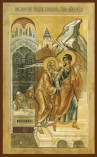 Today we commemorate the
chains with which Peter was shackled by the lawless Herod and which, when an angel appeared
to him in prison, fell from him (Acts 12:7). The faithful kept these chains, both in memory
of the great apostle and also because of their healing power, for many of the sick were
healed by touching them (as with the towel of the Apostle Paul: Acts 19:12). The Patriarch
of Jerusalem, St. Juvenal, made a gift of these chains to the Empress Evdokia, the exiled
wife of the Emperor Theodosios the Younger. She divided them in half, sending one half to
the Church of the Holy Apostles in Constantinople and the other to her daughter, the
Empress Eudoxia, wife of Valentian of Rome. This Eudoxia built the Church of St. Peter and
placed these chains in it, together with those in which Peter was shackled before his death
under the Emperor Nero. Today we commemorate the
chains with which Peter was shackled by the lawless Herod and which, when an angel appeared
to him in prison, fell from him (Acts 12:7). The faithful kept these chains, both in memory
of the great apostle and also because of their healing power, for many of the sick were
healed by touching them (as with the towel of the Apostle Paul: Acts 19:12). The Patriarch
of Jerusalem, St. Juvenal, made a gift of these chains to the Empress Evdokia, the exiled
wife of the Emperor Theodosios the Younger. She divided them in half, sending one half to
the Church of the Holy Apostles in Constantinople and the other to her daughter, the
Empress Eudoxia, wife of Valentian of Rome. This Eudoxia built the Church of St. Peter and
placed these chains in it, together with those in which Peter was shackled before his death
under the Emperor Nero.
|
2. The Holy Martyrs Speusippus, Eleusippus, Meleusippus and their grandmother Leonilla.
They suffered for Christ in Cappadocia in the reign of the Emperor Marcus Aurelius (161-180). The three brothers were triplets. At first only Leonilla was a Christian, while her grandsons were pagans. After much exhortation on the part of the pious Leonilla and a local priest, the three brothers were baptized. Being baptized, they began with youthful fervor to witness to their faith, and in their zeal went out and smashed all the idols in the area. Accused and brought before the judge, they acknowledged their action and openly confessed their faith in Christ. The judge threw them into prison, then summoned their grandmother and directed her to go to the prison and counsel her grandsons to deny Christ and worship idols. Leonilla went off without a word to the prison, but instead of advising her grandsons to deny the true Faith, she set about encouraging them not to give up, but to persevere to the end in all their sufferings and die for Christ. When the judge examined them again and saw their yet stronger steadfastness in the Faith, he condemned them to death. All three were first hanged on one tree, where they hung ‘like the strings of a lute,’ and after that flogged and then finally burned. A woman, Jovilla, stirred by the courage of these martyrs, cried out: ‘I too am a Christian!’ They immediately seized her and beheaded her with a sword, together with the aged Leonilla.
3. Our Holy Father, the New-martyr Damaskenos of Gabrovo.
He lived in asceticism at Hilandar, where he became abbot. When he sought a debt due to the monastery from some Turks, they persuaded a Moslem woman to go into the house where Damaskenos lived. The Turks then came and found the woman, and dragged Damaskenos off before the judge. He was given the alternative: hanging or conversion to Islam, to which he replied decisively: ‘It would be foolishness were I for temporal life to buy eternal peril.’ He was hanged in 1771 in Svishtov. So Damaskenos sacrificed his life to save his soul. But his murderers immediately met God’s punishment. They got into a boat to cross the Danube, but suddenly a storm capsized them and they drowned.
4. Our Holy Father Romil.
Born in Vidin, he was a disciple of St. Gregory the Sinaite, and lived the ascetic life in several monasteries. St. Romil entered into rest at Ravanica in Serbia in about 1375.
FOR CONSIDERATION
Nothing breaks human pride so well as the habit of obedience to one’s elders. In ancient Sparta, obedience was regarded as a great virtue. A tale is told of a Spartan soldier in battle, hurrying to engage the enemy. Just as he drew his sword to cut down his adversary, the trumpet sounded for the end of the battle and he resheathed his sword. When someone who had seen this asked him why he had not run the enemy through, he replied: ‘It is better to obey the commander than to kill the enemy.’ Christian obedience is different from this Spartan obedience in that it is voluntary and has as its goal the salvation of the soul; that is, it exists not in order to safeguard an earthly kingdom but for the attaining of the kingdom of heaven. St. John Kolovos began his ascetic life with an elder in the Thebaid. The elder, in order to teach his disciple obedience, planted a dead tree in the earth and told him to water it every day. John watered the dead wood assiduously for three years, and then it suddenly turned green and bore fruit. This is the fruit of willing obedience. The Lord Himself was obedient to death on the Cross (Phil. 2:8).
Daily Scripture Readings taken from The Orthodox New Testament, translated and published by Holy Apostles Convent, Buena Vista, Colorado, copyright © 2000, used with permission, all rights reserved.
Daily Prologue Readings taken from The Prologue of Ochrid, by Bishop Nikolai Velimirovic, translated by Mother Maria, published by Lazarica Press, Birmingham, England, copyright © 1985, all rights reserved. Edited by Dormition Skete.