

Daily Devotional
Tuesday, January 11, 2028 (NS), December 29, 2027 (OS)
No Fasting.
Tuesday of the Thirtieth Week
The commemoration of the Afterfeast of Nativity, and the 14,000 holy Infants massacred by Herod.
Scripture Readings
Paschalion — Movable Calendar
Tuesday of the Thirtieth Week
Epistle
The Reading is from the Epistle of Saint Paul to the Hebrews [§ 321]. Brethren:
For Gk. usage, see Heb. 9:8-23; for Sl. usage, see Heb. 9:8-10, 15-23.
9 8The Holy Spirit signifieth that the way into the Holies hath not yet been made manifest while the first tabernacle still hath a standing, 9which was a type for the time then present, according to which both gifts and sacrifices are being offered, which is not able to perfect the one who worshippeth, as concerning conscience, 10only in foods and drinks, and diverse ablutions, and ordinances of the flesh being imposed on them, until the time of setting things straight. 11But Christ, Who came as High Priest of the coming good things, by means of the greater and more perfect tabernacle—not made by hand, that is, not of this creation, 12nor by blood of goats and of calves, but by His own blood—entered once for all into the Holies, having Himself obtained eternal redemption. 13For if the blood of bulls and of goats and ashes of a heifer, sprinkling those who have been defiled, sanctifieth to the purity of the flesh, 14how much more shall the blood of the Christ, Who through the eternal Spirit offered Himself without blemish to God, purify your conscience from dead works in order to worship the living God? 15And for this cause He is Mediator of a new testament, so that by means of a death which took place for redemption from the transgressions under the first testament, they who have been called might receive the promise of the eternal inheritance. 16For where a testament is, it is necessary for the death of the one who made a disposition for himself to be brought forward. 17For a testament is confirmed over those dead, since it never hath strength when the one who maketh the disposition liveth. 18Wherefore neither hath the first been inaugurated without blood. 19For after Moses spoke every command to all the people according to the law, he took the blood of the calves and goats, with water, and scarlet wool, and hyssop, and sprinkled both the book itself and all the people, 20saying, “This is the blood of the testament which God enjoined concerning you [cf. Exod. 24:8].” 21And in like manner he sprinkled with blood both the tabernacle and all the vessels of the service. 22And I may almost say all things are being purified with blood according to the law, and without shedding of blood no remission taketh place. 23It was therefore necessary on the one hand that the patterns of the things in the heavens be purified with these, but on the other hand the heavenly things themselves with better sacrifices than these.
Gospel
The Reading is from the Holy Gospel according to Saint Mark [§ 50]. At that time:
11 11Jesus entered into Jerusalem and into the temple. And after He looked about for Himself at all things, as it was already the evening hour, He went out to Bethany with the twelve.
12And on the morrow, after they came out from Bethany, He hungered. 13And having seen from afar a fig tree having leaves, He came, if perhaps He might find something on it. And after He came to it, He found nothing except leaves; for it was not the season of figs. 14And Jesus began to speak and said to it, “May no one any more eat fruit of thee forever.” And His disciples were listening. 15And they came to Jerusalem. And having entered into the temple, Jesus began to cast out those who sold and bought in the temple. And He overturned the tables of the money changers and the seats of those who sold the doves. 16And He did not permit that anyone should carry a vessel through the temple. 17And He was teaching, saying to them, “It hath been written, hath it not, that ‘My house shall be called a house of prayer for all the nations [Is. 56:7]’? But ye made it ‘a den of robbers [cf. Jer. 7:11].’” 18And the scribes and the Pharisees and the chief priests heard it, and they sought how they might destroy Him; for they were fearing Him, because all the crowd was astonished at His teaching. 19And when it came to be evening, He went forth out of the city. 20And in the morning, as they passed by, they saw the fig tree dried up from the roots. 21And Peter, having remembered, saith to Him, “Rabbi, behold, the fig tree which Thou cursedst hath been withered.” 22And Jesus answered, saying to them, “Be having faith in God. 23“For verily I say to you, that whosoever shall say to this mountain, ‘Be thou taken away and be thou cast into the sea,’ and doubt not in his heart, but shall believe that what he saith is coming to pass, it shall be to him whatsoever he shall say.”
Menaion — Fixed Calendar
The commemoration of the Afterfeast of Nativity, and the 14,000 holy Infants massacred by Herod.
Epistle
The Reading is from the Epistle of Saint Paul to the Hebrews [§ 306]. Brethren:
2 11Both He Who sanctifieth and they who are sanctified are all of one; for which cause He is not ashamed to call them brethren, 12saying, “I will announce Thy name to My brethren, in the midst of the church will I hymn Thee [cf. Ps. 21(22):22]”; 13and again, “I will trust in Him [cf. Is. 8:17]”; and again, “Behold, I and the children whom God gave Me [Is. 8:18].” 14Since then the children have partaken of flesh and blood, He also Himself in like manner partook of the same, in order that through death He might bring to nought the one who hath the power of death, that is, the devil, 15and might set free those who through fear of death were all their lifetime subject to bondage. 16For surely He taketh not hold of the nature of the angels, but He taketh hold of the seed of Abraham. 17Wherefore in all things it behooved Him to be made like His brethren, that He might become a merciful and faithful High Priest in things pertaining to God, in order to be made an expiation for the sins of the people. 18For having Himself been tempted in that which He suffered, He is able to help those who are tempted.
for Sl. usage, see [2 Cor. 5:15-21].
Gospel
The Reading is from the Holy Gospel according to Saint Matthew [§ 4].
2 13After the Magi departed, behold, an angel of the Lord appeareth to Joseph in a dream, saying, “Arise, and take the young Child and His Mother, and flee thou into Egypt, and be thou there until I should tell thee; for Herod is about to seek the young Child, to destroy Him.” 14And he arose and took the young Child and His Mother by night and departed into Egypt, 15and was there until the death of Herod, that it might be fulfilled that which was spoken by the Lord through the prophet, saying, “Out of Egypt I called My Son [cf. Hos. 11:1].” 16Then Herod, after he saw that he was mocked by the Magi, was angered exceedingly. And he sent forth and killed all the male children that were in Bethlehem and in all her borders, from two years old and under, according to the time which he inquired carefully from the Magi. 17Then was fulfilled that which was spoken by Jeremias the prophet, saying, 18“A voice in Rama was heard, lamentation and weeping and great mourning, Rachel weeping for her children, and would not be comforted, because they are not [cf. Jer. 38(31):15].” 19But after Herod died, behold, an angel of the Lord appeareth in a dream to Joseph in Egypt, 20saying, “Arise, and take the young Child and His Mother, and go into the land of Israel; for they who sought the soul of the young Child have died.” 21And he arose and took the young Child and His Mother, and came into the land of Israel. 22But after he heard that Archelaus reigned over Judæa instead of Herod his father, he was afraid to go there. And having been divinely warned in a dream, he withdrew into the parts of Galilee. 23And he came and dwelt in a city which is called Nazareth, in order that it might be fulfilled that which was spoken by the prophets, that He shall be called a Nazarene.
Lives of the Saints (Prologue)
January 11th – Civil Calendar
December 29th – Church Calendar
1. The 14,000 Holy Children in Bethlehem.
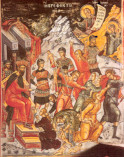 When the Magi from the East failed to return to
Jerusalem from Bethlehem to tell Herod about the newborn King, but at the angel’s command,
returned to their home another way, Herod was as furious as a wild beast, and commanded that all
the children of two years and under in Bethlehem and its surroundings be killed. This terrible
command of the king’s was carried out to the letter. His soldiers cut off some of the
children’s heads with their swords, dashed others on the stones, trampled some of them
underfoot and drowned others with their own hands. The weeping and lamentation of their mothers
rose to heaven: ‘Lamentation and bitter weeping, Rachel weeping for her children’ as
had been prophesied (Jer. 13:15; Matt. 2:18). This evildoing towards the hordes of innocent
children came to pass a year after the birth of Christ, at a time when Herod was trying to find
the divine Child. He sought Zacharias’ son, John, meaning to kill him in the belief that
John was the new king. When Zacharias refused to hand John over, he was killed in the temple on
Herod’s orders. St. Simeon the God-receiver was also killed, and went to God soon after the
Meeting in the Temple. Slaying the children in Bethlehem, Herod then turned on the Jewish elders,
who had revealed to him where the Messiah would be born. He killed Hyrcanes the high priest, and
seventy elders from the Sanhedrin, and thus they who conspired with Herod to kill the new baby
King came to an evil end. After that, Herod killed his own brother and sister and wife, and three
of his sons. Finally, God’s punishment fell on him: he began to tremble, his legs swelled,
the lower part of his body became putrid, and worms came out of the sores. His nose became
blocked and an unbearable stench spread around from it. At the time of his death, he remembered
that there were many captive Jews in prison; so, that they should not rejoice at his death, he
ordered that they all be slaughtered. Thus this terrible ruler lost his inhuman soul and was
given to the devil for eternity.
When the Magi from the East failed to return to
Jerusalem from Bethlehem to tell Herod about the newborn King, but at the angel’s command,
returned to their home another way, Herod was as furious as a wild beast, and commanded that all
the children of two years and under in Bethlehem and its surroundings be killed. This terrible
command of the king’s was carried out to the letter. His soldiers cut off some of the
children’s heads with their swords, dashed others on the stones, trampled some of them
underfoot and drowned others with their own hands. The weeping and lamentation of their mothers
rose to heaven: ‘Lamentation and bitter weeping, Rachel weeping for her children’ as
had been prophesied (Jer. 13:15; Matt. 2:18). This evildoing towards the hordes of innocent
children came to pass a year after the birth of Christ, at a time when Herod was trying to find
the divine Child. He sought Zacharias’ son, John, meaning to kill him in the belief that
John was the new king. When Zacharias refused to hand John over, he was killed in the temple on
Herod’s orders. St. Simeon the God-receiver was also killed, and went to God soon after the
Meeting in the Temple. Slaying the children in Bethlehem, Herod then turned on the Jewish elders,
who had revealed to him where the Messiah would be born. He killed Hyrcanes the high priest, and
seventy elders from the Sanhedrin, and thus they who conspired with Herod to kill the new baby
King came to an evil end. After that, Herod killed his own brother and sister and wife, and three
of his sons. Finally, God’s punishment fell on him: he began to tremble, his legs swelled,
the lower part of his body became putrid, and worms came out of the sores. His nose became
blocked and an unbearable stench spread around from it. At the time of his death, he remembered
that there were many captive Jews in prison; so, that they should not rejoice at his death, he
ordered that they all be slaughtered. Thus this terrible ruler lost his inhuman soul and was
given to the devil for eternity.
2. Our Holy Father Markellos.
From Apameia in Syria, he was abbot of the community of the Unsleeping Ones in Constantinople. He was a clairvoyant, a healer and a great wonder-worker. He spoke with angels, and drove out devils with ease. After his death, he appeared to his close friend, St. Lucian, and told him that he had begged God to take Lucian quickly to His heavenly kingdom. This glorious and holy man entered into rest in 486.
3. Our Holy Fathers Mark the Gravedigger and Theophilus the Weeper.
They were monks of the Kiev Caves. St. Mark had such grace that he could command the dead and they would listen to him. ‘Wait till tomorrow, my brother; your grave isn’t ready yet,’ he is recorded as having said to a dead monk, who was already washed and prepared, and the monk opened his eyes and lived till the following day. Theophilus wept constantly for his sins, catching his tears in a basin. An angel appeared to him at the time of his death, and showed him a very large basin full of tears. These were Theophilus’ tears, that had fallen to the ground or been wiped away with his hand, or had dried on his face. Thus in heaven they know and keep all our tears along with our sufferings and labors and sighs for the sake of our salvation. These holy servants of God entered into rest in the eleventh century, and went to the kingdom of Christ.
FOR CONSIDERATION
A story of the most pure Virgin Mary: she conceived the Lord Jesus on a Friday, and bore Him on the first day of the week. It was on this first day that God said: ‘Let there be light’ (Gen. 1:3), on this day manna fell from heaven, on this day our Lord and Savior was born and was on this day baptized in the Jordan. There lived in Bethlehem at that time the aged Salome, a kinswoman of Joseph and Mary. She could not receive her kinsfolk into her house, but visited them in the shepherd’s cave. When the most holy Virgin stainlessly bore the Lord and Savior, Salome came to visit her, and was amazed that such a young girl should give birth without the aid of a midwife, should swaddle the child herself and still be on her feet. When it was explained to Salome that this birth was of God and not of man, that it was stainless and without pain and that the Virgin Mother remained a virgin after the birth as she was before it, Salome would not believe it, but stretched out her hand to the most holy Virgin’s body, to examine, after the way of a midwife, if this was so. She was punished for her unbelief and impudence: her hand was seized and withered. The old woman was greatly frightened by this, and lamented over her withered hand. Then, as it touched the divine Child, it was restored to its former wholeness, and Salome believed in the virginity of the holy Virgin Mary and the divinity of Christ.
After forty days, when, according to the custom, the most pure Virgin came with the Child to the temple in Jerusalem, Zacharias the high priest stood her in the place reserved for virgins. The Pharisees and priests were amazed at this, and wanted to move her to the place for married women, but Zacharias, gifted with insight, insisted that she was a virgin although she had given birth. Because of this, the Jewish elders hated Zacharias and advised Herod to kill him. Immediately after leaving the temple, the Mother of God and Joseph left Jerusalem for Nazareth, and then for Egypt.
Daily Scripture Readings taken from The Orthodox New Testament, translated and published by Holy Apostles Convent, Buena Vista, Colorado, copyright © 2000, used with permission, all rights reserved.
Daily Prologue Readings taken from The Prologue of Ochrid, by Bishop Nikolai Velimirovic, translated by Mother Maria, published by Lazarica Press, Birmingham, England, copyright © 1985, all rights reserved. Edited by Dormition Skete.