

Daily Devotional
Saturday, January 8, 2028 (NS), December 26, 2027 (OS)
No Fasting.
The Saturday After the Nativity of Christ
Saturday of the Twenty-Ninth Week
The commemoration of the Afterfeast of Nativity, and the Synaxis of our most holy Lady the Theotokos, and Hieromartyr Efthymios, Bishop of Sardis.
Scripture Readings
Special Commemorations
The Saturday After the Nativity of Christ
Epistle
The Reading is from the First Epistle of Saint Paul to Saint Timothy [§ 288]. Child Timothy:
6 11Be pursuing righteousness, piety, faith, love, patience, meekness. 12Keep on fighting the good fight of the faith. Be laying hold of eternal life, to which thou wast also called, and didst confess the good confession before many witnesses. 13I enjoin thee before God Who maketh alive all things, and Christ Jesus Who witnessed the good confession before Pontius Pilate, 14that thou keep the commandment spotless, irreproachable, until the appearance of our Lord Jesus Christ, 15which in His own times He shall reveal the blessed and only Potentate, the King of those who reign as kings and Lord of those who lord as lords, 16the One Who alone hath immortality, dwelling in light unapproachable, Whom not one of mankind did see, nor is able to see, to Whom be honor and everlasting might. Amen.
Gospel
The Reading is from the Holy Gospel according to Saint Matthew [§ 46]. At that time:
12 15Great crowds followed Jesus, and He cured them all. 16And He strictly warned them that they should not make Him manifest, 17in order that what was spoken through Esaias the prophet might be fulfilled, saying, 18“Behold, My Servant Whom I chose, My Beloved, in Whom My soul is well pleased; I will put My Spirit upon Him, and He shall declare judgment to the nations [cf. Is. 42:1]. 19“He shall not strive nor cry out, nor shall anyone hear His voice in the streets [cf. Is. 42:2]. 20“A crushed reed He shall not break to pieces, and a smoking flax He shall not quench, until He should send forth the judgment to victory [cf. Is. 42:3, 4].”
Paschalion — Movable Calendar
Saturday of the Twenty-Ninth Week
Epistle
The Reading is from the Epistle of Saint Paul to the Ephesians [§ mid 220]. Brethren:
2 11Be remembering that once ye, the Gentiles in the flesh—the ones who are called uncircumcision by what is called circumcision in the flesh made by hand— 12that at that time ye were without Christ, having been alienated from the commonwealth of Israel, and strangers from the covenants of promise, having no hope and without God in the world. 13But now in Christ Jesus ye who once were afar off came to be near by the blood of the Christ.
Gospel
The Reading is from the Holy Gospel according to Saint Luke [§ 81]. The Lord said:
16 10“The one who is faithful in that which is least is faithful also in much; and the one who is unjust in that which is least is unjust also in much. 11“If then ye have not been faithful in the unrighteous mammon, who will entrust to you the true wealth? 12“And if in that which is another’s ye have not been faithful, who shall give you that which is your own? 13“Not one household slave is able to serve two lords; for either he will hate the one and love the other, or he will hold to the one and despise the other. Ye are not able to serve God and mammon.” 14And the Pharisees, being lovers of money, were hearing all these things and were turning up their noses at Him. 15And He said to them, “Ye are they who justify yourselves before the face of men, but God knoweth your hearts; for that which is exalted among men is an abomination before the face of God.”
Menaion — Fixed Calendar
The commemoration of the Afterfeast of Nativity, and the Synaxis of our most holy Lady the Theotokos, and Hieromartyr Efthymios, Bishop of Sardis.
Epistle
The Reading is from the Epistle of Saint Paul to the Hebrews [§ 306]. Brethren:
2 11Both He Who sanctifieth and they who are sanctified are all of one; for which cause He is not ashamed to call them brethren, 12saying, “I will announce Thy name to My brethren, in the midst of the church will I hymn Thee [cf. Ps. 21(22):22]”; 13and again, “I will trust in Him [cf. Is. 8:17]”; and again, “Behold, I and the children whom God gave Me [Is. 8:18].” 14Since then the children have partaken of flesh and blood, He also Himself in like manner partook of the same, in order that through death He might bring to nought the one who hath the power of death, that is, the devil, 15and might set free those who through fear of death were all their lifetime subject to bondage. 16For surely He taketh not hold of the nature of the angels, but He taketh hold of the seed of Abraham. 17Wherefore in all things it behooved Him to be made like His brethren, that He might become a merciful and faithful High Priest in things pertaining to God, in order to be made an expiation for the sins of the people. 18For having Himself been tempted in that which He suffered, He is able to help those who are tempted.
Gospel
The Reading is from the Holy Gospel according to Saint Matthew [§ 4].
2 13After the Magi departed, behold, an angel of the Lord appeareth to Joseph in a dream, saying, “Arise, and take the young Child and His Mother, and flee thou into Egypt, and be thou there until I should tell thee; for Herod is about to seek the young Child, to destroy Him.” 14And he arose and took the young Child and His Mother by night and departed into Egypt, 15and was there until the death of Herod, that it might be fulfilled that which was spoken by the Lord through the prophet, saying, “Out of Egypt I called My Son [cf. Hos. 11:1].” 16Then Herod, after he saw that he was mocked by the Magi, was angered exceedingly. And he sent forth and killed all the male children that were in Bethlehem and in all her borders, from two years old and under, according to the time which he inquired carefully from the Magi. 17Then was fulfilled that which was spoken by Jeremias the prophet, saying, 18“A voice in Rama was heard, lamentation and weeping and great mourning, Rachel weeping for her children, and would not be comforted, because they are not [cf. Jer. 38(31):15].” 19But after Herod died, behold, an angel of the Lord appeareth in a dream to Joseph in Egypt, 20saying, “Arise, and take the young Child and His Mother, and go into the land of Israel; for they who sought the soul of the young Child have died.” 21And he arose and took the young Child and His Mother, and came into the land of Israel. 22But after he heard that Archelaus reigned over Judæa instead of Herod his father, he was afraid to go there. And having been divinely warned in a dream, he withdrew into the parts of Galilee. 23And he came and dwelt in a city which is called Nazareth, in order that it might be fulfilled that which was spoken by the prophets, that He shall be called a Nazarene.
Lives of the Saints (Prologue)
January 8th – Civil Calendar
December 26th – Church Calendar
1. The Synaxis of the Most Holy Mother of God.
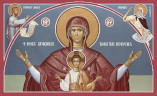 On the second day of Nativity, the Christian Church gives
glory and praise to the most holy Mother of God, who bore our Lord and God and Savior Jesus
Christ. This feast is called a ‘general commemoration’ because, on this day, all the
faithful come together to glorify her, the Mother of God, and to celebrate a triumphant, common
feast in her honor. In Ochrid, it has been the custom from time immemorial that, on the eve of
the second day of Nativity, Vespers has been celebrated only in the church of the Mother of God,
the Chieftain. All the clergy and people there together glorify the most pure Mother of God.
On the second day of Nativity, the Christian Church gives
glory and praise to the most holy Mother of God, who bore our Lord and God and Savior Jesus
Christ. This feast is called a ‘general commemoration’ because, on this day, all the
faithful come together to glorify her, the Mother of God, and to celebrate a triumphant, common
feast in her honor. In Ochrid, it has been the custom from time immemorial that, on the eve of
the second day of Nativity, Vespers has been celebrated only in the church of the Mother of God,
the Chieftain. All the clergy and people there together glorify the most pure Mother of God.
2. Commemoration of the Flight into Egypt.
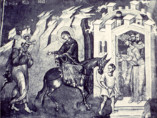 The Magi, astrologers from the East, having worshipped the Lord in
Bethlehem, returned home, at the command of an angel, another way. Herod, that wicked king,
planned to slaughter all the children in Bethlehem, but God saw Herod’s intention and sent
His angel to Joseph. The angel of God spoke to Joseph in a dream and commanded him to take the
Child and His mother and flee to Egypt. Joseph did this. Taking the divine Child and His most
pure Mother, he traveled first to Nazareth (Lk. 2:39), where he set his household affairs in
order and then, taking his son Iakovos with them, went off to Egypt (Matt. 2:14). And so the
words of the prophet: ‘The Lord, riding upon a swift cloud, shall come into Egypt’
(Is. 19:1), were fulfilled. In old Cairo today the cave where the holy travelers lived can be
seen, and in the village of Matarea near Cairo, the tree remains under which the Mother of God
rested with the Lord Jesus, where a miraculous spring of water sprang up under the tree. They
lived in Egypt for several years, and then the travelers returned to Palestine in response to a
command by an angel of God. And so a second prophecy was fulfilled: ‘Out of Egypt have I
called My Son’ (Hosea 11:1). Herod was dead, and on his bloodstained throne sat a worthy
successor in his wicked son Archelaus. Joseph, hearing that Archelaus was reigning in Jerusalem,
returned to Galilee, to his town of Nazareth, where he settled in his own home. Galilee was at
that time ruled by another of Herod’s sons, Herod the Younger, who was somewhat better than
his wicked brother Archelaus.
The Magi, astrologers from the East, having worshipped the Lord in
Bethlehem, returned home, at the command of an angel, another way. Herod, that wicked king,
planned to slaughter all the children in Bethlehem, but God saw Herod’s intention and sent
His angel to Joseph. The angel of God spoke to Joseph in a dream and commanded him to take the
Child and His mother and flee to Egypt. Joseph did this. Taking the divine Child and His most
pure Mother, he traveled first to Nazareth (Lk. 2:39), where he set his household affairs in
order and then, taking his son Iakovos with them, went off to Egypt (Matt. 2:14). And so the
words of the prophet: ‘The Lord, riding upon a swift cloud, shall come into Egypt’
(Is. 19:1), were fulfilled. In old Cairo today the cave where the holy travelers lived can be
seen, and in the village of Matarea near Cairo, the tree remains under which the Mother of God
rested with the Lord Jesus, where a miraculous spring of water sprang up under the tree. They
lived in Egypt for several years, and then the travelers returned to Palestine in response to a
command by an angel of God. And so a second prophecy was fulfilled: ‘Out of Egypt have I
called My Son’ (Hosea 11:1). Herod was dead, and on his bloodstained throne sat a worthy
successor in his wicked son Archelaus. Joseph, hearing that Archelaus was reigning in Jerusalem,
returned to Galilee, to his town of Nazareth, where he settled in his own home. Galilee was at
that time ruled by another of Herod’s sons, Herod the Younger, who was somewhat better than
his wicked brother Archelaus.
3. Our Holy Father Evarestos.
Reading the works of St. Ephraim the Syrian, he abandoned the diplomatic service and became a monk. He was very strict with himself and wore chains on his body, eating dry bread only once a week. He lived for seventy-five years, and went to the Lord in about 825.
4. St. Efthymios the Confessor, Bishop of Sardis.
He took part in the Seventh Ecumenical Council, and spent about thirty years in exile for his veneration of icons. Under the Emperor Theophilus the Iconoclast, he was flogged with bull-whips, during which he died a martyr in 840 and received a wreath of glory in heaven.
5. Our Holy Father Constantine of Synnada.
He was a Jew who came to the Christian Faith. When the Cross was made on his head at his Baptism, it remained visible there till his death in Constantinople in the seventh century. He is famed for his fasting and for his many miracles. He foretold the day of his death seven years in advance.
FOR CONSIDERATION
A story of the divine Christ-Child: When Mary and Joseph were fleeing before Herod’s sword to Egypt, brigands leapt out into the road to steal what they could. Righteous Joseph was leading the donkey on which were some few possessions and on which the most holy Mother of God was riding with her Son at her breast. The robbers seized the donkey, meaning to lead it away. At that moment, one of the robbers went across to the Mother of God to see what she had at her breast. Seeing the Christ-Child, the robber marveled at His beauty and said in wonder: ‘If God were to take human flesh Himself, He would not be more beautiful than this child!’ and the robber told his fellows to take nothing from these travelers. Full of gratitude to this kindly robber, the Mother of God said to him: ‘This Child will reward you richly for having spared Him today’. Thirty-three years later, this same robber was crucified for his wrongdoing on the right of Christ’s cross. His name was Dismas, while the name of the robber on the left was Gestas. Looking at Christ the Lord, crucified in His innocence, Dismas repented of his whole life, and while Gestas reviled the Lord, Dismas rebuked his fellow-robber, saying: ‘He has done no evil’. Dismas is, then, that penitent thief to whom the Lord said: ‘Today shalt thou be with Me in Paradise’ (Lk.23:41-43). Thus the Lord rewarded with Paradise him who had spared Him in childhood.
Daily Scripture Readings taken from The Orthodox New Testament, translated and published by Holy Apostles Convent, Buena Vista, Colorado, copyright © 2000, used with permission, all rights reserved.
Daily Prologue Readings taken from The Prologue of Ochrid, by Bishop Nikolai Velimirovic, translated by Mother Maria, published by Lazarica Press, Birmingham, England, copyright © 1985, all rights reserved. Edited by Dormition Skete.