

Daily Devotional
Wednesday, December 15, 2027 (NS), December 2, 2027 (OS)
Fast Day. No Meat, Fish, Dairy, Eggs, Alcohol or Olive Oil Allowed.
Wednesday of the Twenty-Sixth Week
The commemoration of the Prophet Abbakoum.
Scripture Readings
Paschalion — Movable Calendar
Wednesday of the Twenty-Sixth Week
Epistle
The Reading is from the First Epistle of Saint Paul to Saint Timothy [§ 281].
1 18Child Timothy, this command I commit to thee according to the prophecies which went before concerning thee, that by them thou thyself mayest be waging war for the good campaign, 19having faith and a good conscience, which some have thrust away and suffered shipwreck concerning the faith, 20of whom are Hymenæos and Alexander, whom I delivered up to Satan, in order that they might be disciplined not to blaspheme....
2 8I wish therefore the men to pray in every place, lifting up holy hands, without wrath and doubting. 9In like manner also for the women to adorn themselves in modest dress, with regard for others and sober-mindedness, not with plaitings, or gold, or pearls, or expensive apparel, 10but what becometh women professing reverence of God, by means of good works. 11Let a woman learn in silence, in all subordination. 12And I do not permit a woman to teach, nor to have authority over a man, but to be in silence. 13For Adam first was fashioned, then Eve. 14And Adam was not deceived, but the woman, having been deceived, hath come to be in transgression. 15But she shall be saved through the childbearing, if they abide in faith and love and sanctification with sober-mindedness.
Gospel
The Reading is from the Holy Gospel according to Saint Luke [§ 99]. At that time:
20 1As Jesus taught the people in the temple and preached the Gospel, the chief priests and the scribes, with the elders, suddenly came upon Him, 2and spoke to Him, saying, “Tell us, by what authority doest Thou these things? Or who is the one who gave Thee this authority?” 3And He answered and said to them, “I also will question you for one word, and tell Me: 4“The baptism of John, was it from heaven or from men?” 5And they deduced for themselves, saying, “If we should say, ‘From heaven,’ He will say, ‘Why then did ye not believe him?’ 6“But if we should say, ‘From men,’ all the people will stone us to death; for they have been persuaded that John was a prophet.” 7And they answered that they knew not from what place it was. 8And Jesus said to them, “Neither do I tell you by what authority I am doing these things.”
Menaion — Fixed Calendar
The commemoration of the Prophet Abbakoum.
Epistle
The Reading is from the Epistle of Saint Paul to the Romans [§ 105]. Brethren:
11 2God did not thrust away His people whom He foreknew. Or do ye not know what saith the Scripture in the case of Elias, how he pleadeth with God against Israel, saying, 3“Lord, they killed Thy prophets and dug down Thine altars, and I am left alone, and they seek my life [cf. 3 Kgs. (1 Kgs.) 19:10, 14]”? 4But what saith the divine answer of God to him? “I left to Myself seven thousand men, who bowed not a knee to Baal [cf. 3 Kgs. (1 Kgs.) 19:18].” 5So then, also in the present time there hath come to be a remnant according to an election of grace. 6And if by grace, it is no longer of works; otherwise grace no longer becometh grace. But if it is of works, it is no longer grace; otherwise the work is no longer work. 7What then? What Israel seeketh for, this it did not obtain; but the election obtained it, and the rest were hardened. 8Even as it hath been written: “God gave them a spirit of stupefaction, eyes so as not to see, and ears so as not to hear, unto this day [cf. Is. 29:10].” 9And David saith, “Let their table be for a snare, and for a trap, and for a stumbling block, and for a recompense to them [cf. Ps. 68(69):27]. 10“Let their eyes be darkened, so as not to see, and bow down their back continually [Ps. 68(69):28].” 11I say then, they did not stumble that they should fall, did they? May it not be! But by their falling away, salvation is come to the nations, so as to provoke them to jealousy. 12Now if their falling away is the wealth of the world, and their loss the wealth of the nations, how much more their fullness?
Gospel
No reading given.
Lives of the Saints (Prologue)
December 15th – Civil Calendar
December 2nd – Church Calendar
1. The Holy Prophet Abbakum (Habakkuk).
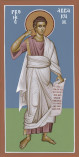 The son of Sapnat, of the tribe of Simeon, he prophesied six
hundred years before Christ, in the time of King Manasseh, and foretold the devastation of
Jerusalem. When Nebuchadnezzar, King of Babylon, attacked Jerusalem, Abbakum went into the land
of the Ishmaelites, whence he returned to Jerusalem and made his living working on the land. One
day, when he was carrying lunch to the workers in the fields, an angel of the Lord suddenly
appeared to him and said: ‘Go, carry the meal that thou hast into Babylon, unto Daniel who
is in the lion’s den.’ Abbakum replied: ‘Lord, I never saw Babylon, neither do
I know where the den is’ (Daniel 14:33 in the Greek text). Then the angel seized him by the
hair and carried him straight to Babylon, over an immense distance, to the lion’s den where
Daniel had been cast by King Cyrus because he would not worship idols. ‘O Daniel,
Daniel,’ cried Abbakum, ‘take the dinner which God hath sent thee!’ And Daniel
took it and ate. Then the angel of God again took hold of Abbakum and carried him back to his
field in Judea. Abbakum preached and prophesied about the liberation of Jerusalem and the coming
of Christ. He entered into rest in great old age and was buried at Keilah. His relics were
discovered during the reign of Theodosios the Great.
The son of Sapnat, of the tribe of Simeon, he prophesied six
hundred years before Christ, in the time of King Manasseh, and foretold the devastation of
Jerusalem. When Nebuchadnezzar, King of Babylon, attacked Jerusalem, Abbakum went into the land
of the Ishmaelites, whence he returned to Jerusalem and made his living working on the land. One
day, when he was carrying lunch to the workers in the fields, an angel of the Lord suddenly
appeared to him and said: ‘Go, carry the meal that thou hast into Babylon, unto Daniel who
is in the lion’s den.’ Abbakum replied: ‘Lord, I never saw Babylon, neither do
I know where the den is’ (Daniel 14:33 in the Greek text). Then the angel seized him by the
hair and carried him straight to Babylon, over an immense distance, to the lion’s den where
Daniel had been cast by King Cyrus because he would not worship idols. ‘O Daniel,
Daniel,’ cried Abbakum, ‘take the dinner which God hath sent thee!’ And Daniel
took it and ate. Then the angel of God again took hold of Abbakum and carried him back to his
field in Judea. Abbakum preached and prophesied about the liberation of Jerusalem and the coming
of Christ. He entered into rest in great old age and was buried at Keilah. His relics were
discovered during the reign of Theodosios the Great.
2. The Holy Martyr Myrope.
Myrope was born in Ephesus of Christian parents. After the death of her father, she went to the island of Chios with her mother, and there suffered for Christ. The passion of this holy virgin took place soon after the passion and death of the soldier-martyr Isidore (May 14th). When the torturers had beheaded Isidore, the courageous Myrope took the body away secretly and buried it in a special place. The wicked prince Numerian heard that the martyr’s body had been stolen, and threatened to execute the guards. Hearing that innocent people were to suffer for her act, blessed Myrope came before the authorities and confessed that it was she who had taken the martyr’s body and buried it. On the prince’s orders, Christ’s holy virgin was savagely beaten, and cast into prison covered with wounds. But the Lord did not leave His martyr comfortless. A heavenly light illumined the prison in the dead of night, and many angels, with St. Isidore in their midst, appeared to her. ‘Peace to thee, Myrope,’ St. Isidore said to her, ‘thy prayer has ascended to God, and thou shalt soon be with us and receive the crown prepared for thee’. The holy martyr was filled with joy, and at that moment surrendered her soul into God’s hands. A sweet fragrance came forth from her body and filled the whole prison. One of the guards who witnessed all this was moved to belief in Christ and was baptized, and soon thereafter suffered a martyr’s death. St. Myrope entered into eternity in the year 251.
3. St. Uroš, King of Serbia.
The son of King Dušan, he ruled during the difficult time of the fall of the Kingdom of Serbia. Humble, pious and gentle, he refused to attempt to restrain the power of the powerful nobles by force. Amongst these was Vukašin, who brought about his death. Good King Uroš suffered a martyr’s death on December 2nd, 1367, at the age of thirty-one. Killed by men, he was glorified by God. His wonder-working relics were preserved in the monastery of Jazak in the Fruška Gora, whence they were taken to Belgrade in 1942, during the Second World War, and placed in the Cathedral beside the bodies of Prince Lazar and Despot Stefan Štiljanović. During the reign of this benevolent king, the monastery of St. Naum was built beside Lake Ochrid by one of Uroš’s nobles, Gregory (Grgur).
4. Our Holy Father Athanasius, the Recluse of the Kiev Caves.
After a long life of asceticism, this holy man died and was washed, attired and prepared for burial. He lay dead for two days, then suddenly returned to life. When they came to bury him, they found him sitting up and weeping. He shut himself in his cell and lived a further twelve years on bread and water. He entered into rest in the Lord in 1176.
5. St. Jesse, Bishop of Tsiklan.
One of the thirteen Syrian fathers (May 7th), he was a great wonder-worker. He changed the course of a distant river by his prayers, and caused it to flow close to the city of Tsiklan. His relics are preserved in the church dedicated to him in that Syrian city.
FOR CONSIDERATION
‘Who has ever come with tidings of the other world?’ This is a frequent question on the lips of unbelievers. One should reply: ‘Repent of your sins if you wish to find out; make yourselves worthy, and you will see.’ The Prophet Abbakum journeyed with an angel; St. Myrope saw a host of angels, with St. Isidore the Martyr among them. St. Athanasius of the Caves was dead to the world for two days and alive only in the next. Upon the return of his soul to his body, they all gathered round him, asking him: ‘How have you come back to life? What have you seen? What have you heard?’ He would say nothing about it, being deeply amazed at what he had seen in the other world, and would only say: ‘Save yourselves!’ When many of them pressed him hard to say what he had seen in the other world after his death, he replied: ‘If I should tell you, you would not believe me or want to listen to me.’ When they urged him yet further, he said: ‘Repent every moment, and pray to the Lord Jesus Christ and to His most pure Mother.’
Even in our own time, cases of seeming death occur. The visions and reports of those who have seemed to die and have then returned to life are not contradictory, but complement and augment one another. For example: every person who ‘dies’ sees some part of that other world that is vast, immeasurably larger than this world. Many see their long-dead kinsfolk and talk with them—this being quite a common occurrence. In 1926, in the village of Vevčani, Meletije P. was on his deathbed. He was talking with his children who had died twenty years earlier. When his living relatives said to him: ‘You’re rambling!’ he replied: ‘I’m not; I’m talking with them just as I’m talking with you, and I can see them just as clearly as I can see you!’
Daily Scripture Readings taken from The Orthodox New Testament, translated and published by Holy Apostles Convent, Buena Vista, Colorado, copyright © 2000, used with permission, all rights reserved.
Daily Prologue Readings taken from The Prologue of Ochrid, by Bishop Nikolai Velimirovic, translated by Mother Maria, published by Lazarica Press, Birmingham, England, copyright © 1985, all rights reserved. Edited by Dormition Skete.