

Daily Devotional
Thursday, December 9, 2027 (NS), November 26, 2027 (OS)
Fast Day, but Fish, Wine and Olive Oil Allowed.
Thursday of the Twenty-Fifth Week
The commemoration of Alypios the Stylite of Adrianopolis, and the repose of our holy father among the saints, Innocent, first Bishop of Irkutsk.
Scripture Readings
Paschalion — Movable Calendar
Thursday of the Twenty-Fifth Week
Epistle
The Reading is from the Second Epistle of Saint Paul to the Thessalonians [§ 276]. Brethren:
2 13We are bound to give thanks to God always concerning you, brethren beloved by the Lord, because God chose you for Himself from the beginning to salvation in sanctification of the Spirit and belief of the truth, 14to which He called you through our Gospel, to acquisition of the glory of our Lord Jesus Christ. 15So then, brethren, be standing firm and holding fast the traditions which ye were taught, whether by word or by our epistle. 16Now may our Lord Jesus Christ Himself, and our God and Father, the One Who loved us and gave everlasting consolation and good hope by grace, 17comfort your hearts and establish you in every good word and work.
3 1For the rest, brethren, be praying for us, that the word of the Lord may run and be glorified, even as also it is with you, 2and that we might be delivered from wayward and evil men; for not all have the faith. 3But faithful is the Lord, Who shall establish you and guard you from the evil one. 4And we trust in the Lord as to you, that ye both do and will do what we command you. 5And may the Lord direct your hearts into the love of God, and into the patience of the Christ.
Gospel
The Reading is from the Holy Gospel according to Saint Luke [§ 92]. At that time:
18 31Jesus, after He took along His twelve disciples, said to them, “Behold, we are going up to Jerusalem, and all things which have been written by the prophets regarding the Son of Man shall be accomplished. 32“For He shall be delivered up to the Gentiles, and shall be mocked and insulted and spat upon. 33“And after they scourge Him, they shall kill Him. And on the third day He shall raise Himself.” 34And they understood none of these things. And this saying was hidden from them, and they were not perceiving the things being said.
Menaion — Fixed Calendar
The commemoration of Alypios the Stylite of Adrianopolis, and the repose of our holy father among the saints, Innocent, first Bishop of Irkutsk.
Epistle
For the Stylite:
The Reading is from the Second Epistle of Saint Paul to the Corinthians [§§ 176, 177]. Brethren:
4 6It is God Who said, “Let there be light [cf. Gen. 1:3]” to shine out of darkness, Who shined in our hearts, for the illumination of the knowledge of the glory of God in the face of Jesus Christ.
7But we have this treasure in earthen vessels, that the preeminence of the power may be of God, and not from us. 8In every way we are afflicted, but not straitened; we are at a loss, but not utterly at a loss; 9persecuted, but not abandoned; cast down, but not destroyed— 10always bearing about in the body the dying of the Lord Jesus, that the life also of Jesus might be made manifest in our body. 11For we, the living, are always being delivered to death on account of Jesus, that also the life of Jesus might be made manifest in our mortal flesh. 12So that indeed death energizeth itself in us, but life in you. 13But having the same spirit of faith, according to that which hath been written: “I believed, wherefore I spoke [Ps. 115(116):1(10)],” we also believe, and therefore speak, 14knowing that the One Who raised up the Lord Jesus shall raise up us also through Jesus, and shall present us with you. 15For all things are for your sakes, that the grace, which abounded through the majority, might cause the giving of thanks to abound more to the glory of God.
For the Hierarch:
The Reading is from the Epistle of Saint Paul to the Hebrews [§ 318]. Brethren:
7 26Such a High Priest was fitting for us: holy, guileless, undefiled, Who hath been separated from the sinners and hath become higher than the heavens, 27Who hath no need daily, even as the high priests, to offer up sacrifices, first for his own sins, then for those of the people; for this He did once for all after He offered up Himself. 28For the law appointeth men high priests who have weakness; but the word of the oath, which is after the law, appointeth the Son, Who hath been perfected forever.
8 1Now in reference to the things being spoken of, the chief point is: We have such a High Priest, Who sat down on the right of the throne of the majesty in the heavens, 2a Liturgist of the holies and of the tabernacle, the true one, which the Lord pitched, and not man.
Gospel
The Reading is from the Holy Gospel according to Saint John [§ 36]. The Lord said to the Jews who had come to Him:
10 9“I am the door; by Me if anyone should enter, he shall be saved, and shall go in and go out and find pasture. 10“The thief cometh not, except that he might steal, and slay, and destroy. I came that they may have life, and may have it abundantly. 11“I am the good shepherd. The good shepherd layeth down his life for the sheep. 12“But the hireling, who indeed is not a shepherd, whose own the sheep are not, seeth the wolf coming, and leaveth the sheep and fleeth; and the wolf seizeth them and scattereth the sheep. 13“Now the hireling fleeth, because he is a hireling and careth not about the sheep. 14“I am the good shepherd; and I know those that are Mine, and am known of those that are Mine. 15“Even as the Father knoweth Me, I also know the Father; and I lay down My life for the sheep. 16“And I have other sheep which are not of this fold; them also it is needful for Me to bring, and they shall hear My voice; and there shall be one flock and one Shepherd.”
Lives of the Saints (Prologue)
December 9th – Civil Calendar
November 26th – Church Calendar
1. Our Holy Father Alypios the Stylite.
Born in Hadrianopolis, a city in Paphlagonia, he was from his youth dedicated to the service of God. As a deacon, he served in the church in that city with Bishop Theodore. But, desiring a solitary life of prayer and meditation, Alypios withdrew to a Greek cemetery outside the city, from which people fled as from a place of terror, as demonic visions had been seen there. Here he erected a cross, and built a church in honor of St. Ephemia, who had appeared to him in a dream. Near the church, he built a high pillar, climbed up onto it and spent fifty-three years there in fasting and prayer. Neither the mockery of men nor the evil demons could drive him away or shake his purpose. This saint endured endless assaults from the demons. They not only tried to terrify him with demonic apparitions, but also stoned him and gave him no peace day nor night for a long time. But Alypios courageously defended himself against this diabolical power with the sign of the Cross and the name of Jesus. Finally, the vanquished demons left him and fled, and men began to revere him and to come to him for his prayers, comfort, teaching and healing. Two monasteries were built beside his pillar, on one side for men and on the other for women. His mother and sisters lived in the women’s monastery. St. Alypios guided the monks and nuns from his pillar by word and example, and shone like the sun in the sky for them all, showing them the way of salvation. This man of God had such grace that he was often bathed in heavenly light, and a pillar of this light stretched above him to heaven. Alypios was a great and mighty wonder-worker, both in his lifetime and after his death. Living for a hundred years, he entered into rest in the year 640, in the time of Emperor Herakleios. Of his holy relics, the head is preserved in the monastery of Koutloumousiou on the Holy Mountain.
2. Our Holy Father Iakovos the Solitary.
A Syrian, he was a disciple of St. Maron (Feb. 14th) and a contemporary of St. Simeon the Stylite. He lived in asceticism under the open sky and fed on soaked lentils. He performed great wonders, even raising the dead in the name of Christ. The Emperor Leo asked him for his thoughts on the Council of Chalcedon. He entered peacefully into rest in the year 457.
3. Our Holy Father Stylianos.
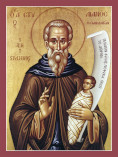 From Paphlagonia, he was a fellow-countryman and
contemporary of St. Alypios. He had a great love for the Lord Jesus, and because of this,
gave himself to strict asceticism. He rejected all things, only to have an undivided love
for his Lord. At the time of his death, an angel appeared to take his soul, and his face
became radiant like the sun. He was a great wonder-worker both before and after his death,
and was of special help to sick children and childless parents. From Paphlagonia, he was a fellow-countryman and
contemporary of St. Alypios. He had a great love for the Lord Jesus, and because of this,
gave himself to strict asceticism. He rejected all things, only to have an undivided love
for his Lord. At the time of his death, an angel appeared to take his soul, and his face
became radiant like the sun. He was a great wonder-worker both before and after his death,
and was of special help to sick children and childless parents.
|
4. Our Holy Father Nikon, the Preacher of Repentance.
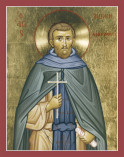 He was born in Armenia. Drawn by
the Lord’s words: ‘He who forsakes father or mother will receive a
hundred-fold, and inherit eternal life’ (Matt. 19:29), Nikon indeed left all for the
sake of Christ and went to a monastery, where he became a monk. When he had become
perfected in all the virtues, he left the monastery and went to preach the Gospel to the
people. He incessantly cried: ‘Repent!’ and thus became known as ‘the
Preacher of Repentance’. As a preacher, he covered the whole of Anatolia and the
Peloponnese, performing many wonders in the name of Christ. He went peacefully to his
beloved Lord in Sparta in 998. He was born in Armenia. Drawn by
the Lord’s words: ‘He who forsakes father or mother will receive a
hundred-fold, and inherit eternal life’ (Matt. 19:29), Nikon indeed left all for the
sake of Christ and went to a monastery, where he became a monk. When he had become
perfected in all the virtues, he left the monastery and went to preach the Gospel to the
people. He incessantly cried: ‘Repent!’ and thus became known as ‘the
Preacher of Repentance’. As a preacher, he covered the whole of Anatolia and the
Peloponnese, performing many wonders in the name of Christ. He went peacefully to his
beloved Lord in Sparta in 998.
|
5. St. Innocent (Innokenty) of Irkutsk.
He died in 1731, and his wonder-working relics were discovered in 1804.
FOR CONSIDERATION
A tale of the elder Barlaam to Ioasaph: In a certain town there was a local custom, namely the choosing as king a stranger who did not know their laws and customs. When they had crowned him king, they arrayed him in exquisite and costly robes, fed him sumptuously and surrounded him with every luxury. When a year had passed, they deposed their king, stripped him of all his goods and his royal robes and drove him, completely naked, off to a distant island, where he had neither bread nor roof nor companionship, and where, in want and abasement, he would end his days. The citizens would then choose another king, also a stranger and also for only a year, then a third, then a fourth and so on. It came to pass at one time that they chose a very wise and prudent man. He discovered from his servants what happened to the king of the town at the end of a year and therefore, during the course of the year, zealously collected food and goods and all sorts of everyday necessities together on the island. When the year had passed, and he was stripped naked and cast onto the island, he found himself in the midst of an enormous quantity of food, silver, gold and precious stones, and continued to live there in an even better way than he had as king of the town. The interpretation is this: the town represents the world; the inhabitants represent the evil spirits; the foolish and wise kings are men. The foolish think only of their comfort in this life, counting it eternal and losing all in the end in death, going naked of all good works to hell. The wise, on the contrary, do many good works, that they then send, like goods, into the other world to await them there, and where they reign in greater splendor and beauty than they did on earth.
Daily Scripture Readings taken from The Orthodox New Testament, translated and published by Holy Apostles Convent, Buena Vista, Colorado, copyright © 2000, used with permission, all rights reserved.
Daily Prologue Readings taken from The Prologue of Ochrid, by Bishop Nikolai Velimirovic, translated by Mother Maria, published by Lazarica Press, Birmingham, England, copyright © 1985, all rights reserved. Edited by Dormition Skete.