

Daily Devotional
Thursday, November 25, 2027 (NS), November 12, 2027 (OS)
No Fasting.
Thursday of the Twenty-Third Week
The commemoration of our holy father among the saints, John the Merciful, Patriarch of Alexandria.
Scripture Readings
Paschalion — Movable Calendar
Thursday of the Twenty-Third Week
Epistle
The Reading is from the First Epistle of Saint Paul to the Thessalonians [§ 265].
2 9Brethren, ye remember our toil and travail; for laboring night and day in order not to burden any of you, we proclaimed to you the Gospel of God. 10Ye are witnesses, and God also, how holily and justly and blamelessly we were with you who believe; 11even as ye know how I was to each one of you, as a father doth his own children, exhorting, and comforting, 12and testifying to you to walk worthily of God Who calleth you to His own kingdom and glory. 13For this we also give thanks to God unceasingly, that, after ye received word of the report of God from us, ye received it not as a word of men, but even as it is truly, God’s word, which also energizeth itself in you who believe. 14For ye, brethren, became imitators of the churches of God which are in Judæa in Christ Jesus. For ye also suffered the same things by your own countrymen, even as they have by the Jews.
Gospel
The Reading is from the Holy Gospel according to Saint Luke [§ 70]. At that time:
13 1There were present at that very season some that bore tidings to Jesus about the Galilæans whose blood Pilate mingled with their sacrifices. 2And Jesus answered and said to them, “Suppose ye that these Galilæans came to be sinners beyond all the Galilæans, because they have suffered such things? 3“By no means, I say to you; but unless ye be repenting, ye shall all perish in like manner. 4“Or those eighteen upon whom the tower in Siloam fell and killed them, suppose ye that these came to be debtors beyond all men who dwell in Jerusalem? 5“By no means, I say to you; but unless ye be repenting, ye shall all perish in like manner.” 6Also He was saying this parable: “A certain man had a fig tree which was planted in his vineyard; and he came seeking fruit on it, and did not find any. 7“And he said to the vinedresser, ‘Behold, three years I come seeking fruit on this fig tree and do not find any. Cut it out. Why is it also rendering the ground useless?’ 8“And answering, he saith to him, ‘Lord, let it alone also this year, until I dig about it, and put manure around it. 9“‘And if indeed it should produce fruit—well; but if not, in the future thou shalt cut it out.’”
Menaion — Fixed Calendar
The commemoration of our holy father among the saints, John the Merciful, Patriarch of Alexandria.
Epistle
The Reading is from the Second Epistle of Saint Paul to the Corinthians [§ 188]. Brethren:
9 6The one who soweth sparingly shall also reap sparingly; and the one who soweth with blessing shall also reap with blessing. 7Let each give even as he purposeth in his heart, not out of sorrow or out of necessity; for God loveth a cheerful giver. 8And God is able to make all grace abound toward you, that ye, always having all self-sufficiency in everything, may abound to every good work, 9even as it hath been written: “He dispersed, he gave to the poor; his righteousness abideth forever [Ps. 111(112):9].” 10Now the One Who supplieth seed to the sower and bread for eating, may He provide and multiply your seed for sowing, and increase the fruits of your righteousness, 11being enriched in everything to all open-handedness, which worketh out through us giving of thanks to God.
for Sl. usage, see [Heb. 4:14-5:6].
Gospel
The Reading is from the Holy Gospel according to Saint Matthew [§ 11]. The Lord said to His disciples:
5 14“Ye are the light of the world. A city situated on the top of a mountain cannot be hid. 15“Nor do they light a lamp and put it under the bushel, but upon the lampstand, and it giveth light to all those in the house. 16“Thus, let your light shine before men, that they might see your good works, and might glorify your Father Who is in the heavens.
17“Do not begin to think that I came to abolish the law or the prophets; I came not to abolish, but to fulfill. 18“For verily I say to you, until the heaven and the earth shall have passed away, one iota or one tittle in no wise shall pass away from the law, until all shall have taken place. 19“Whosoever then shall break one of the least of these commandments, and shall teach men so, he shall be called least in the kingdom of the heavens; but whosoever shall do and teach them, this one shall be called great in the kingdom of the heavens.”
For Sl. usage, see [Lk. 6:17-23].
Lives of the Saints (Prologue)
November 25th – Civil Calendar
November 12th – Church Calendar
1. St. John the Merciful, Patriarch of Alexandria.
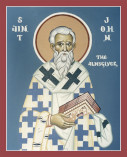 He was born on the island of Cyprus of a princely family. His
father, Epiphanios, being the governor, brought him up from childhood as a true Christian. Under
pressure from his parents, he married and had children. But, by the providence of God, both his
wife and children went from this world to the next. Famed for his compassion and devotion, John
was chosen as Patriarch of Alexandria in the time of the Emperor Herakleios. He governed the
Church in Alexandria for ten years as a true pastor, guarding it from pagans and heretics, and
was a model of meekness, compassion and love for his fellow men. ‘If you seek
nobility,’ he said, ‘seek it not in blood but in virtue, for in virtue lies true
nobility.’ All the saints are distinguished by compassion, but St. John was utterly
dedicated to this great virtue. Celebrating the Liturgy one day, the words of Christ: ‘If
thou bring thy gift to the altar, and there remember that thy brother hath aught against
thee...’ (Matt. 5:23), came into the patriarch’s mind, and he remembered that one of
the clergy in the church there had a grudge against him. He left the holy gifts, went up to the
priest, fell before his feet and begged his forgiveness. As soon as he had made his peace with
that man, he returned to the Table of Preparation. Another time, on the way to the Church of Ss.
Cyrus and John, it happened that he was met by a poor widow, who started speaking to him of her
poverty. The patriarch’s companions were bored by the woman’s lengthy lamenting, and
urged the bishop to hurry to the church for the service, and listen to the woman when it was
over. St. John replied: ‘And how will God obey me, if I don’t obey Him?’ and he
would not move from the spot until he had heard the widow out.
He was born on the island of Cyprus of a princely family. His
father, Epiphanios, being the governor, brought him up from childhood as a true Christian. Under
pressure from his parents, he married and had children. But, by the providence of God, both his
wife and children went from this world to the next. Famed for his compassion and devotion, John
was chosen as Patriarch of Alexandria in the time of the Emperor Herakleios. He governed the
Church in Alexandria for ten years as a true pastor, guarding it from pagans and heretics, and
was a model of meekness, compassion and love for his fellow men. ‘If you seek
nobility,’ he said, ‘seek it not in blood but in virtue, for in virtue lies true
nobility.’ All the saints are distinguished by compassion, but St. John was utterly
dedicated to this great virtue. Celebrating the Liturgy one day, the words of Christ: ‘If
thou bring thy gift to the altar, and there remember that thy brother hath aught against
thee...’ (Matt. 5:23), came into the patriarch’s mind, and he remembered that one of
the clergy in the church there had a grudge against him. He left the holy gifts, went up to the
priest, fell before his feet and begged his forgiveness. As soon as he had made his peace with
that man, he returned to the Table of Preparation. Another time, on the way to the Church of Ss.
Cyrus and John, it happened that he was met by a poor widow, who started speaking to him of her
poverty. The patriarch’s companions were bored by the woman’s lengthy lamenting, and
urged the bishop to hurry to the church for the service, and listen to the woman when it was
over. St. John replied: ‘And how will God obey me, if I don’t obey Him?’ and he
would not move from the spot until he had heard the widow out.
Another thing the blessed man taught and insisted upon with all was never on any occasion whatsoever to associate with heretics, and above all, never to take the holy Communion with them, ‘even if,’ the blessed man said, ‘you remain without communicating all your life, if through stress of circumstances you cannot find a community of the Catholic Church. For if, having legally married a wife in this world of the flesh, we are forbidden by God and by the laws to desert her and be united to another woman, even though we have to spend a long time separated from her in a distant country, and shall incur punishment if we violate our vows, how then shall we, who have been joined to God through the Orthodox Faith and the Catholic Church—as the apostle says: “I espoused you to one husband that I might present you as a pure virgin to Christ [2 Cor 11:2]”—how shall we escape from sharing in that punishment which in the world to come awaits heretics, if we defile the Orthodox and holy Faith by adulterous communion with heretics?’ For ‘communion,’ he said, ‘has been so called because he who has “communion” has things in common and agrees with those with whom he has “communion.”’
When the Persians invaded Egypt, Patriarch John took ship to flee from the assault. He fell ill on the voyage, and arriving in Cyprus, died at his birthplace in 620, entering into the immortal kingdom of his Lord. His wonder-working relics were first taken to Constantinople, then to Budapest and finally came to rest in Presburg.
2. The Holy Prophet Ahijah (Achia), from Siloam.
He prophesied a thousand years before Christ, and foretold to Jeroboam, Solomon’s servant, that he would reign over ten of the tribes of Israel (I Kings 11:29).
3. Our Holy Father Nilus of Sinai.
He was at first a prefect in the capital, Constantinople. A married man, he had a son and a daughter. Seeing the vice-ridden life of the capital, he and his wife agreed to withdraw from the world. This they did. His wife and daughter went to a women’s monastery in Egypt, and Nilus and his son Theodulus went to Mount Sinai. St. Nilus lived for sixty years in asceticism on Sinai, writing beautiful books on the spiritual life. He entered peacefully into rest in about 450, at the age of eighty, and went to the blessed life of heaven. These holy words are his: ‘Physical passions have their origin in physical desires, and against them, restraint is necessary; but spiritual passions originate in spiritual desires, and against them prayer is required.’
4. Our Holy Father Nilus, the Outpourer of Myrrh.
He was born in the Morea. As a hieromonk, he went with his uncle to the Holy Mountain and lived as a solitary in a barren place called ‘the Holy Rocks’. When he entered into rest, myrrh flowed from his body in such abundance that it ran from the top of the hill right down to the sea. This wonder-working myrrh drew the sick from all sides. One of his disciples was disturbed by the press of visitors, and complained in his prayers to his spiritual father, and the flow of myrrh stopped on the instant. St. Nilus lived in asceticism utterly in the spirit of the early fathers. He entered into rest in the seventeenth century.
FOR CONSIDERATION
The time of their death and passing from this life has in the past been revealed to many holy men and women. This is a great gift from heaven, but having no expectation of this gift, we unworthy ones must repent daily to prepare ourselves for our departure. One can flee from men, but not from God. When St. John the Merciful fled from the Persians in Egypt, a man bathed in light, with a golden scepter in his hand, appeared to him in the ship and said to him: ‘The King of kings is calling you to Himself.’ John understood these words and began to prepare for death, which quickly came to him.
The holy King Stefan of Dečani was often visited in visions by his beloved St. Nicholas, who appeared to him before his death and said to him: ‘Stefan, prepare for your departure; you will soon come before God.’
In their compassion, these two saints were very alike. Of the immeasurable goods that John had at his disposal as Patriarch of the Alexandrian Church, he had, at the time of his death, only a few pence, and he left instructions that these be given to the poor. When Stefan was in the Pantocrator monastery in Constantinople, a generous Serbian noble sent him a substantial sum of money. ‘I am grateful to the good gentleman for his love,’ Stefan replied to those who brought it, ‘but it would have given me more joy if the money that he intended for me had been given to the poor.’
Daily Scripture Readings taken from The Orthodox New Testament, translated and published by Holy Apostles Convent, Buena Vista, Colorado, copyright © 2000, used with permission, all rights reserved.
Daily Prologue Readings taken from The Prologue of Ochrid, by Bishop Nikolai Velimirovic, translated by Mother Maria, published by Lazarica Press, Birmingham, England, copyright © 1985, all rights reserved. Edited by Dormition Skete.