

Daily Devotional
Sunday, October 24, 2027 (NS), October 11, 2027 (OS)
No Fasting.
The Sunday of the Holy Fathers
According to Gk. usage, if the 11th of October should fall on Sunday, we commemorate the service of The Holy Fathers of the Seventh Œcumenical Synod. If not, we commemorate the service on the following Sunday. According Sl. usage, if the 11th of October should fall on Wednesday or earlier, the service is commemorated on the preceding Sunday. If the 11th should fall on Thursday or later, then the service is commemorated on the following Sunday.
Third Period
Sunday of the Eighteenth Week
Mode One — Seventh Eothinon
The commemoration of the holy Apostle Philip, one of the seven deacons.
Scripture Readings
Special Commemorations
The Sunday of the Holy Fathers
According to Gk. usage, if the 11th of October should fall on Sunday, we commemorate the service of The Holy Fathers of the Seventh Œcumenical Synod. If not, we commemorate the service on the following Sunday. According Sl. usage, if the 11th of October should fall on Wednesday or earlier, the service is commemorated on the preceding Sunday. If the 11th should fall on Thursday or later, then the service is commemorated on the following Sunday.
Epistle
The Reading is from the Epistle of Saint Paul to Saint Titus [§ mid 302 A]: Child Titus:
3 8Faithful is the word. And concerning these things I desire thee to be affirming, in order that they who have believed God may give heed to set before themselves good works. These things are good and profitable to men. 9But be shunning foolish inquiries, and genealogies, and strifes, and contentions relating to points of the law; for they are unprofitable and vain. 10A heretical man, after a first and second admonition, be rejecting, 11knowing that such a one hath been perverted, and sinneth, being self-condemned.
12Whenever I should send Artemas to thee, or Tychikos, hasten to come to me in Nicopolis, for I have decided to winter there. 13Send forth with haste Zenas the lawyer and Apollos, in order that nothing may be lacking to them. 14And let ours also be learning to set before themselves good works for necessary uses, that they may not be unfruitful.
15All those with me salute thee. Greet those who love us in faith.
Grace be with you all. Amen.
For Sl. usage, see [Heb. 13:7-16].
Gospel
The Reading is from the Holy Gospel according to Saint Matthew [§ 11]. The Lord said to His disciples:
5 14“Ye are the light of the world. A city situated on the top of a mountain cannot be hid. 15“Nor do they light a lamp and put it under the bushel, but upon the lampstand, and it giveth light to all those in the house. 16“Thus, let your light shine before men, that they might see your good works, and might glorify your Father Who is in the heavens.
17“Do not begin to think that I came to abolish the law or the prophets; I came not to abolish, but to fulfill. 18“For verily I say to you, until the heaven and the earth shall have passed away, one iota or one tittle in no wise shall pass away from the law, until all shall have taken place. 19“Whosoever then shall break one of the least of these commandments, and shall teach men so, he shall be called least in the kingdom of the heavens; but whosoever shall do and teach them, this one shall be called great in the kingdom of the heavens.”
for Sl. usage, see [Jn. 17:1-13].
Paschalion — Movable Calendar
Third Period
Sunday of the Eighteenth Week
Mode One — Seventh Eothinon
Epistle
The Reading is from the Second Epistle of Saint Paul to the Corinthians [§ 188]. Brethren:
9 6The one who soweth sparingly shall also reap sparingly; and the one who soweth with blessing shall also reap with blessing. 7Let each give even as he purposeth in his heart, not out of sorrow or out of necessity; for God loveth a cheerful giver. 8And God is able to make all grace abound toward you, that ye, always having all self-sufficiency in everything, may abound to every good work, 9even as it hath been written: “He dispersed, he gave to the poor; his righteousness abideth forever [Ps. 111(112):9].” 10Now the One Who supplieth seed to the sower and bread for eating, may He provide and multiply your seed for sowing, and increase the fruits of your righteousness, 11being enriched in everything to all open-handedness, which worketh out through us giving of thanks to God.
Gospel
The Reading is from the Holy Gospel according to Saint Luke [§ 35]. The Lord said this parable:
8 5“The one who soweth went out to sow his seed. And as he was sowing, some seed indeed fell by the wayside; and it was trampled down, and the birds of the heaven devoured it. 6“And other seed fell upon the rock; and having sprung up, it was dried up, because it had no moisture. 7“And other seed fell in the midst of the thorns; and the thorns, having sprung up together, choked it. 8“And other seed fell upon the good ground; and having sprung up, it produced fruit a hundredfold.” And after He said these things, He cried, “The one who hath ears to hear, let him hear.” 9And His disciples were asking Him, saying, “What may this parable be?” 10And He said, “To you it hath been given to know the mysteries of the kingdom of God, but to the rest in parables, that ‘seeing they see not, and hearing they understand not [cf. Is. 6:9].’ 11“Now the parable is this: The seed is the word of God. 12“And those by the wayside are the ones who hear; then the devil cometh and taketh away the word from their heart, lest after they believe they should be saved. 13“And those upon the rock are the ones who, whenever they hear, receive the word with joy; and yet these, who for a time believe, have no root, and in time of temptation withdraw. 14“And that which fell into the thorns, these are the ones who heard, and while they are going on their way, they are being choked by cares and wealth and pleasures of life, and do not bring fruit to perfection. 15“But that in the good ground, these are they who, after they hear the word with a noble and good heart, held fast and bore fruit in patience.”
Menaion — Fixed Calendar
The commemoration of the holy Apostle Philip, one of the seven deacons.
Epistle
The Reading is from the Acts of the Apostles [§ 20]. In those days:
8 26An angel of the Lord spoke to Philip, saying, “Rise up and go toward the south, on the way which goeth down from Jerusalem to Gaza”; the same is desert. 27And having risen, he went. And behold, an Ethiopian man, a eunuch, a potentate under Candace, the queen of the Ethiopians, who was over all her treasure, and who had come to Jerusalem to make obeisance, 28was returning, and he was both sitting in his chariot and reading the Prophet Esaias. 29And the Spirit said to Philip, “Go near and join thyself to this chariot.” 30And Philip ran up and heard him reading the Prophet Esaias, and said, “So then dost thou really understand what thou readest?” 31But he said, “No. How can I, unless someone should guide me?” And he besought Philip to come up and sit with him. 32And the section of the Scripture which he was reading was this: “As a sheep He was led to slaughter; and as a lamb dumb before him who sheareth him, thus He openeth not His mouth [cf. Is. 53:7]. 33“In His humiliation, His judgment was taken away; but who shall describe His generation? For His life is being taken away from the earth [cf. Is. 53:8].” 34And the eunuch answered and said to Philip, “I entreat thee, concerning Whom speaketh the prophet this? Concerning himself or concerning some other?” 35And Philip opened his mouth and began from this Scripture, and preached the good tidings to him—Jesus. 36And as they were going along the way, they came upon some water. And the eunuch saith, “Behold, water; what hindereth me to be baptized?” 37And Philip said, “If thou believest with all thy heart, it is possible.” And he answered and said, “I believe Jesus Christ to be the Son of God.” 38And he commanded the chariot to stand still. And they both went down into the water, both Philip and the eunuch; and he baptized him. 39And when they came up out of the water, the Spirit of the Lord carried off Philip, and the eunuch saw him no longer; then he went on his way rejoicing.
Gospel
The Reading is from the Holy Gospel according to Saint Luke [§ 50]. At that time:
10 1The Lord appointed seventy others also, and sent them forth two by two before His face into every city and place where He Himself was about to go. 2Therefore He was saying to them, “The harvest indeed is great, but the workers are few. Entreat therefore the Lord of the harvest that He would send out workers into His harvest. 3“Go; behold, I send you forth as lambs in the midst of wolves. 4“Cease carrying a purse, neither a leathern pouch, nor sandals; and do not begin to greet anyone along the way. 5“And into whatsoever house ye enter, first say, ‘Peace be to this house.’ 6“And if, indeed, there be there a son of peace, your peace shall come to rest upon it; but if not so, it shall return to you. 7“And in that very house keep on remaining, eating and drinking the things given by them, for the worker is worthy of his hire. Do not have the habit of moving from house to house. 8“And into whatsoever city ye enter, and they receive you, go on eating the things which are set before you; 9“and keep on curing the sick in it, and saying to them, ‘The kingdom of God hath drawn near to you.’ 10“But into whatsoever city ye enter, and they receive you not, go out into its broad streets, and say, 11“‘Even the dust of your city, which cleaveth to us, we wipe off ourselves against you; but know this, that the kingdom of God hath drawn near to you.’ 12“But I say to you that it shall be more tolerable in that day for Sodom than for that city. 13“Woe to thee, Chorazin! Woe to thee, Bethsaida! For if the works of power which took place in you took place in Tyre and Sidon, they would have repented long ago, sitting in sackcloth and ashes. 14“But it shall be more tolerable for Tyre and Sidon in the judgment than for you. 15“And thou, Capernaum, which hath been lifted high unto the heaven, shall be brought down as far as Hades.”
Lives of the Saints (Prologue)
Special Commemorations
Commemoration of the Seventh Ecumenical Council.
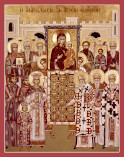 This Council was held in 787 in Nicaea. in the reign of the
devout Empress Irene and her son Constantine, and in the time of Patriarch Tarasius. This Council
finally upheld the veneration of icons, expounding it from Holy Scripture, the witness of the
holy fathers and the examples of miracles in connection with the holy icons. Among other examples
cited, the Cypriot bishop, Constantine, brought forward this one: A herdsman from the city of
Constantia, driving his flock out to pasture one day, saw an icon of the Mother of God adorned
with flowers by the devout. ‘Why give so much honour to a rock?’, said the herdsman,
obviously brought up in iconoclasm, and threw his iron stave at the icon, damaging the right eye
of the Mother of God. As soon as he had left that spot, he stumbled over the same stave and put
out his own right eye. Returning blinded to the city, he cried out tearfully that it was a
punishment from the Mother of God.
This Council was held in 787 in Nicaea. in the reign of the
devout Empress Irene and her son Constantine, and in the time of Patriarch Tarasius. This Council
finally upheld the veneration of icons, expounding it from Holy Scripture, the witness of the
holy fathers and the examples of miracles in connection with the holy icons. Among other examples
cited, the Cypriot bishop, Constantine, brought forward this one: A herdsman from the city of
Constantia, driving his flock out to pasture one day, saw an icon of the Mother of God adorned
with flowers by the devout. ‘Why give so much honour to a rock?’, said the herdsman,
obviously brought up in iconoclasm, and threw his iron stave at the icon, damaging the right eye
of the Mother of God. As soon as he had left that spot, he stumbled over the same stave and put
out his own right eye. Returning blinded to the city, he cried out tearfully that it was a
punishment from the Mother of God.
This Council also decided that the relics of the martyrs be placed in the antimins.* Three hundred and sixty-seven fathers took part in the Council. May the Lord have mercy on us and save us by their prayers.
*Antimins: A cloth containing relics of the saints that is spread on the Holy Table for the celebration of the Divine Liturgy—Tr.
Menaion — Fixed Calendar
October 24th — Civil Calendar
October 11th — Church Calendar
1. The Holy Apostle Philip of the Seventy.
![Saint Philip the Deacon with the Eunuch of Candace [Acts 8:27-30].](/teachings/images/icons/4-021-1.jpg) Born in Palestinian
Caesarea, he was married and had four daughters, all four endowed by God with the gift of
discernment and all four vowed virgins for the sake of Christ (Acts 21:8-9). When the holy
apostles chose deacons, Philip was chosen along with Stephen and the others (6:5). Philip served
the poor and the widows with great fervour. When persecution fell on the Christians in Jerusalem,
he fled to Samaria and there preached the Gospel and witnessed to it by many miracles, driving
out demons, healing the sick and so forth. Seeing the miracles of the holy apostle, Simon the
Magician was baptised. St Philip also baptised the eunuch of Queen Candace. After that, an angel
of God suddenly and invisibly bore him away to Azotus, where he taught and preached, bringing
many to Christ (Acts 8). He was later made bishop in Tralles. He died peacefully in great old
age, and entered into the joy of his Lord.
Born in Palestinian
Caesarea, he was married and had four daughters, all four endowed by God with the gift of
discernment and all four vowed virgins for the sake of Christ (Acts 21:8-9). When the holy
apostles chose deacons, Philip was chosen along with Stephen and the others (6:5). Philip served
the poor and the widows with great fervour. When persecution fell on the Christians in Jerusalem,
he fled to Samaria and there preached the Gospel and witnessed to it by many miracles, driving
out demons, healing the sick and so forth. Seeing the miracles of the holy apostle, Simon the
Magician was baptised. St Philip also baptised the eunuch of Queen Candace. After that, an angel
of God suddenly and invisibly bore him away to Azotus, where he taught and preached, bringing
many to Christ (Acts 8). He was later made bishop in Tralles. He died peacefully in great old
age, and entered into the joy of his Lord.
2. Our Holy Father Theophanes the Hymnographer (the Branded).
A confessor and writer of Canons, he was born in Arabia of wealthy and devout parents. With his brother Theodore (see Dec. 27th), he became a monk in the monastery of St Sava the Sanctified. Being very well-educated monks, they were sent by Patriarch Thomas of Jerusalem to Leo the Armenian, to explain things to the Emperor and defend the veneration of icons. The wicked Emperor inflicted harsh torture on these two holy brothers and threw them into prison. Later, the iconoclast Emperor Theophilus continued their torture, and to expose them to the world’s ridicule, commanded that derisory words be branded on their faces. At the end of the iconoclast controversy, Theophanes was freed and quickly made bishop. He suffered for the holy icons for twenty-five years, writing a hundred and forty-five Canons in that time. He died peacefully in 847, and entered into the joy of his Lord.
3. St Nectarius, Patriarch of Constantinople.
As a layman and a high-ranking court official, he was chosen as Patriarch after St Gregory the Theologian, in 381. He was distinguished by a deep understanding, tact and zeal for the Church. He entered peacefully into rest in 397.
4. The Holy Martyrs Zinais and Philonilla.
They were sisters, born in Tarsus, kinswomen of Paul the Apostle. As virgins, they scorned the world for the sake of Christ and withdrew to a cave to live in asceticism. They were skilled in medicine, and helped many of the sick. Philonilla especially, for her great fasting, was made worthy of the gift of wonderworking. But unbelievers fell on them one night and stoned them to death.
FOR CONSIDERATION
As, by God’s providence, the power of healing is given to blessed water and blessed oil, so these same powers are given to icons. One marvellous example of the wonder-working power of the holy icons is cited by St. Athanasius the Great. In the town of Beirut there lived a Christian in a rented house near a local synagogue. Moving from this house, he left behind by mistake an icon of the Savior. A Jew moved into the same house, but he paid no attention to that icon. When one of his fellow Jews saw that icon, he reported his coreligionist, who was then expelled from the synagogue as a violator of their laws. Then the Jews, who were particularly ill-disposed towards the Christian Faith, took that icon to their meeting-place and began to mock it, as their forbears had once mocked the living Savior. They whipped the icon, nailed it to a tree, placed thorns around the head, put vinegar on the Savior’s lips, and in all possible ways ridiculed the holy image. Finally, one of them took a spear and pierced the sacred image under the rib. And, wonder of wonders, blood and water flowed from the pierced spot as it had aforetime from the body of the crucified Lord. The amazement and horror of the Jews was indescribable. Their rabbis then decided to test the miraculous liquids, so they took a vessel of the blood into their synagogue, where a multitude of the ailing were cured of their diseases after being anointed. The whole town gathered to see the miracle, and all glorified Christ our God. And all the Jews in the town came to belief in Christ, the living and life-giving Lord. The converts went to the Bishop of Beirut and confessed their wicked deed with respect to the icon, and the hierarch received their sincere repentance, catechizing them for many days before baptizing them. Then he consecrated the synagogue as a church of the Lord Jesus Christ, as well as many other synagogues, at the request of the Jews, dedicating them to the holy martyrs, and there was great joy in the city for this marvellous conversion.
Daily Scripture Readings taken from The Orthodox New Testament, translated and published by Holy Apostles Convent, Buena Vista, Colorado, copyright © 2000, used with permission, all rights reserved.
Daily Prologue Readings taken from The Prologue of Ochrid, by Bishop Nikolai Velimirovic, translated by Mother Maria, published by Lazarica Press, Birmingham, England, copyright © 1985, all rights reserved. Edited by Dormition Skete.