

Daily Devotional
Monday, October 4, 2027 (NS), September 21, 2027 (OS)
No Fasting.
Monday of the Sixteenth Week
The commemoration of the Leave-taking of the Exaltation of the holy Cross, and the holy Apostle Quadratus of the Seventy, and our father among the saints, Demetrios, Metropolitan of Rostov, the Wonder-worker.
Scripture Readings
Paschalion — Movable Calendar
Monday of the Sixteenth Week
Epistle
The Reading is from the Epistle of Saint Paul to the Galatians [§ 211].
4 28Brethren, after the manner of Isaac, we are children of promise. 29But as then he who was born according to the flesh persecuted him who was born according to the Spirit, even so it is now. 30But what saith the Scripture? “Cast out the maidservant and her son; for in no wise shall the son of the maidservant inherit with the son of the free woman [cf. Gen. 21:10].” 31So then, brethren, we are not children of a maidservant, but of the free woman.
5 1Keep on standing fast therefore in the freedom with which Christ set us free, and cease being held fast again with a yoke of slavery. 2Behold, I Paul say to you, that if ye be circumcised, Christ shall profit you nothing. 3And I testify again to every man being circumcised, that he is a debtor to do the whole law. 4Ye are deprived of all effect from the Christ, ye who are trying to be justified in the law; ye fell from grace. 5For we by the Spirit out of faith eagerly await the hope of righteousness. 6For in Christ Jesus neither circumcision hath any strength, nor uncircumcision, but faith energizing itself through love. 7Ye were running well; who cut in on you that ye should not be persuaded to the truth? 8The persuasion is not from the One Who calleth you. 9A little leaven leaveneth the whole lump. 10I have confidence in regard to you in the Lord, that ye will not be otherwise minded; but the one who troubleth you shall bear the judgment, whosoever he may be.
Gospel
The Reading is from the Holy Gospel according to Saint Luke [§ 10]. At that time:
3 19Herod the tetrarch, being reproved by John for Herodias, the wife of his brother Philip, and for all the evils which Herod did, 20added also this above all, he even shut up John in the prison.
21Now it came to pass, as all the people were being baptized, Jesus also was baptized; and while He prayed, the heaven was opened. 22And the Holy Spirit descended in a bodily shape as a dove upon Him; and there came to be a voice out of heaven, saying, “Thou art My Son, the Beloved; in Thee I am well pleased.”
Menaion — Fixed Calendar
The commemoration of the Leave-taking of the Exaltation of the holy Cross, and the holy Apostle Quadratus of the Seventy, and our father among the saints, Demetrios, Metropolitan of Rostov, the Wonder-worker.
Epistle
The Reading is from the Epistle of Saint Paul to the Hebrews [§ 318]. Brethren:
7 26Such a High Priest was fitting for us: holy, guileless, undefiled, Who hath been separated from the sinners and hath become higher than the heavens, 27Who hath no need daily, even as the high priests, to offer up sacrifices, first for his own sins, then for those of the people; for this He did once for all after He offered up Himself. 28For the law appointeth men high priests who have weakness; but the word of the oath, which is after the law, appointeth the Son, Who hath been perfected forever.
8 1Now in reference to the things being spoken of, the chief point is: We have such a High Priest, Who sat down on the right of the throne of the majesty in the heavens, 2a Liturgist of the holies and of the tabernacle, the true one, which the Lord pitched, and not man.
Gospel
The Reading is from the Holy Gospel according to Saint John [§ 36]. The Lord said to the Jews who had come to Him:
10 9“I am the door; by Me if anyone should enter, he shall be saved, and shall go in and go out and find pasture. 10“The thief cometh not, except that he might steal, and slay, and destroy. I came that they may have life, and may have it abundantly. 11“I am the good shepherd. The good shepherd layeth down his life for the sheep. 12“But the hireling, who indeed is not a shepherd, whose own the sheep are not, seeth the wolf coming, and leaveth the sheep and fleeth; and the wolf seizeth them and scattereth the sheep. 13“Now the hireling fleeth, because he is a hireling and careth not about the sheep. 14“I am the good shepherd; and I know those that are Mine, and am known of those that are Mine. 15“Even as the Father knoweth Me, I also know the Father; and I lay down My life for the sheep. 16“And I have other sheep which are not of this fold; them also it is needful for Me to bring, and they shall hear My voice; and there shall be one flock and one Shepherd.”
Lives of the Saints (Prologue)
October 4th – Civil Calendar
September 21st – Church Calendar
1. The Holy Apostle Codratus.
One of the Seventy, he was a disciple of the great apostles. He preached the Gospel in Athens, and was at first bishop in Athens after St. Publius, and then in the city of Magnesia. He was very learned in the secular disciplines and rich with the grace of the Holy Spirit. His biographer says of him. ‘He was as a morning star among clouds,’ the clouds being the darkness of Hellenic paganism, lacking the light of devotion, and the holy Apostle Codratus shone to them—the Hellenes—as a great light, illumining the darkness, casting down the foul sacrifices and destroying demonic temples by his prayers. But darkness always hates the light, and the pagans hated holy Codratus. They first stoned him, as the Jews had earlier stoned St. Stephen, and then imprisoned him, leaving him without bread until his holy soul left his body and entered into the kingdom of Christ his God. St. Codratus wrote a defence of Christianity and gave it to the Emperor Hadrian. This defence acted so strongly upon the pagan emperor that he decreed that Christians should not be persecuted without especial cause. Holy Codratus suffered in about 130. He was buried in Magnesia, the place of his passion.
2. St. Dimitri, Bishop of Rostov.
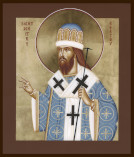 He is commemorated on October 28th, and on this
day is commemorated the finding of his wonder-working relics in 1752. He is commemorated on October 28th, and on this
day is commemorated the finding of his wonder-working relics in 1752.
|
FOR CONSIDERATION
If we begin, with firm intention, to live according to God’s law, we must not fear any sort of attack by those who do not understand, for to him who has truly begun to live according to God’s law, all that happens to him at the hands of men, happens for his help and to the glory of God. It is especially necessary not to fear a move from a place we like to a place we dislike, a place of fear and of a depressed uncertainty about God’s intentions towards us. Did the wickedness of Joseph’s brethren do him harm? Was not rather his involuntary departure for Egypt the means of his rise to glory, the saving of his brothers from famine and the establishing of the conditions for all the wonderful works of God through Moses in Egypt and in the wilderness? Pagans and heretics often chased Orthodox Christians into barbarian regions. What happened then? Did this annihilate Orthodoxy? No; it rather confirmed it in the souls that were exiled and scattered among the barbarian peoples. The evil heretic Lucius drove the famous Makarios and several of the Tabennisiot hermits out of Egypt to a barbarian island, where all the inhabitants were idol-worshipers. But these holy men, by their teaching and example, quickly succeeded in baptising the whole island, and it later became known as the Isle of Repentance.
Daily Scripture Readings taken from The Orthodox New Testament, translated and published by Holy Apostles Convent, Buena Vista, Colorado, copyright © 2000, used with permission, all rights reserved.
Daily Prologue Readings taken from The Prologue of Ochrid, by Bishop Nikolai Velimirovic, translated by Mother Maria, published by Lazarica Press, Birmingham, England, copyright © 1985, all rights reserved. Edited by Dormition Skete.