

Daily Devotional
Wednesday, September 22, 2027 (NS), September 9, 2027 (OS)
Fast Day, but Fish, Wine and Olive Oil Allowed.
Wednesday of the Fourteenth Week
The commemoration of the Afterfeast of the Nativity of the Theotokos, and the holy and righteous ancestors of God, Joachim and Anna.
Scripture Readings
Paschalion — Movable Calendar
Wednesday of the Fourteenth Week
Epistle
The Reading is from the Second Epistle of Saint Paul to the Corinthians [§ 197]. Brethren:
13 2I have said before, and say beforehand, as when I was present the second time, and now being absent I write to those who have previously sinned, and to all the rest, that if I come in regard to that again I will not spare, 3since ye seek a proof of Christ speaking in me, Who is not weak toward you, but is mighty in you. 4For even if He was crucified out of weakness, yet He liveth by the power of God. For we also are weak in Him, but we shall live with Him by the power of God toward you. 5Be putting yourselves to the test if ye are in the faith; be examining yourselves. Or do ye yourselves not fully know that Jesus Christ is in you—unless ye are unapproved? 6But I hope that ye shall know that we are not unapproved. 7Now I pray to God that ye do no evil at all, not that we should appear approved, but that ye may do that which is good, and we may be as those not proved. 8For we are not able to do anything against the truth, but for the truth. 9For we rejoice whenever we are weak, and ye are strong; but we pray for this also, your perfecting. 10Therefore I write these things being absent, that I might not when present use severity, according to the authority which the Lord gave me for building up, and not for pulling down.
11Finally, brethren, keep on rejoicing, keep on being perfected, being comforted, being of the same mind, being at peace, and the God of love and peace shall be with you. 12Greet one another with a holy kiss. 13All the saints greet you.
14The grace of the Lord Jesus Christ, and the love of God, and the communion of the Holy Spirit, be with you all. Amen.
Gospel
The Reading is from the Holy Gospel according to Saint Mark [§ 18]. The Lord said to His disciples:
4 35“Let us pass over to the other side.” 36And after they dismissed the crowd, they took Him along, as He was in the ship; but also other small ships were with Him. 37And there arose a great storm of wind, and the waves were thrown over into the ship, so that already it was filling. 38And He was at the stern, sleeping on the cushion. And they awake Him, and say to Him, “Teacher, is it no concern to Thee that we perish?” 39And He arose and rebuked the wind, and said to the sea, “Be still! Be silent!” And the wind abated, and there was a great calm. 40And He said to them, “Why are ye cowardly in this manner? How is it that ye have no faith?” 41And they feared with a great fear, and were saying to one another, “Who then is this One, that even the wind and the sea obey Him?”
Menaion — Fixed Calendar
The commemoration of the Afterfeast of the Nativity of the Theotokos, and the holy and righteous ancestors of God, Joachim and Anna.
Epistle
The Reading is from the Epistle of Saint Paul to the Galatians. Brethren:
For Gk. usage, see Gal. 4:22-27 [§ mid 210]; for Sl. usage, see Gal. 4:22-31 [§§ mid 210, 211].
4 22Abraham had two sons: one by the maidservant, and one by the free woman. 23But on the one hand, the one of the maidservant hath been born according to the flesh; and on the other hand, the one of the free woman through the promise, 24which things are allegorized. For these are the two covenants: one indeed from Mount Sinai which bringeth forth to slavery, which is Agar— 25for the Agar is Mount Sinai in Arabia, and correspondeth to the present Jerusalem, and she doth slave with her children— 26but the Jerusalem above is free, which is Mother of us all. 27For it hath been written: “Rejoice, thou barren, who bearest not; break forth and cry thou who travailest not; for many are the children of the desolate more than of her who hath the husband [Is. 54:1].” 28Now we, brethren, after the manner of Isaac, are children of promise. 29But as then he who was born according to the flesh persecuted him who was born according to the Spirit, even so it is now. 30But what saith the Scripture? “Cast out the maidservant and her son; for in no wise shall the son of the maidservant inherit with the son of the free woman [cf. Gen. 21:10].” 31So then, brethren, we are not children of a maidservant, but of the free woman.
Gospel
The Reading is from the Holy Gospel according to Saint Luke [§ 36]. The Lord said:
8 16“No one, having lit a lamp, covereth it with a vessel or putteth it underneath a bed, but placeth it upon a lampstand, that they who enter in may see the light. 17“For nothing is secret which shall not become manifest, nor hidden that shall not be known and come to light. 18“Be taking heed then how ye hear: for whosoever hath, it shall be given to him; and whosoever hath not, even what he seemeth to have shall be taken away from him.”
19And His Mother and brethren came to Him, and were not able to meet with Him on account of the crowd. 20And it was reported to Him by some who said, “Thy Mother and Thy brethren are standing outside, wishing to see Thee.” 21And He answered and said to them, “My mother and My brethren are these who hear the word of God and do it.”
Lives of the Saints (Prologue)
September 22nd – Civil Calendar
September 9th – Church Calendar
1. Ss. Joachim and Anna.
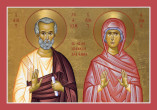 St. Joachim was of the tribe of Judah, and a descendant of King
David. Anna was the daughter of Matthan the priest, of the tribe of Levi as was Aaron the high
priest. This Matthan had three daughters: Mary, Zoia and Anna. Mary was married in Bethlehem and
bore Salome; Zoia was also married in Bethlehem and bore Elisabeth, the mother of St. John the
Forerunner; and Anna was married in Nazareth to Joachim, and in old age gave birth to Mary, the
most holy Mother of God. Joachim and Anna had been married for fifty years, and were barren. They
lived devoutly and quietly, using only a third of their income for themselves and giving a third
to the poor and a third to the Temple, and they were well provided for. Once, when they were
already old and were in Jerusalem to offer sacrifice to God, the high priest, Issachar, upbraided
Joachim: ‘You are not worthy to offer sacrifice with those childless hands.’ Others
who had children jostled Joachim, thrusting him back as unworthy. This caused great grief to the
two aged souls, and they went home with very heavy hearts. Then the two of them gave themselves
to prayer to God that He would work in them the wonder that He had worked in Abraham and Sarah,
and give them a child to comfort their old age. God sent them His angel, who gave them tidings of
the birth of ‘a daughter most blessed, by whom all the nations of the earth will be
blessed, and through whom will come the salvation of the world.’ Anna conceived at once,
and in the ninth month gave birth to the holy Virgin Mary. St. Joachim lived for eighty years and
Anna for seventy-nine, and they both entered into the kingdom of God.
St. Joachim was of the tribe of Judah, and a descendant of King
David. Anna was the daughter of Matthan the priest, of the tribe of Levi as was Aaron the high
priest. This Matthan had three daughters: Mary, Zoia and Anna. Mary was married in Bethlehem and
bore Salome; Zoia was also married in Bethlehem and bore Elisabeth, the mother of St. John the
Forerunner; and Anna was married in Nazareth to Joachim, and in old age gave birth to Mary, the
most holy Mother of God. Joachim and Anna had been married for fifty years, and were barren. They
lived devoutly and quietly, using only a third of their income for themselves and giving a third
to the poor and a third to the Temple, and they were well provided for. Once, when they were
already old and were in Jerusalem to offer sacrifice to God, the high priest, Issachar, upbraided
Joachim: ‘You are not worthy to offer sacrifice with those childless hands.’ Others
who had children jostled Joachim, thrusting him back as unworthy. This caused great grief to the
two aged souls, and they went home with very heavy hearts. Then the two of them gave themselves
to prayer to God that He would work in them the wonder that He had worked in Abraham and Sarah,
and give them a child to comfort their old age. God sent them His angel, who gave them tidings of
the birth of ‘a daughter most blessed, by whom all the nations of the earth will be
blessed, and through whom will come the salvation of the world.’ Anna conceived at once,
and in the ninth month gave birth to the holy Virgin Mary. St. Joachim lived for eighty years and
Anna for seventy-nine, and they both entered into the kingdom of God.
2. Commemoration of the Third Ecumenical Council.
This council met in 431 in Ephesus, in the time of the Emperor Theodosios the Younger. Two hundred fathers gathered at it. The council condemned Nestorius, Patriarch of Constantinople, for his heretical teaching on the most holy Virgin Mary and the birth of the Lord. Nestorius would not call the holy Virgin the Mother of God, but only the Mother of Christ. The holy fathers, in condemning Nestorius’ teaching, confirmed that the holy Virgin be called the Mother of God. Besides this, it confirmed the decisions of the First and Second Councils, especially the Nicene-Constantinopolitan Creed, laying down that no one may add anything to, or take anything from, this Creed.
3. The Holy Martyr Severian.
He was a nobleman of Sebaste. At the time of the martyrdom of the Forty Martyrs of Sebaste (March 9th), he succoured them in prison, encouraging and serving them. After their glorious death, he was also arrested, whipped and tortured for Christ, and finally hanged from a tree with a heavy stone round his neck and another hanging from his feet. Praising God for everything, he breathed his last in the reign of the Emperor Licinius, in the year 320.
4. St. Theophanes, Confessor and Faster.
After a life pleasing to God, in which he underwent much suffering for Christ, he died peacefully in the year 299.
5. St. Niketas the Man of God.
He lived in Constantinople in the twelfth century. His life was so pleasing to God that the doors of the church opened of themselves before him, and the icon lamps lit spontaneously. At the desire of Sozon, a deacon, and at Niketas’ prayers, a priest with whom Sozon had quarreled and with whom he remained estranged, appeared from the other world. There appeared first a row of priests robed in white, then a row in red vestments. Sozon recognized his adversary among them, and made his peace with him. This happened at night in the church at Vlachernai.
FOR CONSIDERATION
One must give alms, not with pride but with humility, considering those to whom one gives alms as better than oneself. Does not the Lord Himself say: ‘inasmuch as you did it unto one of the least of these My brethren, you did it unto Me’ (Matt, 25:40)? Theophanes the Confessor, while still a boy, had a mind enlightened by the light of Christ. He was walking around the streets one day when he saw a naked child freezing in the street. He quickly took off his own clothes and wrapped the child in them, and thus warmed it and restored it to life. He returned home naked, and his astonished parents asked him where his clothes were. Theophanes replied: ‘They’re clothing Christ!’ He was given Christ’s grace, and was later a great ascetic, confessor of the Faith and wonder-worker. If we give alms, whether in some other man’s name or our own but not in the name of Christ, we cannot escape pride, which, as soon as it appears in the heart, brings to naught all the good works we have done. When we give to a beggar as a beggar and not as Christ, we can escape neither pride nor disdain. What is the good of giving alms to a man, with the increase of one’s own pride and the scorning of the man? A virtue is no virtue if it is mixed up with sin, as milk is not milk if it is mixed with petrol or vinegar.
Daily Scripture Readings taken from The Orthodox New Testament, translated and published by Holy Apostles Convent, Buena Vista, Colorado, copyright © 2000, used with permission, all rights reserved.
Daily Prologue Readings taken from The Prologue of Ochrid, by Bishop Nikolai Velimirovic, translated by Mother Maria, published by Lazarica Press, Birmingham, England, copyright © 1985, all rights reserved. Edited by Dormition Skete.