

Daily Devotional
Saturday, September 11, 2027 (NS), August 29, 2027 (OS)
Fast Day, but Shellfish, Wine and Olive Oil Allowed.
Saturday of the Twelfth Week
| The commemoration of the beheading of the glorious prophet, forerunner, and Baptist John. |
Scripture Readings
Paschalion — Movable Calendar
Saturday of the Twelfth Week
Epistle
The Reading is from the First Epistle of Saint Paul to the Corinthians [§ mid 125].
For Gk. usage, see 1 Cor. 1:26-2:5; for Sl. usage, see 1 Cor. 1:26-29.
1 26Brethren, ye see your calling, that there are not many wise according to the flesh, not many powerful, not many well-born. 27But God chose for Himself the foolish things of the world, that He may put to shame the wise; and God chose for Himself the weak things of the world, that He may put to shame the mighty things. 28And God chose for Himself the low-born of the world and the despised, and the things that are nothing, that He might make of no effect the things that are, 29so that no flesh should boast before Him. 30But of Him are ye in Christ Jesus, Who became for us wisdom from God, and righteousness and sanctification and redemption, 31in order that, even as it hath been written: “He that boasteth, in the Lord let him boast [cf. Jer. 9:23, 24].”
2 1And I, brethren, having come to you, came not according to excellency of speech or of wisdom, announcing to you the testimony of God. 2For I decided not to know anything among you, except Jesus Christ, even this One Who was crucified. 3And I was with you in weakness, and in fear, and in much trembling. 4And my speech and my preaching were not in persuasive words of human wisdom, but in demonstration of the Spirit and of power, 5that your faith should not be in the wisdom of men, but in the power of God.
Gospel
The Reading is from the Holy Gospel according to Saint Matthew [§ 82]. At that time:
20 29As Jesus went forth from Jericho, a great crowd followed Him. 30And behold, two blind men sitting by the wayside, after they heard “Jesus is passing by,” cried out, saying, “Have mercy on us, O Lord, Son of David.” 31And the crowd rebuked them that they should be silent; but they kept on crying out the more, saying, “Have mercy on us, O Lord, Son of David.” 32And Jesus stood still and called them, and said, “What do ye wish that I should do to you?” 33They say to Him, “Lord, that our eyes might be opened.” 34And Jesus was moved with compassion and touched their eyes; and straightway their eyes recovered sight, and they followed Him.
Menaion — Fixed Calendar
The commemoration of the beheading of the glorious prophet, forerunner, and Baptist John.
Epistle
The Reading is from the Acts of the Apostles [§ 33]. In those days:
13 25“As John was fulfilling his course, he kept on saying, ‘Whom do ye suppose me to be? I am not He. But behold, He cometh after me, of Whom I am not worthy to loose the sandal of His feet.’ 26“Men, brethren, sons of the race of Abraham, and those among you who fear God, to you the word of this salvation was sent forth. 27“For they who dwell in Jerusalem, and their rulers, because they knew not this One and the voices of the prophets who are read on every sabbath, they fulfilled them, having condemned Him. 28“And though they did not find even one charge of death in Him, they themselves demanded that Pilate put Him to death. 29“And when they fulfilled all the things that were written concerning Him, they took Him down from the tree and laid Him in a sepulcher. 30“But God raised Him from the dead; 31“and He appeared for many days to those who came up with Him from Galilee to Jerusalem, who are His witnesses to the people. 32“And we announce to you the good tidings—the promise which was made to the fathers. 33“For God hath fulfilled this for us their children, having raised up Jesus.”
Gospel
In the Orthros
The Reading is from the Holy Gospel according to Saint Matthew [§ 57].
14 1At that time Herod the tetrarch heard the report concerning Jesus, 2and said to his servants, “This is John the Baptist; he was raised from the dead, and on account of this the works of power energize in him.” 3For Herod laid hold of John, and bound him, and put him in prison on account of Herodias, the wife of his brother Philip. 4For John kept on saying to him, “It is not lawful for thee to have her.” 5And though he wished to put him to death, he was afraid of the crowd, because they were holding him as a prophet. 6But when Herod’s birthday was kept, the daughter of Herodias danced in the midst, and pleased Herod. 7Whereupon he promised with an oath to give her whatsoever she would ask for herself. 8And she, having been urged on by her mother, said, “Give me here the head of John the Baptist on a platter.” 9And the king was grieved; but on account of the oaths, and those who reclined with him at table, he commanded it to be given to her. 10And he sent and beheaded John in the prison. 11And his head was brought on a platter and given to the girl; and she brought it to her mother. 12And his disciples came forward and took up the body and buried it; and they went and brought tidings to Jesus.
13And after Jesus heard it, He withdrew from that place by ship privately to a desolate place. And when the crowds heard of it, they followed Him on foot from the cities.
In the Liturgy
The Reading is from the Holy Gospel according to Saint Mark [§ 24]. At that time:
6 14Herod the king heard of Jesus, for His name became publicly known. And he was saying, “John, the one who baptizeth, was raised from the dead, and on this account works of power energize in him.” 15Others were saying, “It is Elias”; but others were saying, “It is a prophet, or as one of the prophets.” 16But after Herod heard thereof, he said, “It is John, whom I beheaded; he was raised from the dead.” 17For Herod himself sent forth and laid hold of John, and bound him in the prison for Herodias’ sake, the wife of Philip his brother; for he married her. 18For John kept on saying to Herod, “It is not lawful for thee to have the wife of thy brother.” 19But Herodias was holding it against him and kept on wishing to kill him, but had not been able; 20for Herod was fearing John, knowing him to be a just and holy man, and he kept on preserving him. And after he heard him, he was doing many things, and was hearing him gladly. 21And it having become an opportune day when Herod was making a supper on his birthday for his grandees and the tribunes and the first ones of Galilee, 22there also came in the daughter of Herodias herself. And she danced, and pleased Herod and those reclining at table with him. And the king said to the girl, “Ask me whatsoever thou wilt, and I will give it to thee.” 23And he swore to her, “Whatsoever thou shalt ask me, I will give it to thee, up to half of my kingdom.” 24And she went out and said to her mother, “What shall I ask for myself?” And she said, “The head of John the Baptist.” 25And she came in straightway with haste to the king, and she asked for herself, saying, “I wish that thou give me at once upon a platter the head of John the Baptist.” 26And though the king became very sad, yet on account of the oaths and those reclining at table with him, he did not wish to reject her. 27And straightway the king sent off a guardsman, and commanded his head to be brought. And he went forth and beheaded him in the prison, 28and brought his head upon a platter, and gave it to the girl; and the girl gave it to her mother. 29And after his disciples heard of it, they came and took up his corpse, and laid it in a sepulcher.
30And the apostles were gathered together to Jesus, and related to Him all things, both as much as they did and as much as they taught.
Lives of the Saints (Prologue)
September 11th – Civil Calendar
August 29th – Church Calendar
1. The Beheading of St. John the Baptist.
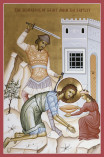 Herod Antipas, son of the Herod who slew the young
children in Bethlehem at the time of the birth of the Lord Jesus, was ruler of Galilee when John
the Baptist was preaching. This Herod was married to the daughter of Aretas, an Arabian prince.
But Herod, an evil branch of evil stock, put away his lawful wife and took Herodias, his brother
Philip’s wife, to live with him. John the Baptist stood up against this lawlessness and
strongly denounced Herod, at which Herod threw him into prison. At the time of a birthday feast
at his court in Sebastia in Galilee, Salome, the daughter of Herodias and Philip, danced for the
guests. Herod, in his cups and carried away by her dancing, promised her whatever she asked, even
to the half of his kingdom. Instructed by her mother, she asked for the head of John the Baptist.
Herod commanded that John be beheaded in the prison and his head brought on a platter.
John’s disciples took the body of their teacher by night and buried it, but Herodias tore
out John’s tongue with a needle and then buried his head in an unclean place. What later
happened to John’s head is recorded and can be read under February 24th.
Herod Antipas, son of the Herod who slew the young
children in Bethlehem at the time of the birth of the Lord Jesus, was ruler of Galilee when John
the Baptist was preaching. This Herod was married to the daughter of Aretas, an Arabian prince.
But Herod, an evil branch of evil stock, put away his lawful wife and took Herodias, his brother
Philip’s wife, to live with him. John the Baptist stood up against this lawlessness and
strongly denounced Herod, at which Herod threw him into prison. At the time of a birthday feast
at his court in Sebastia in Galilee, Salome, the daughter of Herodias and Philip, danced for the
guests. Herod, in his cups and carried away by her dancing, promised her whatever she asked, even
to the half of his kingdom. Instructed by her mother, she asked for the head of John the Baptist.
Herod commanded that John be beheaded in the prison and his head brought on a platter.
John’s disciples took the body of their teacher by night and buried it, but Herodias tore
out John’s tongue with a needle and then buried his head in an unclean place. What later
happened to John’s head is recorded and can be read under February 24th.
God’s punishment was quickly visited upon this group of evildoers. Prince Aretas, to avenge his daughter’s honor, attacked Herod with his army and brought him to his knees. The defeated Herod was condemned by the Roman Caesar, Caligula, to exile first in Gaul and then in Spain. As exiles, Herod and Herodias lived in need and debasement until the earth opened and swallowed them up. Salome, Herodias’ daughter, came to a bad end in the River Sikaris (Sula).
The death of John took place before the Passover, but its commemoration on August 29th was instituted because it was on this day that a church, that had been built over his grave in Sebastia by the Emperor Constantine and the Empress Helena, was consecrated. In this church were also placed the relics of John’s disciples, Eliseus and Audius.
2. Our Holy Mother Theodora of Thessalonica.
A wealthy and devout woman, she lived on the island of Aegina, but when the Arabs over-ran the island, she moved to Thessalonica. There she gave her only daughter to a monastery, where she received the monastic name Theopista. Her husband Theodorinos died very soon, and then Theodora became a nun. She was a great ascetic. She often heard angelic singing, and would say to her sisters: ‘Don’t you hear how wonderfully the angels are singing in heavenly light?’ She entered into rest in 879, and a healing myrrh flowed from her body, which gave healing to many.
3. The Holy Martyr Vasilissa.
She suffered for Christ in Srem.
4. The Holy Martyr Anastasios.
A young man from Radoviste in the diocese of Strumica, he learned a trade in Thessalonica. The Turks tried to force him to become one of them, but he refused firmly. For this he was tortured and finally hanged, on August 29th, 1794.
FOR CONSIDERATION
If you notice how men die, you will see that a man’s death usually reflects his sin. As it is written: ‘He who takes the sword shall perish by the sword’ (Matt. 26:52). Every sin is a sword, and men are usually run through by the sin that they first committed. Salome, the foul daughter of Herodias, who asked for and received the head of St. John the Baptist on a platter from Herod, offers us an example of this. Living in Spain, in the town of Lerida, with the exiled Herod and Herodias, she began one day to cross the frozen Sikaris River. The ice broke and she fell into the water up to her throat. Pieces of the ice held her by the throat, and she struggled, dancing with her legs in the water as she once danced in Herod’s court. She could neither raise herself nor sink, and in the end a fragment of ice decapitated her. The water carried her body away, but her head was taken on a platter to Herodias, as had earlier been the head of John the Baptist. See how a terrible death reflects the sin committed!
Daily Scripture Readings taken from The Orthodox New Testament, translated and published by Holy Apostles Convent, Buena Vista, Colorado, copyright © 2000, used with permission, all rights reserved.
Daily Prologue Readings taken from The Prologue of Ochrid, by Bishop Nikolai Velimirovic, translated by Mother Maria, published by Lazarica Press, Birmingham, England, copyright © 1985, all rights reserved. Edited by Dormition Skete.