

Daily Devotional
Thursday, September 9, 2027 (NS), August 27, 2027 (OS)
No Fasting.
Thursday of the Twelfth Week
27. The commemoration of our venerable Father Poemen the Great, and the Great-martyr Phanurios, the newly-appeared of Rhodes.
Scripture Readings
Paschalion — Movable Calendar
Thursday of the Twelfth Week
Epistle
The Reading is from the Second Epistle of Saint Paul to the Corinthians [§ 183]. Brethren:
7 1Let us cleanse ourselves from all defilement of flesh and spirit, bringing to perfection holiness in the fear of God.
2Make room for us; we wronged no one, we corrupted no one, we defrauded no one. 3I speak not for condemnation; for I have said before that ye are in our hearts, to die together and to live together. 4Great is my boldness toward you, great is my boasting on your behalf; I have been filled with comfort, I am superabounding with joy over all our affliction. 5For, even after we came into Macedonia, our flesh hath had no rest, but in every way we were being oppressed: fights from outside, and fears from inside. 6But God, the One Who comforteth the humble, comforted us by the coming of Titus; 7and not by his coming only, but also by the comfort with which he was comforted over you, when he brought back tidings of your yearning, your mourning, your zeal for me; so as for me to rejoice the more. 8For though I sorrowed you in the epistle, I do not feel regret, though I was feeling regret; for I see that the epistle sorrowed you, though for an hour. 9Now I rejoice, not that ye were sorrowed, but that ye were sorrowed to repentance; for ye were sorrowed in accordance with God, that ye might suffer loss by us in nothing. 10For the sorrow in accordance with God worketh out repentance to salvation, not to be regretted.
Gospel
The Reading is from the Holy Gospel according to Saint Mark [§ 5]. At that time:
1 29Jesus came into the house of Simon and Andrew, with Iakovos and John. 30And the mother-in-law of Simon was lying down ill with a fever. And straightway they speak to Him about her. 31And He came and took hold of her hand, and raised her up. And immediately the fever left her, and she began ministering to them. 32And evening having come to pass, when the sun did set, they kept on bringing to Him all those who were ill, and those possessed by demons. 33And the whole city was gathered together at the door. 34And He cured many who were ill with various diseases, and cast out many demons; and He was not allowing the demons to talk, because they knew Him.
35And having risen up very early at night, He went out and departed into a desolate place, and was praying there.
Menaion — Fixed Calendar
27. The commemoration of our venerable Father Poemen the Great, and the Great-martyr Phanurios, the newly-appeared of Rhodes.
Epistle
For the venerable Father:
The Reading is from the Epistle of Saint Paul to the Galatians [§ 213]. Brethren:
5 22The fruit of the Spirit is love, joy, peace, long-suffering, kindness, goodness, faith, 23meekness, self-control; against such things there is no law. 24But they who are of the Christ crucified the flesh with the passions and the lusts. 25If we live by the Spirit, let us also be walking by the Spirit. 26Let us not become vainglorious, provoking one another, envying one another.
6 1Brethren, even if a man should be overtaken in some transgression, ye, the spiritual ones, be restoring such a one in the spirit of meekness, looking out for thyself, lest thou also be tempted. 2Keep on bearing one another’s burdens, and thus fill up the law of the Christ.
For the Martyr:
The Reading is from the Epistle of Saint Paul to the Ephesians [§ 233].
6 10Brethren, keep on being empowered in the Lord and in the strength of His might. 11Put on the full armor of God, for you to be able to stand against the wiles of the devil; 12because for us the wrestling is not against blood and flesh, but against the principalities, against the powers, against the cosmic rulers of the darkness of this age, against spiritual hosts of evil on account of the heavenly things. 13For this cause take up the full armor of God, in order that ye might be able to withstand in the evil day, and having counteracted all things, to stand. 14Stand therefore, having girt your loins with truth, and having put on for yourselves the breastplate of righteousness, 15and having shod your feet in readiness of the Gospel of peace; 16on the whole, take up the shield of faith, with which ye shall be able to quench all the fiery darts of the evil one. 17And take the helmet of salvation, and the sword of the Spirit, which is the word of God.
Gospel
For the venerable Father:
The Reading is from the Holy Gospel according to Saint Matthew [§ 10]. At that time:
4 25Great crowds followed Jesus from Galilee, and Decapolis, and Jerusalem, and Judæa, and beyond the Jordan.
5 1And seeing the crowds, He went up into the mountain; and after He sat down, His disciples came to Him. 2And He opened His mouth and began to teach them, saying:
3“Blessed are the poor in spirit, for theirs is the kingdom of the heavens.
4“Blessed are they who mourn, for they shall be comforted.
5“Blessed are the meek, for they shall inherit the earth.
6“Blessed are they who hunger and thirst after righteousness, for they shall be filled.
7“Blessed are the merciful, for they shall find mercy.
8“Blessed are the pure in heart, for they shall see God.
9“Blessed are the peacemakers, for they shall be called sons of God.
10“Blessed are they who have been persecuted on account of righteousness, for theirs is the kingdom of the heavens.
11“Blessed are ye whenever they reproach you and persecute you, and say every evil word against you falsely on account of Me.
12“Be rejoicing and be exceedingly glad, for your reward is great in the heavens. For so they persecuted the prophets who were before you.”
Lives of the Saints (Prologue)
September 9th – Civil Calendar
August 27th – Church Calendar
1. Our Holy Father Poemen the Great.
He was an Egyptian by birth and a great Egyptian ascetic. As a boy, he visited various spiritual teachers and gathered proven experience as a bee gathers honey from flowers. Poemen once begged the elder Paul to take him to St. Paisius. Seeing him, Paisius said: ‘This child will save many; the hand of God is on him.’ In time, Poemen became a monk and drew two of his brothers to monasticism. Their mother once came to see her sons, but Poemen would not allow her in, asking through the door: ‘Which do you want more: to see us here and now, or in the other world in eternity?’ Their mother went away joyfully, saying: ‘If I will see you for certain there, I don’t need to see you here.’ In the monastery of these three brothers, governed by the eldest, Abba Anoub, the rule was as follows: at night, four hours were passed in manual work, four hours in sleep and four in reading the Psalter. The day was passed, from morning to noon, in alternate work and prayer, from midday to Vespers in reading and after Vespers they prepared their meal, the only one in the twenty-four hours, and this usually of some sort of cabbage. Poemen himself said about their life: ‘We ate what was at hand. No one ever said: “Give me something else”, or “I won’t eat that”. In that way, we spent our whole life in silence and peace.’ He lived in the fifth century, and entered peacefully into rest in great old age.
2. Our Holy Father Poemen of Palestine.
He lived the ascetic life in Rouba, in the Palestinian desert, in the time of the Emperor Maurice (582-602), and was a shepherd in his youth. Once his dogs fell on a man and tore him to pieces, and he, from capriciousness, did not try to save him. It was revealed to him that, because of this, he would, in the end, be devoured by wild beasts. So it came to pass: he was so devoured, and gave his soul into God’s hands.
3. St. Hosius of Cordova.
He governed the Church in Spain as Bishop of Cordova for over sixty years, and played a prominent part in the First Ecumenical Council in Nicaea. He also presided at the local Council in Sardica in 343. He was so zealous for Orthodoxy that, at the time of his death, he renewed the anathema against the Arian heresy.
4. The Hieromartyr Kuksha and Poemen the Faster.
They were both monks of the Monastery of the Caves in Kiev. Kuksha was successful in preaching the Gospel to the Wallachians and in baptising them. One day, pagans fell on him and killed him, together with his disciple. At that moment, Poemen the Faster was standing in the church in the Monastery of the Caves, and seeing in his spirit the death of his disciple and friend Kuksha, cried out: ‘Our brother Kuksha has today been killed for the Gospel!’ Thus saying, he also breathed his last. This was in 1113.
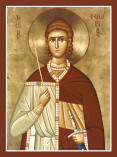 In the Greek Great Synaxarion, the Holy Martyr Phanurios is
also commemorated. Who he was and when he lived is not known, but he is much venerated in Rhodes
and Crete. In about 1500, some Arabs discovered amid the ruins of an ancient church several
icons, and other artifacts. All of the icons were severely decayed and in near ruins except for
one, which appeared new and fresh. The Arabs discarded the icons as useless. Some monks in hiding
who were watching the Arab marauders waited for them to leave, and then rushed to reclaim this
fantastic image in its remarkable state of preservation. The icon’s lettering spelled out
“Phanurios”, and depicted the saint as a young soldier holding a cross in his right
hand and a burning candle in his left, along with twelve scenes from his martyrdom. The scenes
depicted Phanurios being stoned, on the rack, being slashed, behind bars, standing before a
judge, tied to a frame, being burned with candles, tied to a post, thrown to wild animals,
crushed by a boulder, holding hot coals, and a demon hovering against a background of flames. All
of these horrors conveyed that Phanurios was apparently an indestructible instrument of God.
In the Greek Great Synaxarion, the Holy Martyr Phanurios is
also commemorated. Who he was and when he lived is not known, but he is much venerated in Rhodes
and Crete. In about 1500, some Arabs discovered amid the ruins of an ancient church several
icons, and other artifacts. All of the icons were severely decayed and in near ruins except for
one, which appeared new and fresh. The Arabs discarded the icons as useless. Some monks in hiding
who were watching the Arab marauders waited for them to leave, and then rushed to reclaim this
fantastic image in its remarkable state of preservation. The icon’s lettering spelled out
“Phanurios”, and depicted the saint as a young soldier holding a cross in his right
hand and a burning candle in his left, along with twelve scenes from his martyrdom. The scenes
depicted Phanurios being stoned, on the rack, being slashed, behind bars, standing before a
judge, tied to a frame, being burned with candles, tied to a post, thrown to wild animals,
crushed by a boulder, holding hot coals, and a demon hovering against a background of flames. All
of these horrors conveyed that Phanurios was apparently an indestructible instrument of God.
There is a pious tradition that his mother was a great sinner, whom not even he could convert. But his filial love for his mother was great beyond measure, and he prayed more for his mother’s salvation than his own. When the pagans stoned him to death for Christ, St. Phanurios prayed to God: ‘For the sake of these my sufferings, Lord, help all those who will pray to Thee for the salvation of my sinful mother.’ In Egypt, many Christians pray thus: “O Lord, save Phanurios’ mother and help me, a sinner”—and many receive help through this prayer. St. Phanurios is a great aid in locating lost articles; and many people, upon finding their lost possessions from the aid of St. Phanurios, in thanks to him, say a special prayer for his mother.
FOR CONSIDERATION
As those who clamber up a steep mountainside and scrabble with hands and feet to make one yard of progress, utterly forgetful of self—such were the great ascetics of Orthodoxy on their exhausting climb to the kingdom of God. Truly, their efforts and their detachment were marvellous. St. Poemen would not see his mother when she came to visit him. Some prince desired to see Poemen, but the latter refused. Then the prince thought up a devious way of forcing the elder to see him: he seized the son of Poemen’s sister and told her that he would let her son go only if Poemen himself came to speak with him. The sister went off to the desert, and tapping on the door, begged her brother to come and save her son. But Poemen did not come out. Then his sister began to abuse him and curse him. Hearing of this, the prince commanded that a letter be written to Poemen, saying that if he, Poemen, would put in writing (as he would not do so orally) a request to the prince to let his nephew go, the prince would do so. Poemen replied: ‘O powerful prince, be sure to enquire closely into the boy’s guilt. If his guilt be such that he is deserving of death, let him die, that he may by temporal punishment escape torment in eternity. If his guilt does not merit capital punishment, punish him according to the law, and then let him go.’ Reading this impartial and detached letter, the prince was greatly amazed and let the boy go, and his respect for Poemen was deepened.
Daily Scripture Readings taken from The Orthodox New Testament, translated and published by Holy Apostles Convent, Buena Vista, Colorado, copyright © 2000, used with permission, all rights reserved.
Daily Prologue Readings taken from The Prologue of Ochrid, by Bishop Nikolai Velimirovic, translated by Mother Maria, published by Lazarica Press, Birmingham, England, copyright © 1985, all rights reserved. Edited by Dormition Skete.