

Daily Devotional
Tuesday, September 7, 2027 (NS), August 25, 2027 (OS)
No Fasting.
Tuesday of the Twelfth Week
The commemoration of the return of the relics of the holy Apostle Bartholomew from Anastasiopolis to Lipari, and the holy Apostle Titus of the Seventy, Bishop of Crete.
Scripture Readings
Paschalion — Movable Calendar
Tuesday of the Twelfth Week
Epistle
The Reading is from the Second Epistle of Saint Paul to the Corinthians [§ 180]. Brethren:
5 15Christ died for all, in order that they who are living no longer are living to themselves, but to Him Who died for them and was raised. 16So that from now we know no one according to the flesh; and even if we have known Christ according to the flesh, but now we know Him no more. 17Therefore, if anyone is in Christ, he is a new creation; the old things passed away; behold, all things have become new. 18But all things are from God Who reconciled us to Himself through Jesus Christ and gave to us the ministry of reconciliation, 19that is, that God was reconciling the world to Himself in Christ, not reckoning their transgressions to them, and He put in us the word of reconciliation. 20On behalf of Christ therefore we are ambassadors, as though God were beseeching you by us; we beseech on behalf of Christ, be ye reconciled to God. 21For Him Who knew no sin He made to be sin on our behalf, that we might become the righteousness of God in Him.
Gospel
The Reading is from the Holy Gospel according to Saint Mark [§ 3]. At that time:
1 16As Jesus walked by the Sea of Galilee, He saw Simon and Andrew his brother casting a net into the sea; for they were fishermen. 17And Jesus said to them, “Come after Me, and I will make you to become fishers of men.” 18And straightway they left their nets and followed Him. 19And after He went a little farther from that place, He saw Iakovos the son of Zebedee, and John his brother; and they were in the ship mending the nets. 20And straightway He called them. And they left their father Zebedee in the ship with the hired servants, and went away after Him.
21And they went into Capernaum; and straightway on the sabbath days He entered into the synagogue and began to teach. 22And they were astonished at His teaching; for He was teaching them as one having authority, and not as the scribes.
Menaion — Fixed Calendar
The commemoration of the return of the relics of the holy Apostle Bartholomew from Anastasiopolis to Lipari, and the holy Apostle Titus of the Seventy, Bishop of Crete.
Epistle
The Reading is from the Epistle of Saint Paul to Saint Titus [§ 300].
For Gk. usage, see Tit. 1:1-5, 2:15-3:2, 12-15; for Sl. usage, see Tit. 1:1-4, 2:15-3:3, 12, 13, 15.
1 1Paul, a slave of God, and an apostle of Jesus Christ according to the faith of God’s elect, and full knowledge of the truth which is according to piety, 2in the hope of eternal life, which the God, Who cannot lie, Himself promised before the times of the ages, 3but manifested in His own seasons His word in a proclamation, which I was entrusted with, according to the command of God our Savior; 4to Titus, my genuine child according to the common faith: grace, mercy, peace from God the Father and the Lord Jesus Christ our Savior.
5For this cause I left thee behind in Crete, in order that thou shouldest set right the things wanting, and ordain presbyters in every city, as I ordered thee....
2 15These things be speaking and exhorting and reproving with all command; let no one despise thee.
3 1Be reminding them to submit themselves to rulers and authorities, to obey a superior, to be ready for every good work, 2to speak evil of no one, to not be contentious, but equitable, showing forth meekness toward all men. 3For we also were once without understanding, disobedient, deceived, slaving for various desires and pleasures, passing life in wickedness and envy, hateful, hating one another....
12Whenever I should send Artemas to thee, or Tychikos, hasten to come to me in Nicopolis, for I have decided to winter there. 13Send forth with haste Zenas the lawyer and Apollos, in order that nothing may be lacking to them. 14And let ours also be learning to set before themselves good works for necessary uses, that they may not be unfruitful.
15All those with me salute thee. Greet those who love us in faith.
Grace be with you all. Amen.
Gospel
The Reading is from the Holy Gospel according to Saint Matthew [§ 11]. The Lord said to His disciples:
5 14“Ye are the light of the world. A city situated on the top of a mountain cannot be hid. 15“Nor do they light a lamp and put it under the bushel, but upon the lampstand, and it giveth light to all those in the house. 16“Thus, let your light shine before men, that they might see your good works, and might glorify your Father Who is in the heavens.
17“Do not begin to think that I came to abolish the law or the prophets; I came not to abolish, but to fulfill. 18“For verily I say to you, until the heaven and the earth shall have passed away, one iota or one tittle in no wise shall pass away from the law, until all shall have taken place. 19“Whosoever then shall break one of the least of these commandments, and shall teach men so, he shall be called least in the kingdom of the heavens; but whosoever shall do and teach them, this one shall be called great in the kingdom of the heavens.”
Lives of the Saints (Prologue)
September 7th – Civil Calendar
August 25th – Church Calendar
1. The Holy Apostle Bartholomew.
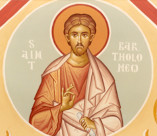 Today is the commemoration of the translation of St.
Bartholomew’s relics, while his main feast falls on June 11th. When this great apostle was
crucified in Ourbanopolis in Armenia, Christians took his body and buried it in a leaden coffin.
When numerous miracles had been wrought over the apostle’s grave, especially healings of
the sick—which led to an increase in the number of Christians—the pagans took the coffin
containing Bartholomew’s relics and cast it into the sea. At the same time, they threw in
four other coffins with the relics of four martyrs: Papian, Lucian, Gregory and Acacius. By
God’s providence, the coffins did not sink, but floated, carried by the waves, to various
places: Acacius’ to the city of Askalon, Gregory’s to Calabria, Lucian’s to Messina,
Papian’s to another place in Sicily and Bartholomew’s to the island of Lipara. By
divine revelation, the Bishop of Lipara, Agathon, learned of the approach to Lipara of the relics
of St. Bartholomew. Agathon, with his clergy and people, went out to the shore and awaited the
coffin with great joy. On that occasion, many of the sick were healed by the holy apostle’s
relics. They were placed in the church of St. Bartholomew and lay there until the time of
Theophilus the Iconoclast (about 839), then, when the Moslems threatened the Liparites, the
apostle’s relics were taken to the town of Benevento. Thus God glorified His apostle by
miracles, both during his lifetime and after his death.
Today is the commemoration of the translation of St.
Bartholomew’s relics, while his main feast falls on June 11th. When this great apostle was
crucified in Ourbanopolis in Armenia, Christians took his body and buried it in a leaden coffin.
When numerous miracles had been wrought over the apostle’s grave, especially healings of
the sick—which led to an increase in the number of Christians—the pagans took the coffin
containing Bartholomew’s relics and cast it into the sea. At the same time, they threw in
four other coffins with the relics of four martyrs: Papian, Lucian, Gregory and Acacius. By
God’s providence, the coffins did not sink, but floated, carried by the waves, to various
places: Acacius’ to the city of Askalon, Gregory’s to Calabria, Lucian’s to Messina,
Papian’s to another place in Sicily and Bartholomew’s to the island of Lipara. By
divine revelation, the Bishop of Lipara, Agathon, learned of the approach to Lipara of the relics
of St. Bartholomew. Agathon, with his clergy and people, went out to the shore and awaited the
coffin with great joy. On that occasion, many of the sick were healed by the holy apostle’s
relics. They were placed in the church of St. Bartholomew and lay there until the time of
Theophilus the Iconoclast (about 839), then, when the Moslems threatened the Liparites, the
apostle’s relics were taken to the town of Benevento. Thus God glorified His apostle by
miracles, both during his lifetime and after his death.
2. The Holy Apostle Titus.
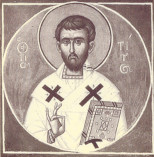 One of the Seventy, he was born in Crete and educated in Greek
philosophy and poetry. Led by a dream, he read the Prophet Isaias and came to doubt all Hellenic
learning. Hearing of Christ the Lord, he went to Jerusalem with some other Cretans, and himself
heard the words of the Savior and saw His mighty works. His youthful heart clave utterly to
Christ. He was later baptized by the Apostle Paul, whom he served in the works of the Gospel as a
son serves his father. Paul loved Titus so greatly that he sometimes called him his son (Titus
1:4), and sometimes his brother (II Cor. 12:18). Titus travelled widely with the great apostle of
the nations, and was by him made Bishop of Crete. At the time of Paul’s suffering in Rome,
Titus was there, and buried the body of his teacher and spiritual father. He then returned to
Crete, where he had great success in baptising the pagans, and wisely governed the Church to
great old age. He entered into rest at the age of ninety-four.
One of the Seventy, he was born in Crete and educated in Greek
philosophy and poetry. Led by a dream, he read the Prophet Isaias and came to doubt all Hellenic
learning. Hearing of Christ the Lord, he went to Jerusalem with some other Cretans, and himself
heard the words of the Savior and saw His mighty works. His youthful heart clave utterly to
Christ. He was later baptized by the Apostle Paul, whom he served in the works of the Gospel as a
son serves his father. Paul loved Titus so greatly that he sometimes called him his son (Titus
1:4), and sometimes his brother (II Cor. 12:18). Titus travelled widely with the great apostle of
the nations, and was by him made Bishop of Crete. At the time of Paul’s suffering in Rome,
Titus was there, and buried the body of his teacher and spiritual father. He then returned to
Crete, where he had great success in baptising the pagans, and wisely governed the Church to
great old age. He entered into rest at the age of ninety-four.
3. The Holy Confessors of Edessa.
They suffered greatly in imprisonment and exile for the Orthodox Faith in the time of the Emperor Valens, who held the Arian heresy. They were freed under the Emperor Theodosios.
4. St. Menas, Patriarch of Constantinople.
He governed the Church wisely from 536 to 552. Before that, he ran the Home of St. Sampson for the poor and needy (see June 27th). Pope Agapetus, who had come to Constantinople at that time to oppose and depose the heretical Patriarch Anthimos, participated in Menas’ consecration as bishop there. It is said that the following marvel came to pass in Constantinople in the time of Patriarch Menas: a Jewish boy went to church with his friends, and following their example, received holy Communion. The boy’s father, a glassblower, when he heard of his son’s action, seized him and threw him into the red-hot kiln that he had prepared for the firing of glass. The boy remained shut in this kiln for three days and nights, but when the kiln was opened, he was found alive and unharmed, preserved by God’s providence.
FOR CONSIDERATION
The superhuman courage of our Christian forbears and their readiness to undergo all manner of sufferings and voluntary death for Christ was a source of terror to their torturers. The Emperor Maximian, a fierce and shameless persecutor of Christians, commanded his proconsul in Antioch to set St. Andrew Stratelates free from prison, for fear that the people, who had more respect for Andrew than for the emperor, would revolt. The Emperor Valens commanded his eparch in Edessa to slay all the Christians who were opposed to Arius. The eparch had more human compassion than the emperor, and warned the Christians secretly by night not to leave the city the following day for the fields where they usually held their services (for the Arians had seized all the churches), or they would be slaughtered. Heedless of this warning, the Christians all went to the field in the morning with great joy, rejoicing that they would suffer for the true Faith. The eparch, coming out of the city with his soldiers, saw a Christian woman with a child in her arms, hurrying past the soldiers near the field. The eparch said to her: ‘Have you not heard that the eparch is coming with all his soldiers, to kill everyone he finds?’ The woman replied: ‘I have; and that is why I’m hurrying to die for Christ with the others.’ The eparch continued: ‘But why are you taking that child with you?’ The woman replied: ‘I want my child to be made worthy of martyrdom along with me.’ Seeing and hearing this, the eparch returned in fear to the city and informed the emperor. The emperor was filled with fear, and withdrew his order to massacre.
Daily Scripture Readings taken from The Orthodox New Testament, translated and published by Holy Apostles Convent, Buena Vista, Colorado, copyright © 2000, used with permission, all rights reserved.
Daily Prologue Readings taken from The Prologue of Ochrid, by Bishop Nikolai Velimirovic, translated by Mother Maria, published by Lazarica Press, Birmingham, England, copyright © 1985, all rights reserved. Edited by Dormition Skete.