

Daily Devotional
Saturday, August 7, 2027 (NS), July 25, 2027 (OS)
No Fasting.
Saturday of the Seventh Week
The commemoration of the Dormition of Righteous Anna, the mother of the Virgin Mary, the Theotokos, and our venerable Mothers Olympia the deaconess of Constantinople and the Virgin Efpraxia of Tabenna, and our venerable Father Makarios, Abbot of Sheltovod and Unzha.
Scripture Readings
Paschalion — Movable Calendar
Saturday of the Seventh Week
Epistle
The Reading is from the Epistle of Saint Paul to the Romans [§ 108]. Brethren:
12 1I beseech you therefore, by the mercies of God, to present your bodies a living sacrifice, holy, well-pleasing to God, your rational worship. 2And cease being fashioned according to this age, but be transfigured by the renewing of your mind, in order for you to put to the test what is the good and well-pleasing and perfect will of God.
3For I say, through the grace which is given to me, to everyone that is among you, not to be high-minded beyond what is needful to be minded, but to be minded so as to be sober-minded, as God allotted a measure of faith to each.
Gospel
The Reading is from the Holy Gospel according to Saint Matthew [§ 39]. The Lord said:
10 37“The one who loveth father or mother more than Me is not worthy of Me; and the one who loveth son or daughter more than Me is not worthy of Me. 38“And whosoever taketh not his cross and followeth after Me is not worthy of Me. 39“The one who findeth his life shall lose it; and the one who loseth his life on account of Me shall find it. 40“The one who receiveth you receiveth Me, and the one who receiveth Me receiveth the One Who sent Me forth. 41“The one who receiveth a prophet in the name of a prophet shall receive a prophet’s reward; and the one who receiveth a righteous man in the name of a righteous man shall receive a righteous man’s reward. 42“And whosoever shall give to one of these little ones only a cup of cold water to drink in the name of a disciple, verily I say to you, in no wise shall he lose his reward.”
11 1And it came to pass, when Jesus finished commanding His twelve disciples, He passed over from that place to teach and preach in their cities.
Menaion — Fixed Calendar
The commemoration of the Dormition of Righteous Anna, the mother of the Virgin Mary, the Theotokos, and our venerable Mothers Olympia the deaconess of Constantinople and the Virgin Efpraxia of Tabenna, and our venerable Father Makarios, Abbot of Sheltovod and Unzha.
Epistle
For the Dormition:
The Reading is from the Epistle of Saint Paul to the Galatians. Brethren:
For Gk. usage, see Gal. 4:22-27 [§ mid 210]; for Sl. usage, see Gal. 4:22-31 [§§ mid 210, 211].
4 22Abraham had two sons: one by the maidservant, and one by the free woman. 23But on the one hand, the one of the maidservant hath been born according to the flesh; and on the other hand, the one of the free woman through the promise, 24which things are allegorized. For these are the two covenants: one indeed from Mount Sinai which bringeth forth to slavery, which is Agar— 25for the Agar is Mount Sinai in Arabia, and correspondeth to the present Jerusalem, and she doth slave with her children— 26but the Jerusalem above is free, which is Mother of us all. 27For it hath been written: “Rejoice, thou barren, who bearest not; break forth and cry thou who travailest not; for many are the children of the desolate more than of her who hath the husband [Is. 54:1].” 28Now we, brethren, after the manner of Isaac, are children of promise. 29But as then he who was born according to the flesh persecuted him who was born according to the Spirit, even so it is now. 30But what saith the Scripture? “Cast out the maidservant and her son; for in no wise shall the son of the maidservant inherit with the son of the free woman [cf. Gen. 21:10].” 31So then, brethren, we are not children of a maidservant, but of the free woman.
Gospel
The Reading is from the Holy Gospel according to Saint Luke [§ 36]. The Lord said:
8 16“No one, having lit a lamp, covereth it with a vessel or putteth it underneath a bed, but placeth it upon a lampstand, that they who enter in may see the light. 17“For nothing is secret which shall not become manifest, nor hidden that shall not be known and come to light. 18“Be taking heed then how ye hear: for whosoever hath, it shall be given to him; and whosoever hath not, even what he seemeth to have shall be taken away from him.”
19And His Mother and brethren came to Him, and were not able to meet with Him on account of the crowd. 20And it was reported to Him by some who said, “Thy Mother and Thy brethren are standing outside, wishing to see Thee.” 21And He answered and said to them, “My mother and My brethren are these who hear the word of God and do it.”
Lives of the Saints (Prologue)
August 7th – Civil Calendar
July 25th – Church Calendar
1. Saint Anna, the Mother of the Most Holy Mother of God.
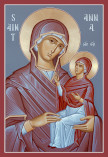 Today is the commemoration of
her falling asleep; her main feast is on September 9th, where her life is written. Anna was
of the tribe of Levi, and was the daughter of Matthan the priest. After a long life
pleasing to God, she entered into rest at a great age. Today is the commemoration of
her falling asleep; her main feast is on September 9th, where her life is written. Anna was
of the tribe of Levi, and was the daughter of Matthan the priest. After a long life
pleasing to God, she entered into rest at a great age.
|
2. St. Olympias the Deaconess.
Olympias was born in Constantinople of very eminent parents. Her father, Anysios Secundos, was a senator and her mother was the daughter of the famous aristocrat Evlavios, who is mentioned in the life of St. Nicholas the Wonder-worker. When Olympias was fully grown, she was betrothed to a nobleman who died before his marriage to this honored maiden. The emperor and others exhorted her to take another husband, but in vain; she refused them all and devoted herself to a life pleasing to God, giving of her inherited wealth great gifts to the Church and alms to the poor. She served in the Church as a deaconess, first in the time of Patriarch St. Nectarios, and after his death, under St. John Chrysostom. When Chrysostom went into exile, he advised Olympias to remain in the Church as before and serve it, whichever patriarch should succeed him. But, immediately after the exile of this great hierarch, the church of Hagia Sophia caught fire, and the conflagration took hold of many of the public buildings in the capital in a miraculous way showing God’s displeasure. St. Chrysostom’s enemies accused this holy woman of being a malicious fire-raiser. Olympias was exiled from Constantinople to Nikomedia, where she entered into rest in 408, leaving instructions that her body be placed in a coffin and cast into the sea, and that she be buried wherever the waves threw the coffin up. The coffin was cast up at a place called Vrochthoi, where there was a church dedicated to the Apostle Thomas. Great miracles of healing have been performed through the centuries by her relics. The exiled St. Chrysostom wrote beautiful letters to the exiled Olympias, which to this day serve to give support to all who suffer for God’s justice. Among other things, Chrysostom wrote to Olympias: ‘Now I am deeply joyful, not only because you have been delivered from sickness, but even more because you are bearing adversities with such fortitude, calling them trifles—a characteristic of a soul filled with power and abounding in the rich fruits of courage. You are not only enduring misfortune with fortitude, but are making light of it in a seemingly effortless way, rejoicing and triumphing over it—this is a proof of the greatest wisdom’ (Letter 6 of the seventeen that have come down to us).
3. Our Holy Mother Efpraxia the Virgin.
She was the daughter of a Constantinopolitan nobleman, Antigonus, and a kinswoman of the Emperor Theodosios the Great. With her mother, a young widow, she went to Egypt and travelled around the monasteries, giving alms and praying to God. The seven-year-old Efpraxia, in fulfillment of her burning desire, received the monastic schema in a women’s monastery. As she grew older, she took on herself harsher and harsher asceticism, once fasting for forty days. She entered into rest in the year 413, at the age of thirty. She had great grace from God to heal the gravest sicknesses.
4. Commemoration of the Fifth Ecumenical Council.
This council was held in Constantinople in the time of the Emperor Justinian the Great, in 553. All the Monophysite heresies were condemned at this council, and also the heretical writings of Theodore of Mopsuestia, Theodoretus of Kyros and Origen (his writings against the resurrection of the dead).
FOR CONSIDERATION
‘As virginity is better than marriage, so a first marriage is better than a second.’ Thus writes St. John Chrysostom to the young widow of the deceased Constantinopolitan noble Tarasios, advising her not to contract a second marriage. Efpraxia the elder, mother of St. Efpraxia and kinswoman of the Emperor Theodosios the Great, was left a widow while still a young woman, on the death of her husband Antigonus, with whom she had lived in wedlock for only two years, and one further year, by a common vow, as brother and sister. The emperor and empress urged her to marry another nobleman, but she refused to do this, and took her daughter Efpraxia off to Egypt. And what shall we say of St. Olympias and of St. Efpraxia? Also of St. Makrina, and those who were only betrothed as maidens and then, when their affianced husbands died, regarded themselves as widows and did not entertain the thought of entering upon another marriage. What purity of heart! What faithfulness to the betrothed! What fear of God! What a steadfast faith in the life to come, in which the betrothed hope to meet again!
Daily Scripture Readings taken from The Orthodox New Testament, translated and published by Holy Apostles Convent, Buena Vista, Colorado, copyright © 2000, used with permission, all rights reserved.
Daily Prologue Readings taken from The Prologue of Ochrid, by Bishop Nikolai Velimirovic, translated by Mother Maria, published by Lazarica Press, Birmingham, England, copyright © 1985, all rights reserved. Edited by Dormition Skete.