

Daily Devotional
Wednesday, July 21, 2027 (NS), July 8, 2027 (OS)
Fast Day, but Wine and Olive Oil Allowed.
Wednesday of the Fifth Week
8. The commemoration of the holy and glorious Great-martyr Prokopios, and the Icon of the Mother of God of Kazan.
Scripture Readings
Paschalion — Movable Calendar
Wednesday of the Fifth Week
Epistle
The Reading is from the Epistle of Saint Paul to the Romans [§ 117]. Brethren:
15 7Be receiving one another, even as also the Christ Himself received us to the glory of God. 8Now I say that Jesus Christ hath become a servant to the circumcision for the truth of God, in order to confirm the promises to the fathers, 9and so that the nations might glorify God for His mercy, even as it hath been written: “For this cause I will confess to Thee among the nations, and I will chant to Thy name [Ps. 17(18):50(49)].” 10And again he saith: “Rejoice, ye nations, with His people [Deut. 32:43]!” 11And again: “Praise the Lord, all the nations; and praise Him, all the peoples [Ps. 116(117):1].” 12And again, Esaias saith: “There shall be a root of Jesse; and the One Who riseth up to rule over the nations, on Him shall the nations hope [Is. 11:10].” 13Now may the God of hope fill you with all joy and peace in believing, in order for you to abound in hope, in the power of the Holy Spirit.
14And I myself also am persuaded concerning you, my brethren, that ye yourselves also are full of goodness, filled with all knowledge, being able also to admonish one another. 15But I am writing more boldly to you, brethren, in part, as reminding you, because of the grace which was given to me by God, 16in order for me to be a liturgist of Jesus Christ to the nations, ministering as priest in sacred sacrifice the Gospel of God, that the offering of the nations might be acceptable, sanctified in the Holy Spirit.
Gospel
The Reading is from the Holy Gospel according to Saint Matthew [§ 48]. At that time:
12 38Some of the Scribes and Pharisees came to Jesus, saying, “Teacher, we wish to see a sign from Thee.” 39But He answered and said to them, “An evil and adulterous generation seeketh for a sign; and there shall be no sign given to it, except the sign of Jonas the prophet. 40“For even as Jonas was three days and three nights in the belly of the sea-monster, so the Son of Man shall be three days and three nights in the heart of the earth. 41“Men, Ninevites, shall stand up in the judgment with this generation and shall condemn it, for they repented at the proclamation of Jonas; and behold, something more than Jonas is here. 42“A queen of the south shall be raised in the judgment with this generation and shall condemn it, for she came from the ends of the earth to hear the wisdom of Solomon; and behold, something more than Solomon is here. 43“But whenever the unclean spirit should go out from the man, he goeth through waterless places, seeking rest, and findeth it not. 44“Then he saith, ‘I will return to my house from which I came out.’ And after he cometh, he findeth it unoccupied, swept clean, and adorned. 45“Then he goeth and taketh with himself seven other spirits more evil than himself, and they enter and dwell there; and the latter things of that man become worse than those of the former. Thus it shall be also to this wicked generation.”
Menaion — Fixed Calendar
8. The commemoration of the holy and glorious Great-martyr Prokopios, and the Icon of the Mother of God of Kazan.
Epistle
For the Icon:
The Reading is from the Epistle of Saint Paul to the Philippians [§ 240]. Brethren:
2 5Let this mind be in you which was also in Christ Jesus, 6Who, existing in the form of God, deemed it not a prize to be seized to be equal with God; 7but He emptied Himself and took the form of a slave, and came to be in the likeness of men. 8And having been found in fashion as a man, He humbled Himself and became obedient even to death—indeed, the death of a cross. 9Wherefore God also exalted Him exceedingly, and freely gave to Him a name that is above every name, 10that in the name of Jesus every knee should bow, of those in heaven and on earth and under the earth; 11and every tongue should confess for itself that Jesus Christ is Lord, to the glory of God the Father.
For the Great-martyr:
The Reading is from the First Epistle of Saint Paul to Saint Timothy [§ mid 285 A]. Child Timothy:
4 9Faithful is the word and worthy of all acceptance. 10For to this end we both toil and are reproached, because we have hoped upon a living God, Who is the Savior of all men, especially of believers.
11Keep on commanding these things and teaching. 12Let no one despise thy youth, but keep on becoming an example of the believers in word, in behavior, in love, in spirit, in faith, in purity. 13While I am coming, be giving attention to the reading, to the exhortation, to the teaching. 14Do not neglect the gift of grace in thee, which was given thee by prophecy with laying on of the hands of the presbytery. 15Keep on meditating upon these things; keep on being in these things, that thy progress may be manifest in all things.
for Sl. usage, see [2 Tim. 2:1-10].
Gospel
For the Icon:
The Reading is from the Holy Gospel according to Saint Luke [§ 54]. At that time:
10 38 Jesus entered into a certain village. And a certain woman, by name Martha, received Him into her house. 39And she had a sister called Mary, who also sat down beside the feet of Jesus, and was listening to His word. 40But Martha was distracted about much serving, and she came up to Him and said, “Lord, is it no concern to Thee that my sister left me to serve alone? Speak to her therefore that she should help me.” 41And Jesus answered and said to her, “Martha, Martha, thou art anxious and troubled about many things. 42“But there is need of one thing, and Mary chose the good part, which shall not be taken away from her.”...
11 27And it came to pass, as He was speaking these things, a certain woman out of the crowd lifted up her voice and said to Him, “Blessed is the womb that bore Thee, and the breasts which Thou didst suck.” 28But He said, “Yea rather, blessed are they who hear the word of God and keep it.”
For the Great-martyr:
The Reading is from the Holy Gospel according to Saint Luke [§§ 24, 40, 51]. At that time:
6 17Jesus came down with His disciples and stood upon a level place. And there was a crowd of His disciples, and a great multitude of the people from all of Judæa and Jerusalem and the seacoast of Tyre and Sidon, who came to hear Him, and to be healed of their diseases— 18even those who were troubled by unclean spirits; and they were cured. 19And all the crowd was seeking to touch Him, for power was coming forth from Him and healing all....
9 1And Jesus, having called together to Himself His twelve disciples, gave them power and authority over all the demons, and to cure diseases. 2And He sent them forth to proclaim the kingdom of God and to heal those who were sick....
10 16“The one who heareth you heareth Me, and the one who rejecteth you rejecteth Me, and the one who rejecteth Me rejecteth the One Who sent Me forth.”
17And the seventy returned with joy, saying, “Lord, even the demons are being made subject to us in Thy name.” 18And He said to them, “I was beholding Satan as lightning having fallen out of the heaven. 19“Behold, I give you the authority to tread upon serpents and scorpions, and upon all the power of the enemy; and nothing in anywise shall injure you. 20“However cease rejoicing in this, that the spirits are being made subject to you; but be rejoicing that your names were written in the heavens.” 21In the same hour Jesus rejoiced in the Spirit, and said, “I give thanks to Thee, O Father, Lord of the heaven and of the earth, that Thou didst hide these things from the wise and intelligent, and didst reveal them to babes. Yea, Father, for thus it was well-pleasing before Thee.”
For Sl. usage, see [Mt. 10:37-11:1].
Lives of the Saints (Prologue)
July 21st – Civil Calendar
July 8th – Church Calendar
1. The Holy and Great Martyr Prokopios.
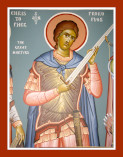 He was born in Jerusalem of a Christian
father and a pagan mother, at first bearing the name Neanias. After his father’s death, his
mother brought him up entirely in the spirit of Roman idolatry. When he had grown up, the Emperor
Diocletian saw him at some time and was so pleased with him that he took him to court to serve in
the army. When this wicked emperor launched a persecution of Christians, he ordered Neanias to go
with a detachment of soldiers to Alexandria and exterminate the Christians there. But, on the
road, there happened to Neanias something similar to that which happened to Saul. At three
o’clock in the morning there was a violent earthquake, the Lord Jesus appearing to him and
saying: ‘Neanias, where are you going, and against whom are you rebelling?’ In great
fear, Neanias replied: ‘Who art Thou, Lord? I cannot recognize Thee.’ Then a
brilliant Cross, as of crystal, appeared in the sky and a voice came from the Cross: ‘I am
Jesus, the crucified Son of God.’ The Lord went on: ‘By this sign that you have seen,
overcome your enemies, and My peace will be with you.’ This event utterly changed Neanias’
life. He caused a cross such as he had seen to be made, and instead of moving against the
Christians, set off with his soldiers against the Hagarenes, who were attacking Jerusalem. He
entered Jerusalem victorious and told his mother that he was a Christian. Brought to trial, he
took off his army belt and sword and cast them before the judge, demonstrating by this that he
was a soldier only of Christ the King. After harsh torture, he was thrown into prison. There
Christ the Lord appeared to him again, baptising him and giving him the name Prokopios. One day
twelve women came to the window of his cell and said to him: ‘We also are the servants of
Christ.’ Arrested for this, they were thrown into the same prison, where St. Prokopios
instructed them in the Christian Faith and carefully prepared them to receive the crown of
martyrdom.* These twelve women were then harshly tortured. Beholding their sufferings and
courage, Prokopios’ mother also came to faith in Christ, and then all thirteen were put to death.
When St. Prokopios was led to the scaffold, he raised his hands towards the East and prayed to
God for all the poor and needy, the destitute and the widowed, and especially for the holy
Church, that it might grow and spread and that Orthodoxy might shine to the end of time. He was
assured from heaven that his prayer was heard, after which he joyfully laid his head under the
sword and went to his Lord, to eternal joy. St. Prokopios suffered with honor in Palestinian
Caesarea, and was crowned with an eternal wreath of glory, on July 8th, 303.
He was born in Jerusalem of a Christian
father and a pagan mother, at first bearing the name Neanias. After his father’s death, his
mother brought him up entirely in the spirit of Roman idolatry. When he had grown up, the Emperor
Diocletian saw him at some time and was so pleased with him that he took him to court to serve in
the army. When this wicked emperor launched a persecution of Christians, he ordered Neanias to go
with a detachment of soldiers to Alexandria and exterminate the Christians there. But, on the
road, there happened to Neanias something similar to that which happened to Saul. At three
o’clock in the morning there was a violent earthquake, the Lord Jesus appearing to him and
saying: ‘Neanias, where are you going, and against whom are you rebelling?’ In great
fear, Neanias replied: ‘Who art Thou, Lord? I cannot recognize Thee.’ Then a
brilliant Cross, as of crystal, appeared in the sky and a voice came from the Cross: ‘I am
Jesus, the crucified Son of God.’ The Lord went on: ‘By this sign that you have seen,
overcome your enemies, and My peace will be with you.’ This event utterly changed Neanias’
life. He caused a cross such as he had seen to be made, and instead of moving against the
Christians, set off with his soldiers against the Hagarenes, who were attacking Jerusalem. He
entered Jerusalem victorious and told his mother that he was a Christian. Brought to trial, he
took off his army belt and sword and cast them before the judge, demonstrating by this that he
was a soldier only of Christ the King. After harsh torture, he was thrown into prison. There
Christ the Lord appeared to him again, baptising him and giving him the name Prokopios. One day
twelve women came to the window of his cell and said to him: ‘We also are the servants of
Christ.’ Arrested for this, they were thrown into the same prison, where St. Prokopios
instructed them in the Christian Faith and carefully prepared them to receive the crown of
martyrdom.* These twelve women were then harshly tortured. Beholding their sufferings and
courage, Prokopios’ mother also came to faith in Christ, and then all thirteen were put to death.
When St. Prokopios was led to the scaffold, he raised his hands towards the East and prayed to
God for all the poor and needy, the destitute and the widowed, and especially for the holy
Church, that it might grow and spread and that Orthodoxy might shine to the end of time. He was
assured from heaven that his prayer was heard, after which he joyfully laid his head under the
sword and went to his Lord, to eternal joy. St. Prokopios suffered with honor in Palestinian
Caesarea, and was crowned with an eternal wreath of glory, on July 8th, 303.
* Author’s note: Therefore those in the married state (‘crowned’), invoke St. Prokopios, together with the God-crowned Constantine and Helena.
2. St. Procopius (Prokopy) the Fool for Christ.
A wonder-worker of Ustiug, who died in 1303, he was of German origin and was a well-known merchant. Arriving in Novgorod in the course of his work, he was entranced by the beauty of Orthodoxy and embraced the Orthodox Faith. He desired to be a perfect Christian, to which end he gave away all his goods to the poor and exercised himself in the practice of all the other virtues. He feigned madness to avoid the praise of men, had insight into their hearts and destinies and was also able to predict natural occurrences. By his tearful prayers before the icon of the most holy Mother of God, he stopped a terrible hailstorm over the town of Ustiug, and thus brought the sinful town to repentance. His dead body was found in the road, covered with snow. A church was built over his wonder-working relics.
3. Our Holy Father Theophilus the Outpourer of Myrrh.
A Macedonian by birth, from the village of Ziki, he was a very learned man and a great ascetic. By order of Patriarch Niphon of Constantinople, he travelled to Alexandria to ascertain whether it was true that Patriarch Joachim could move mountains and drink poison without harm, being driven to this by the Jews and Moslems. Convinced of the truth of these marvels, Theophilus returned to the Holy Mountain, where he lived in asceticism first at Vatopedi, then at Iviron and finally in St. Basil’s cell near Karyes. Urged to accept the archbishopric of Thessalonica, this holy man refused. Through profound silence, meditation and heartfelt prayer, he succeeded in purifying his mind from all passionate thoughts, and thus became a pure vessel of the Holy Spirit, indwelt by Christ. At the time of his death, he ordered his disciple, Isaac, not to bury him when he was dead but to tie a cord round his feet and drag him away to a nearby stream, and there throw him in. With great fear, the disciple did this. But, by the providence of God, St. Theophilus’ relics were discovered, and when they were taken to his cell, a miraculous myrrh began to flow from them. He entered into rest on July 8th, 1548.
FOR CONSIDERATION
St. Anthony teaches: ‘Be fearful of becoming famed for anything that you may do. If men begin to praise you for your deeds, do not rejoice at it or find sweetness therein. Keep your deeds as secret as possible and do not make it necessary for any to speak of them.’ How much more peace and joy would there be among men on earth if even half of them would take these words to heart! St. Theophilus, although he lived withdrawn on the Holy Mountain as a simple monk, was famed among all the Eastern patriarchs both for his learning and for his asceticism and good works. It happened at one time that Theoleptos, Patriarch of Constantinople, visited Thessalonica. At that time the archiepiscopal throne in Thessalonica was vacant. The Christians of Thessalonica begged the patriarch with one voice to give them Theophilus as archbishop. The patriarch, a fellow-countryman and friend of Theophilus, wrote to him with his own hand, inviting him to accept the archiepiscopal throne. The humble Theophilus, fearing the praise of men but not finding it easy to refuse the patriarch, immediately received the Great Habit,* and then informed the patriarch, adding: ‘If God wills, we shall meet again in the heavenly kingdom.’ Thus did spiritual giants, proclaimed saints by the Church, shun vanity and the praise of men.
* Translator’s note: The reception of the Great Habit, the strictest order of monasticism, according to one tradition, precludes a man from holding office in the Church.
Daily Scripture Readings taken from The Orthodox New Testament, translated and published by Holy Apostles Convent, Buena Vista, Colorado, copyright © 2000, used with permission, all rights reserved.
Daily Prologue Readings taken from The Prologue of Ochrid, by Bishop Nikolai Velimirovic, translated by Mother Maria, published by Lazarica Press, Birmingham, England, copyright © 1985, all rights reserved. Edited by Dormition Skete.