

Daily Devotional
Monday, July 19, 2027 (NS), July 6, 2027 (OS)
No Fasting.
Monday of the Fifth Week
The commemoration of our venerable Father Sisoes the Great.
Scripture Readings
Paschalion — Movable Calendar
Monday of the Fifth Week
Epistle
The Reading is from the Epistle of Saint Paul to the Romans [§ 109]. Brethren:
12 4Even as we have many members in one body, but all the members have not the same function, 5so we, who are many, are one body in Christ, and each one members of one another....
15Be rejoicing with those who rejoice, and be weeping with those who weep. 16Be of the same mind toward one another. Mind not high things, but bring yourselves down to associate with the humble. Cease becoming wise in your own conceits. 17Render to no one evil for evil. Provide for yourselves right things before all men. 18If possible, as to that which depends on you, be at peace with all men. 19Avenge not yourselves, beloved, but give place to wrath; for it hath been written: “Vengeance is Mine; I will repay [Deut. 32:35],” saith the Lord. 20Therefore, “If thine enemy should hunger, be feeding him; if he should thirst, be giving him drink; for in doing this thou shalt heap coals of fire on his head [Prov. 25:21, 22].” 21Cease being conquered by the bad, but keep on conquering the bad with the good.
Gospel
The Reading is from the Holy Gospel according to Saint Matthew [§ 45]. At that time:
12 9Jesus went into the synagogue of the Jews. 10And behold, there was a man who had a withered hand. And they asked Him, saying, “Is it lawful to cure on the sabbath days?”—that they might accuse Him. 11And He said to them, “What man shall there be among you who shall have one sheep, and if this should fall into a pit on the sabbath days, will he not lay hold of it and raise it up? 12“How much then doth a man excel a sheep? Therefore it is lawful on the sabbath days to do well.” 13Then He saith to the man, “Stretch forth thy hand”; and he stretched it forth; and it was restored sound as the other.
Menaion — Fixed Calendar
The commemoration of our venerable Father Sisoes the Great.
No readings given.
Lives of the Saints (Prologue)
July 19th – Civil Calendar
July 6th – Church Calendar
1. Our Holy Father Sisoës the Great.
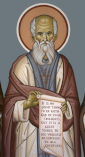 An Egyptian by birth, he lived
at first in Sketis then, after St. Anthony’s death, settled on the desert mountain on which
Anthony had earlier lived in asceticism and which was named after him. He learned humility
through great struggles with himself, becoming meek and guileless as a lamb. Therefore God gave
him the great gifts of healing the sick, driving out unclean spirits and raising the dead.
Sisoës lived in the desert for sixty years, and was a fount of living wisdom for all the
monks and lay folk who came to him for advice. At the time of his death, his face shone like the
sun. The monks stood around him and marvelled at this sight, and when the saint gave up his soul,
the whole chamber was filled with a wonderful fragrance. He entered into rest in great old age,
in about 429. St. Sisoës taught his monks: ‘When temptation comes to a man, that man
must give himself over to the will of God, and acknowledge that the temptation comes upon him
because of his sins. If something good comes to pass, he must acknowledge that it comes about by
the providence of God.’ A monk asked him: ‘How can I please God and be saved?’
The saint replied: ‘If you desire to please God, withdraw from the world, separate yourself
from the earth, leave aside creation and draw near to the Creator, unite yourself to God with
prayers and tears, and you will find rest in this world and in the next.’ A monk asked
Sisoës: ‘How can I acquire humility?’ The saint replied: ‘When a man
learns to regard every man as better than himself, he thus acquires humility.’ Ammon
complained to Sisoës that he could not memorise the wise sayings that he had read, to be
able to quote them in conversation with others. The saint replied: ‘It is not necessary.
That which is necessary is to acquire purity of mind and to speak from this purity, placing
one’s hope in God.’
An Egyptian by birth, he lived
at first in Sketis then, after St. Anthony’s death, settled on the desert mountain on which
Anthony had earlier lived in asceticism and which was named after him. He learned humility
through great struggles with himself, becoming meek and guileless as a lamb. Therefore God gave
him the great gifts of healing the sick, driving out unclean spirits and raising the dead.
Sisoës lived in the desert for sixty years, and was a fount of living wisdom for all the
monks and lay folk who came to him for advice. At the time of his death, his face shone like the
sun. The monks stood around him and marvelled at this sight, and when the saint gave up his soul,
the whole chamber was filled with a wonderful fragrance. He entered into rest in great old age,
in about 429. St. Sisoës taught his monks: ‘When temptation comes to a man, that man
must give himself over to the will of God, and acknowledge that the temptation comes upon him
because of his sins. If something good comes to pass, he must acknowledge that it comes about by
the providence of God.’ A monk asked him: ‘How can I please God and be saved?’
The saint replied: ‘If you desire to please God, withdraw from the world, separate yourself
from the earth, leave aside creation and draw near to the Creator, unite yourself to God with
prayers and tears, and you will find rest in this world and in the next.’ A monk asked
Sisoës: ‘How can I acquire humility?’ The saint replied: ‘When a man
learns to regard every man as better than himself, he thus acquires humility.’ Ammon
complained to Sisoës that he could not memorise the wise sayings that he had read, to be
able to quote them in conversation with others. The saint replied: ‘It is not necessary.
That which is necessary is to acquire purity of mind and to speak from this purity, placing
one’s hope in God.’
2. The Holy Martyrs Marinus and Martha, with their sons Audifax and Habakkuk, the Priest Valentine, Cyrinus, Asterius and many others.
They all suffered in the time of the Emperor Claudius Flavius in Rome, in the year 269. Marinus and Martha were rich Persians, who had sold all their goods in Persia and gone with their sons to Rome to venerate the relics of the holy apostles and other martyrs. When the emperor asked them why they had come such a distance, forsaking their household gods to seek the dead in Rome, they replied: ‘We are servants of Christ, and are come to venerate the holy apostles whose immortal souls are alive with God, that they may be our intercessors with Christ our God.’ Cyrinus was thrown into the Tiber, whence Marinus retrieved his body and buried it. The priest Valentine was committed to a General Asterius, whose task it was to urge him to deny Christ. But Valentine healed Asterius’ daughter, who had been blind for two years, by his prayers, and then baptized Asterius and his whole household. These all, in diverse ways, received torture and death for Christ the Lord, Who welcomed them into His immortal kingdom to rejoice eternally.
3. The Finding of the Relics of St. Juliana the Virgin.
The daughter of a prince of Olshansk, Juliana died in about 1540, as a girl of sixteen. Two hundred years after her death, some men digging a grave near the great church in a monastery in Kiev found the relics of this holy virgin, whole and incorrupt as though she had just fallen asleep. Many wonders were worked over these relics, and Juliana herself appeared several times to various people. The famous Peter Moghila was one of those who saw her.
4. The Holy Martyr Lucy.
The barbarian King Austius made her a slave in Campania. He wanted to have her live with him, but she resisted. The king left her in peace, to live in asceticism. She brought the king to the Faith because, by her prayers, he was victorious in battle. Later, they both suffered for Christ in Rome, in about 300.
FOR CONSIDERATION
Whence do we know that there is life after death? We know from Christ the Lord, on the foundation of His words, His Resurrection and His appearances after His death. Philosophers who recognize life after death accept it on the foundation of their own reasoning, but we recognize it on the foundation of experience, especially the experience of holy men and women who were unable to proclaim a lie. When St. Sisoës lay on his deathbed, his face was suffused with light. The monks, his disciples, stood around him. Suddenly the saint’s gaze became intent, and he said: ‘Behold, the prophets are coming!’ His countenance became yet more radiant, and he said: ‘Behold, the apostles are coming!’ Then he said: ‘Behold, the angels are coming to take my soul!’ Finally, his face shone like the sun and all were in great fear, then the elder said: ‘Behold, the Lord is coming; look, all of you! Listen! He’s saying: “Bring Me the chosen vessel from out of the wilderness”!’ After this, the saint gave up his soul. How many similar visions have there been—and all by reliable witnesses!
Daily Scripture Readings taken from The Orthodox New Testament, translated and published by Holy Apostles Convent, Buena Vista, Colorado, copyright © 2000, used with permission, all rights reserved.
Daily Prologue Readings taken from The Prologue of Ochrid, by Bishop Nikolai Velimirovic, translated by Mother Maria, published by Lazarica Press, Birmingham, England, copyright © 1985, all rights reserved. Edited by Dormition Skete.