

Daily Devotional
Sunday, June 20, 2027 (NS), June 7, 2027 (OS)
No Fasting.
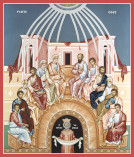
| Eighth Sunday, or the Sunday of Holy Pentecost |
The commemoration of Hieromartyr Theodotos at Ankyra, and the holy five Virgin-martyrs, Martha, Mary, Kyria, Vareria (Valeria), and Markia of Palestine (commemorated on Gk. calendar on the 6th of June).
Scripture Readings
Paschalion — Movable Calendar
Eighth Sunday, or the Sunday of Holy Pentecost
Epistle
The Reading is from the Acts of the Apostles [§ 3].
2 1While the day of Pentecost was being fulfilled, they were all with one accord in the same place. 2And suddenly there came to be a sound out of the heaven, like as of a violent wind borne along, and it filled the whole house where they were sitting. 3And there appeared to them tongues, as if of fire, being distributed; and it sat upon each one of them. 4And they were all filled with the Holy Spirit, and began to speak in other tongues, even as the Spirit was giving them to utter. 5And there were Jews abiding in Jerusalem, pious men, from every nation of those under the heaven. 6And the report of this having arisen, the multitude came together and was confounded, because they were hearing, each one of them, speaking in his own dialect. 7And they were all amazed and wondering, saying to one another, “Behold, all these who are speaking are Galilæans, are they not? 8“And how do we each hear in our own dialect in which we were born? 9“Parthians and Medes and Elamites and those who dwell in Mesopotamia, also Judæa and Cappadocia, Pontos and Asia, 10“also Phrygia and Pamphylia, Egypt and the parts of Libya which are in the region of Cyrene, and the Romans, both Jews and proselytes, who sojourn here, 11“Cretans and Arabians—we hear them speaking in our own tongues the magnificent works of God.”
Gospel
In the Orthros
The Reading is from the Holy Gospel according to Saint John [§ 65].
20 19When it was evening on that day, the first of the week—and the doors were closed where the disciples were gathered together for fear of the Jews—Jesus came and stood in the midst, and saith to them, “Peace be to you.” 20And after He said this, He showed them His hands and His side. Then were the disciples glad, after they saw the Lord. 21Then Jesus said to them again, “Peace be to you; even as the Father hath sent Me forth, I also send you.” 22And after He said this, He breathed on them, and saith to them, “Receive ye the Holy Spirit: 23“if ye forgive the sins of any, they are forgiven to them; if ye retain the sins of any, they are retained.”
In the Liturgy
The Reading is from the Holy Gospel according to Saint John [§ 27].
7 37In the last day, that great day of the feast, Jesus was standing and cried out, saying, “If anyone thirst, let him come to Me and drink. 38“The one who believeth in Me, even as the Scripture said—rivers of living water shall flow out of his belly.” 39But this He said concerning the Spirit, Whom those who believe in Him were about to receive; for the Holy Spirit was not yet given, because Jesus was not yet glorified. 40Many therefore of the crowd, having heard the utterance, were saying, “This is truly the Prophet.” 41Others were saying, “This is the Christ.” But others were saying, “The Christ is not coming out of Galilee, is He? 42“Hath not the Scripture said that of the seed of David and from the village of Bethlehem, where David was, the Christ is coming?” 43Therefore a division occurred in the crowd on account of Him. 44And some of them were wishing to lay hold of Him, but no one laid hands on Him. 45Then came the officers to the chief priests and Pharisees, and they said to them, “Why did ye not bring Him?” 46The officers answered, “Never did a man so speak as this Man.” 47Then the Pharisees answered them, “Ye have not also been deceived, have ye? 48“Not one of the rulers believe in Him or of the Pharisees, doth he? 49“But this people who knoweth not the law are accursed!” 50Nicodemos (the one who came by night to Him, being one of them) saith to them, 51“Our law doth not judge the man, unless it should first hear him, and know from the man himself what he doeth, doth it?” 52They answered and said to him, “Thou art not also of Galilee, art thou? Search and look, for a prophet hath not been raised out of Galilee.”...
8 12Then Jesus spoke again to them, saying, “I am the light of the world; the one who followeth Me in no wise shall walk in the darkness, but shall have the light of the life.”
Menaion — Fixed Calendar
The commemoration of Hieromartyr Theodotos at Ankyra, and the holy five Virgin-martyrs, Martha, Mary, Kyria, Vareria (Valeria), and Markia of Palestine (commemorated on Gk. calendar on the 6th of June).
No readings given.
Lives of the Saints (Prologue)
June 20th – Civil Calendar
June 7th – Church Calendar
1. The Holy Martyr Theodotus of Ankyra.
This martyr was a secret Christian, and as such, used to help the Church and give burial to the bodies of the martyrs. He buried the bodies of seven young maidens who had suffered for Christ. When the pagans discovered this, they attacked him and he was killed (see May 18th for more about him).
2. The Holy Martyrs Kyria, Valeria and Maria.
All three of these martyrs were from Caesarea in Palestine. When a persecution of Christians arose, they withdrew from the city to a hut, where they prayed unceasingly to God with fasting and tears that the Christian Faith might be spread throughout the entire world and that persecution might cease. As the result of slander, they were brought to trial and tortured, and died under their torments in the year 304. And so these glorious virgins were crowned with the wreath of martyrdom.
3. The Hieromartyr Marcellus, Pope of Rome.
In the reign of the Emperor Maximian, Marcellus was condemned to keep cattle in a certain place. In order to please Diocletian, who had taken him as co-emperor, Maximian began to build the Thermae, the baths in Rome, and forced the Christians to work on them as Pharaoh had once forced the Jews in Egypt. Many Christians perished there. The deacon Kyriakus, who had healed Artemia, Diocletian’s daughter, of an evil spirit (for he had great power over demons), suffered at this time. He had also healed Jovia, the daughter of the Persian king, and had baptized them both. Artemia, the deacon Sisinius, two friends of Kyriakus, Smaragdus and Largius, the deacon Aphronianus and two newly baptized Roman soldiers, Papius and Maurus, the elder Saturninus and Crescentianus, the blessed maidens Priscilla and Lucina, who used their great wealth to have graves made for the Christian martyrs—all these suffered at this time. The holy Pope Marcellus cared for the cattle for a long time, but finally became weakened from hunger and humiliation and the tortures of the soldiers, and surrendered his soul to God.
4. The Hieromartyr Marcellinus, Pope of Rome.
Marcellinus was Pope Marcellus’ predecessor on the Roman throne. When the Emperor Diocletian summoned him and threatened him with torture, he offered sacrifice to idols and was, because of this, rewarded by the emperor with a costly garment. But Marcellinus repented bitterly and began to weep both day and night for his rejection of Christ, even as the Apostle Peter had before him. A synod of bishops was held at that time in Campania, and the pope dressed himself in sackcloth and sprinkled ashes on his head, and going before the synod, confessed his sin and asked them to judge him. The fathers said: ‘Let him judge himself.’ Then he said: ‘I strip myself of the sacerdotal rank of which I am not worthy; and further, let my body not be buried after my death, but let it be thrown to the dogs.’ Having said this, he pronounced a curse on any who should dare to bury him. He then went to the Emperor Diocletian, and casting the precious garment in front of him, confessed his faith in Christ and cursed the idols. The enraged emperor ordered that he be tortured and killed outside the city, together with three other men: Claudius, Cyrinus and Antoninus. The bodies of these three were buried at once, but the pope’s body lay there for thirty-six days. Then St. Peter appeared to Marcellus, the new pope, and told him to bury Marcellinus’ body, saying: ‘Who so humbleth himself shall be exalted.’
5. Our Holy Father Daniel of Sketis.
The abbot of the famous Sketis in Egypt, he was a disciple of St. Arsenius and a teacher of many. Many of his words and teachings are like celestial signposts for monks. Once, when the barbarians were attacking Sketis, the brethren called to him to flee with them, but he replied: ‘If God does not care for me, what reason is there for me to live?’ He also once said: ‘Insofar as your body grows fat, even so does your soul wither away.’ He lived the communal life as an ascetic for forty years, and then in the year 420 took himself off to the desert. He happened to be in Alexandria when an evil man murdered his son’s wife because of her chastity. This was St. Thomaïs (see April 13th), and he buried the martyr with the help of his disciples.
FOR CONSIDERATION
A saint has a very sensitive conscience. What ordinary people may consider a small sin, a saint sees as a great crime. It is said of Abba Daniel that highwaymen attacked him on three occasions and took him off into the mountains. Twice he was rescued, but the third time, in attempting to escape, he struck one of them with a stone and killed him, and then made his escape. That murder lay on his conscience like a lead weight. In perplexity as to what he should do, he went to Timothy, the Patriarch of Alexandria, and asked his advice. The patriarch soothed him, and released him from all penance. But his conscience continued to gnaw at him, and he went to Rome, to the pope. The pope gave him the same reply as had the patriarch. Still dissatisfied, Daniel visited the remaining patriarchs in turn; going to Constantinople, Antioch and Jerusalem, confessing to each of them and asking for advice. But he could find no peace. So he returned home to Alexandria and declared himself to the authorities as a murderer, and was flung into prison. At his trial before the governor, Daniel told how everything had come about, and pleaded that he might be killed too, that his soul might be saved from eternal fire. The governor was amazed at the whole thing and said to him: ‘Go your way, father, and pray to God for me, even if you kill seven more!’ Still dissatisfied with this, Daniel resolved to take a leper into his cell and care for him until he died, and then find another. He did as he had resolved, and in this way brought peace to his conscience.
Daily Scripture Readings taken from The Orthodox New Testament, translated and published by Holy Apostles Convent, Buena Vista, Colorado, copyright © 2000, used with permission, all rights reserved.
Daily Prologue Readings taken from The Prologue of Ochrid, by Bishop Nikolai Velimirovic, translated by Mother Maria, published by Lazarica Press, Birmingham, England, copyright © 1985, all rights reserved. Edited by Dormition Skete.