

Daily Devotional
Thursday, June 17, 2027 (NS), June 4, 2027 (OS)
No Fasting.
Thursday of the Seventh Week
The commemoration of our holy father among the saints, Metrophanes, Archbishop of Constantinople.
Scripture Readings
Paschalion — Movable Calendar
Thursday of the Seventh Week
Epistle
The Reading is from the Acts of the Apostles [§ 48]. In those days:
25 13Agrippa the king and Bernice came down to Cæsarea, greeting Festus. 14And when they spent more days there, Festus himself set forth to the king the matter relating to Paul, saying, “There is a certain man, a prisoner, who hath been left behind by Felix, 15“concerning whom, when I was in Jerusalem, the chief priests and the elders of the Jews brought charges, requesting a judgment against him. 16“To whom I answered, ‘It is not a custom with Romans to be giving up any man to destruction before the one who is accused may have the accusers face to face, and may receive an opportunity of speaking in his own defense concerning the charge.’ 17“Therefore when they came together here, I made no delay. And on the next day I sat on the tribunal and commanded the man to be brought forth, 18“concerning whom after the accusers stood up, they did not bring even one charge of which I suspected. 19“But they were having certain subjects of dispute with him concerning their own religion, and about a certain Jesus Who had died, Whom Paul was affirming to be alive.”
Gospel
The Reading is from the Holy Gospel according to Saint John [§ 55]. The Lord said to His disciples:
16 23“Verily, verily, I say to you that whatsoever ye shall ask the Father in My name, He will give it to you. 24“Until now ye asked nothing in My name. Keep on asking, and ye shall receive, in order that your joy may be made full. 25“These things I have spoken to you in proverbs; but an hour is coming when I will no longer talk to you in proverbs, but I shall announce plainly to you concerning the Father. 26“In that day ye shall ask for yourselves in My name, and I say not to you that I will ask the Father for you; 27“for the Father Himself loveth you, because ye have loved Me, and have believed that I came forth from God. 28“I came forth from the Father and have come into the world. Again I leave the world and go to the Father.” 29His disciples say to Him, “Behold, now Thou speakest plainly, and speakest no proverb. 30“Now we know that Thou knowest all things, and hast no need that anyone should question Thee. By this we believe that Thou camest forth from God.” 31Jesus answered them, “Now do ye believe? 32“Behold, an hour is coming and now hath come, that ye shall be scattered each to his own, and shall leave Me alone; and yet I am not alone, because the Father is with Me. 33“These things I have spoken to you, in order that ye may have peace in Me. In the world ye shall have affliction; but be of good courage, I have overcome the world.”
Menaion — Fixed Calendar
The commemoration of our holy father among the saints, Metrophanes, Archbishop of Constantinople.
Epistle
The Reading is from the Epistle of Saint Paul to the Hebrews [§ 318]. Brethren:
7 26Such a High Priest was fitting for us: holy, guileless, undefiled, Who hath been separated from the sinners and hath become higher than the heavens, 27Who hath no need daily, even as the high priests, to offer up sacrifices, first for his own sins, then for those of the people; for this He did once for all after He offered up Himself. 28For the law appointeth men high priests who have weakness; but the word of the oath, which is after the law, appointeth the Son, Who hath been perfected forever.
8 1Now in reference to the things being spoken of, the chief point is: We have such a High Priest, Who sat down on the right of the throne of the majesty in the heavens, 2a Liturgist of the holies and of the tabernacle, the true one, which the Lord pitched, and not man.
Gospel
The Reading is from the Holy Gospel according to Saint John [§ mid 35]. The Lord said to those Jews who had come to Him:
10 1“Verily, verily, I say to you, the one who entereth not by the door into the fold of the sheep, but goeth up from another place, that one is a thief and a robber. 2“But the one who entereth by the door is a shepherd of the sheep. 3“To this one the doorkeeper openeth, and the sheep hear his voice; and he calleth his own sheep by name and leadeth them out. 4“And whenever he should put forth his own sheep, he goeth before them; and the sheep follow him, because they know his voice. 5“But a stranger in no wise will they follow, but will flee from him, because they know not the voice of strangers.” 6This parable Jesus spoke to them; but they understood not what it was which He spoke to them. 7Then said Jesus to them again, “Verily, verily, I say to you that I am the door of the sheep. 8“All, as many as came before Me, are thieves and robbers; but the sheep heard them not. 9“I am the door; by Me if anyone should enter, he shall be saved, and shall go in and go out and find pasture.”
Lives of the Saints (Prologue)
June 17th – Civil Calendar
June 4th – Church Calendar
1. St. Metrophanes of Constantinople.
His father Dometius, brother of the Roman Emperor Probus, fled from Rome as a Christian during a persecution and went to Byzantium. The Bishop of Byzantium, Titus, ordained Dometius priest, and after Titus’ death, Dometius became Bishop of Byzantium. After Dometius’ death, his elder son Probus occupied the episcopal throne (Dometius had children from his earlier, pagan days), and Metrophanes succeeded him on his death. When the Emperor Constantine first set eyes on Metrophanes, he loved him as a father. At the time of the First Ecumenical Council, Metrophanes was a very old man, and being unable to take a full part in the council’s deliberations, appointed his assistant bishop, Alexander, as his representative. The emperor had Metrophanes raised to the rank of patriarch by the council, and he thus became the first Patriarch of Constantinople. The emperor further invited the whole council to visit the sick and aged hierarch. When the emperor asked him who he wished to succeed him on the patriarchal throne, Metrophanes named Alexander of Alexandria, after which he said to him: ‘My brother, you are my chosen successor!’ He also took Archdeacon Athanasius (later Athanasius the Great, Patriarch of Alexandria) by the hand and praised him before them all. After this prophetic act, he took leave of them all, and ten days later, gave his soul to God, in 325.
2. The Holy Martyr Concordius.
He was a great ascetic and a wonder-worker during his earthly life. Arrested as a Christian under the Emperor Antoninus, he was tortured and imprisoned, and led before the stone idol of Zeus to pay it reverence. He spat on the idol, for which he was at once beheaded.
3. The Holy Martyrs Frontasius, Severinus, Severian and Silanus.
They were martyred in France in the time of the Emperor Claudius. When they had been beheaded, they rose to their feet, took their heads in their hands, crossed the river Ile and came to the church of the most holy Mother of God, where Bishop Frontanus was at prayer. Entering the church, they laid their heads at the bishop’s feet and then lay down and crossed themselves. They were buried there, and at their burial, the singing of an unseen host of angels was heard.
4. Our Holy Father Zosimas, Bishop of New Babylon in Egypt.
He lived in asceticism on Mount Sinai. Going to Alexandria in the course of his work, he was consecrated by the venerable Patriarch Apollinarios as Bishop of New Babylon. He was a good pastor of Christ’s flock, but when old age and weariness came upon him, he withdrew again to Sinai, where he gave his soul into God’s hands and received a wreath of glory among the great hierarchs. He lived and died in the 6th century.
5. The Hieromartyr Astius (Asteios), Bishop of Dyrrachium.
He suffered under Trajan. First beaten with leaden rods, he was then stripped bare and crucified on a tree. His naked body, smeared with honey, was left for the wasps and hornets to eat. St. Astius breathed his last in great torment, praising God, and received a twofold wreath: as a martyr and a hierarch. He suffered at the beginning of the second century.
6. Ss. Mary and Martha, the Sisters of Lazarus.
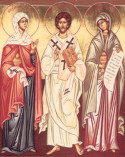 After the Lord’s Ascension,
Lazarus went about preaching the Gospel, and his sisters helped him in this work. It is not
known where they died. After the Lord’s Ascension,
Lazarus went about preaching the Gospel, and his sisters helped him in this work. It is not
known where they died.
|
FOR CONSIDERATION
It is a terrible thing to murder a man. There are no words that would suffice to express the terror that seizes upon the murderer. While a man is plotting to kill another, he reckons that it is the same thing to kill a man as it is to kill an ox, but when he has carried out his planned wickedness, he suddenly finds that he has declared war on both heaven and earth and that he is exiled, cut off from both. The slain one gives him no peace either day or night.
A notorious brigand came to St. Zosimas on Sinai, and asked him to make him a monk. St. Zosimas clothed him in the monastic schema and sent him to the monastery of St. Dorotheos in Gaza, to live the ascetic life in the community there. Nine years later, this brigand-become-monk returned to him and sought his secular clothing, handing him back his monastic schema. When asked why he was doing this, he replied that he had, for nine years, prayed to God with all his heart, fasted, kept vigil and fulfilled every obedience; that he felt many of his sins had been forgiven, but that one sin constantly tormented him. He had once murdered an innocent child, and this child appeared to him day and night, asking: ‘Why did you murder me?’ He had therefore decided to go and give himself up to the authorities, that they might execute him and he might thus pay blood for blood. Dressing himself in his former garments, he went to the town of Diospolis, where he declared his evil-doing and was beheaded, and thus, by his blood, washed away his bloody sin.
Daily Scripture Readings taken from The Orthodox New Testament, translated and published by Holy Apostles Convent, Buena Vista, Colorado, copyright © 2000, used with permission, all rights reserved.
Daily Prologue Readings taken from The Prologue of Ochrid, by Bishop Nikolai Velimirovic, translated by Mother Maria, published by Lazarica Press, Birmingham, England, copyright © 1985, all rights reserved. Edited by Dormition Skete.