

Daily Devotional
Sunday, May 23, 2027 (NS), May 10, 2027 (OS)
No Fasting.
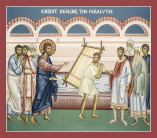
| The Fourth Sunday of Pascha, or the Sunday of the Paralytic Mode Three — Fifth Eothinon |
The commemoration of the holy Apostle Simon the Zealot.
Scripture Readings
Paschalion — Movable Calendar
The Fourth Sunday of Pascha, or the Sunday of the Paralytic
Mode Three — Fifth Eothinon
Epistle
The Reading is from the Acts of the Apostles [§ 23]. In those days:
9 32It came to pass, as Peter passed through all quarters, he went down also to the saints that dwelt at Lydda. 33And there he found a certain man, by name Æneas, who kept his bed for eight years, and was paralyzed. 34And Peter said to him, “Æneas, Jesus the Christ healeth thee; rise up and make up thy bed for thyself.” And straightway he rose up. 35And all those inhabiting Lydda and the Sharon Plain, who saw him, turned to the Lord. 36Now there was in Joppa a certain disciple, by name Tabitha, which, being interpreted, is called Dorcas. She was full of good works and of alms which she used to do. 37And it came to pass in those days she fell sick and died. And after they washed her, they laid her in an upper room. 38And since Lydda was near to Joppa, and the disciples heard that Peter was in it, they sent forth two men to him, beseeching him not to delay to come over to them. 39And Peter, having risen up, went with them, whom after he came, they brought him into the upper room. And all the widows stood by him weeping, and showing howsoever many tunics and garments Dorcas used to make while she was with them. 40But Peter put them all forth, and kneeled down, and prayed. And turning to the body, he said, “Tabitha, rise up.” And she opened her eyes; and after she saw Peter she sat up. 41And he gave her his hand and raised her up; and after he called the saints and the widows, he presented her alive. 42And it became known throughout all of Joppa; and many believed on the Lord.
Gospel
The Reading is from the Holy Gospel according to Saint John [§ 14]. At that time:
5 1Jesus went up to Jerusalem. 2Now there is in Jerusalem by the gate a sheep pool, which is surnamed in Hebrew, Bethesda, having five porches. 3In these was lying a great multitude of the infirm, blind, lame, withered, awaiting the moving of the water. 4For an angel used to come down from time to time into the pool and trouble the water; then after the troubling of the water, the one who first entered became well of whatsoever disease he was held by. 5And a certain man was there, who had been thirty and eight years in his infirmity. 6Jesus saw this one lying there, and knew that he had already been much time in that condition, and He said to him, “Dost thou wish to become well?” 7The sick man answered Him, “Sir, I have no man in order that whenever the water is troubled he may put me into the pool; but while I am coming, another goeth down before me.” 8Jesus saith to him, “Rise, take up thy bed and be walking.” 9And straightway the man became well, and took up his bed, and went on walking. And on that day it was a sabbath. 10The Jews therefore were saying to him who had been healed, “It is a sabbath; it is not lawful for thee to take up the bed.” 11He answered them, “The One Who made me well, the same said to me, ‘Take up thy bed and be walking.’” 12Then they asked him, “Who is the Man Who said to thee, ‘Take up thy bed and be walking?’” 13But the one who was healed knew not Who it was, for Jesus turned aside, because a crowd was in the place. 14After these things Jesus findeth him in the temple, and said to him, “Behold, thou hast become well; no longer go on sinning, lest a worse thing should befall thee.” 15The man went away, and told the Jews that Jesus was the One Who made him well.
Menaion — Fixed Calendar
The commemoration of the holy Apostle Simon the Zealot.
Epistle
The Reading is from the First Epistle of Saint Paul to the Corinthians [§ 131]. Brethren:
4 9I think that God showed forth us the apostles last, as condemned to death; for we became a spectacle to the world, both to angels and to men. 10We are fools for Christ’s sake, but ye are wise in Christ. We are weak, but ye are strong. Ye are held in honor, but we are dishonored. 11Until the present hour, we both hunger and thirst, and are naked, and are being buffeted, and never at rest. 12And we toil working with our own hands. Being reviled, we bless; being persecuted, we bear up; 13being evilly spoken of, we beseech. We became as the filth of the world, the off-scouring of all until now. 14I do not write these things shaming you, but admonishing you as my beloved children. 15For if ye have myriads of tutors in Christ, yet ye have not many fathers; for in Christ Jesus I begot you through the Gospel. 16Therefore, I beseech you, keep on becoming imitators of me.
Gospel
The Reading is from the Holy Gospel according to Saint Matthew [§ 56]. At that time:
13 54After Jesus came into His own country, He was teaching the crowds in their synagogue, insomuch that they were astonished and said, “From what place hath this One this wisdom and the works of power? 55“This is the carpenter’s Son, is it not? His Mother is called Mariam, is she not, and His brothers, Iakovos, and Joses, and Simon, and Judas? 56“And His sisters are all with us, are they not? From what place then hath this One all these things?” 57And they were offended in Him. But Jesus said to them, “A prophet is not without honor, except in his own country and in his own house.” 58And He did not do many works of power there because of their unbelief.
or
The Reading is from the Holy Gospel according to Saint John [§ 6]. At that time:
2 1A marriage took place in Cana of Galilee, and the Mother of Jesus was there. 2And Jesus also was invited, and His disciples, to the marriage. 3And after they fell short of wine, the Mother of Jesus saith to Him, “They have no wine.” 4Jesus saith to her, “What is it to Me and to thee, woman? Mine hour is not yet come.” 5His Mother saith to the servants, “Whatsoever He saith to you, do it.” 6And there were standing there six stone waterpots, according to the purification of the Jews, containing two or three measures each. 7Jesus saith to them, “Fill the waterpots with water.” And they filled them up to the top. 8And Jesus saith to them, “Draw out now, and bear it to the master of the feast.” And they brought it. 9Now when the master of the feast tasted the water that had become wine, and knew not from what place it was—but the servants who had drawn the water knew—the master of the feast called the bridegroom, 10and saith to him, “Every man first setteth forth the good wine, and whenever they have drunk freely, then the inferior. As for thee, thou hast kept the good wine until now.” 11This did Jesus in Cana of Galilee as the beginning of the signs, and it made manifest His glory; and His disciples believed in Him.
Lives of the Saints (Prologue)
May 23th – Civil Calendar
May 10th – Church Calendar
1. The Holy Apostle Simon the Zealot.
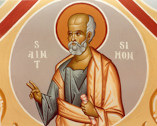 One of the twelve great apostles, he
was born in Cana of Galilee. The Lord Jesus came to his wedding with His Mother and His
disciples, and when the wine ran out, the Lord changed water into wine. Seeing this wonder,
the newly-married Simon left his home and parents and bride, to go after Christ. Simon was
called the Zealot because of his great and burning zeal for the Savior and His Gospel.
After receiving the Holy Spirit, he went off to preach the Gospel in Mauretania in Africa.
As a result of his success in bringing many to the Faith of Christ, he was tortured and
finally crucified like his Lord, Who had prepared a crown of glory for him in His immortal
kingdom. One of the twelve great apostles, he
was born in Cana of Galilee. The Lord Jesus came to his wedding with His Mother and His
disciples, and when the wine ran out, the Lord changed water into wine. Seeing this wonder,
the newly-married Simon left his home and parents and bride, to go after Christ. Simon was
called the Zealot because of his great and burning zeal for the Savior and His Gospel.
After receiving the Holy Spirit, he went off to preach the Gospel in Mauretania in Africa.
As a result of his success in bringing many to the Faith of Christ, he was tortured and
finally crucified like his Lord, Who had prepared a crown of glory for him in His immortal
kingdom.
|
2. The Holy Martyrs Alphaeus, Philadelphus and Cyprinus.
They were brothers, sons of Vitalius, a governor in southern Italy, and were men of great nobility and strong faith. They were brought to judgement for their faith in Christ and taken from one judge to another, from one torturer to another. They were finally taken to Sicily and killed there, in the time of the Emperor Licinius. Alphaeus had his tongue torn out and died from the loss of blood. Philadelphus was burned in an iron coffin, and Cyprinus in fire. Their incorrupt relics were found in 1517. The three brothers appeared to St. Euthalia (see March 2nd).
3. Our Holy Mother Isidora the Fool for Christ.
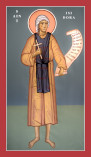 She lived in the
fourth century, and was a nun in a women’s monastery in Tabennisi. She pretended to be mad
in order to conceal her virtues and asceticism. She did the dirtiest jobs, fed herself from
left-over scraps from the plates, was the servant of each and all and was despised by everyone.
At that time, an angel of God appeared secretly to the great ascetic Pitirim, and told him about
Isidora. Pitirim came to the monastery, and when he saw Isidora, bowed down to the ground, and
she did the same before him. The sisters told him that she was mad. ‘It is you that are
mad,’ replied Pitirim. ‘She is greater before God than either you or me. I only beg
God to give me also that which is destined for her at the dreadful Judgement!’ Then the
sisters were ashamed, and begged Pitirim and Isidora to forgive them. From that time, they all
began to show honor to Isidora. But she, to escape this honor, fled from the monastery and
finished her monastic life in obscurity in about 365.
She lived in the
fourth century, and was a nun in a women’s monastery in Tabennisi. She pretended to be mad
in order to conceal her virtues and asceticism. She did the dirtiest jobs, fed herself from
left-over scraps from the plates, was the servant of each and all and was despised by everyone.
At that time, an angel of God appeared secretly to the great ascetic Pitirim, and told him about
Isidora. Pitirim came to the monastery, and when he saw Isidora, bowed down to the ground, and
she did the same before him. The sisters told him that she was mad. ‘It is you that are
mad,’ replied Pitirim. ‘She is greater before God than either you or me. I only beg
God to give me also that which is destined for her at the dreadful Judgement!’ Then the
sisters were ashamed, and begged Pitirim and Isidora to forgive them. From that time, they all
began to show honor to Isidora. But she, to escape this honor, fled from the monastery and
finished her monastic life in obscurity in about 365.
4. Blessed Thaïs.
Thaïs was a rich maiden, a Christian, in Egypt. She decided not to marry, but to give her possessions to the hermit monks. But, when she had given away all her goods, she gave herself to a life of debauchery. Hearing of this, the hermits begged Abba John Kolovos to do something, and he went to Alexandria and began to weep in Thaïs’ hearing. When she heard the elder weeping for her sins, she repented at once, left her house and everything she had and went into the desert after the saint. One night when she was sleeping and John was standing in prayer, he saw an angel in a nimbus of light coming down to take Thaïs’ soul. And John saw that her sudden but deep repentance was more pleasing to God than the years-long but shallow repentance of many of the hermits.
FOR CONSIDERATION
In one of his prayers, St. Ephraim the Syrian turns to God with these words: ‘On that dreadful and amazing day, Thou shalt say to us sinners, O Lord: “You men know well what I have undergone for you.... What have you suffered for Me?” What shall I say to that; I who, though penitent, am evil, sinful and polluted? The martyrs will point to their wounds, their sufferings, the severed parts of their bodies, and to their endurance to the end. The ascetics will point to their asceticism, to their long fasts and vigils, to their liberality, their tears and their endurance to the end. But I, idle, sinful, transgressing as I am, what shall I be able to point to? Spare me, O merciful One! Spare me, O Thou Lover of mankind!’
Daily Scripture Readings taken from The Orthodox New Testament, translated and published by Holy Apostles Convent, Buena Vista, Colorado, copyright © 2000, used with permission, all rights reserved.
Daily Prologue Readings taken from The Prologue of Ochrid, by Bishop Nikolai Velimirovic, translated by Mother Maria, published by Lazarica Press, Birmingham, England, copyright © 1985, all rights reserved. Edited by Dormition Skete.