

Daily Devotional
Friday, May 21, 2027 (NS), May 8, 2027 (OS)
Fast Day, but Fish, Wine and Olive Oil Allowed.
Friday of the Third Week
The commemoration of the holy and all-praised Apostle and Evangelist John the Theologian, and our venerable Father Arsensios the Great.
Scripture Readings
Paschalion — Movable Calendar
Friday of the Third Week
Epistle
The Reading is from the Acts of the Apostles [§ 21]. In those days:
8 40Philip was found in Azotos. And passing through, he preached the Gospel to all the cities till he came to Cæsarea.
9 1But Saul, still breathing in threats and murder against the disciples of the Lord, went to the high priest, 2and asked from him letters for himself to Damascus, to the synagogues, so that if he should find any being of the Way, both men and women, he might bring them bound to Jerusalem. 3But as he was proceeding, it came to pass that he drew near to Damascus, and suddenly there flashed a light around him from the heaven. 4And he fell on the ground, and heard a voice saying to him, “Saul, Saul, why persecutest thou Me?” 5And he said, “Who art Thou, Lord?” And the Lord said, “I am Jesus Whom thou persecutest; 6“but rise up and enter into the city, and it shall be told thee what is needful for thee to do.” 7But the men who were traveling with him stood speechless, hearing, indeed, the voice, but seeing no one. 8And Saul was raised up from the ground; and when his eyes were opened he saw no one; but they led him by the hand, and brought him to Damascus. 9And he was three days not seeing, and neither ate nor drank.
10And there was a certain disciple in Damascus, by name Ananias; and the Lord said to him in a vision, “Ananias.” And he said, “Behold, I am here, Lord.” 11And the Lord said to him, “Arise and go to the street which is called Straight, and inquire in the house of Judas for a Tarsian, by name Saul; for behold, he prayeth. 12“And he saw in a vision a man, by name Ananias, who came in and laid his hand on him, so that he might recover his sight.” 13But Ananias answered, “Lord, I have heard from many concerning this man, how many bad things he did to Thy saints in Jerusalem. 14“And here he hath authority from the chief priests to bind all those who call upon Thy name.” 15But the Lord said to him, “Go thy way, for this one is a vessel of election to Me, to bear My name before the nations, and kings, and the sons of Israel. 16“For I will show him how much it is necessary for him to suffer for My name’s sake.” 17And Ananias went away and entered into the house. And having laid his hands upon him he said, “Saul, brother, the Lord, Jesus, Who appeared to thee in the way in which thou wast coming, hath sent me forth, in order that thou mightest recover sight and be filled with the Holy Spirit.” 18And straightway, as if scales fell from his eyes, he both recovered sight forthwith and rose up and was baptized. 19And having received food, he was strengthened.
Gospel
The Reading is from the Holy Gospel according to Saint John [§ 23]. The Lord said to the Jews who had believed in Him:
6 48“I am the bread of life. 49“Your fathers ate the manna in the wilderness, and died. 50“This One is the bread, the One coming down out of the heavens, in order that anyone might eat of it and not die. 51“I am the bread, the living one, the One having come down out of the heavens; if anyone should eat of this bread, he shall live forever. And indeed the bread that I will give is My flesh, which I will give for the life of the world.” 52Then the Jews began quarreling with one another, saying, “How is this One able to give us His flesh to eat?” 53Then Jesus said to them, “Verily, verily, I say to you, unless ye should eat the flesh of the Son of Man and drink His blood, ye are not having life in yourselves. 54“The one who partaketh of My flesh and drinketh My blood hath eternal life; and I will raise him up in the last day.”
Menaion — Fixed Calendar
The commemoration of the holy and all-praised Apostle and Evangelist John the Theologian, and our venerable Father Arsensios the Great.
Epistle
The Reading is from the First General Epistle of Saint John [§ 68 B].
1 1That which was from the beginning, that which we have heard, that which we have seen with our eyes, that which we beheld, and our hands touched, concerning the Logos of the Life— 2and the Life was manifested, and we have seen, and bear witness, and relate to you the Life, the Eternal One, which was with the Father and was manifested to us— 3that which we have seen and heard we relate to you, in order that ye also may have communion with us; and our communion also is with the Father and with His Son, Jesus Christ. 4And these things we write to you in order that our joy may be made full.
5And this is the message which we have heard from Him and we announce to you, that God is light and in Him is no darkness at all. 6If we should say that we have communion with Him, and walk in the darkness, we lie and do not practise the truth; 7but if we walk in the light, as He is in the light, we have communion with one another, and the blood of Jesus Christ His Son cleanseth us from all sin.
Gospel
For the Apostle:
The Reading is from the Holy Gospel according to Saint John [§§ 61, mid 67]. At that time:
19 25There had stood by the Cross of Jesus His Mother, and His Mother’s sister, Mary the wife of Cleopas, and Mary Magdalene. 26Then Jesus, having seen His Mother and the disciple whom He loved standing by, saith to His Mother, “Woman, behold thy son.” 27Then He saith to the disciple, “Behold, thy Mother.” And from that hour the disciple took her into his own home....
21 24This is the disciple who beareth testimony concerning these things, and wrote these things; and we know that his testimony is true. 25And there are also many other things, which if as much as Jesus did may be written one by one, I suppose even the world itself could not contain the books that would be written. Amen.
For the venerable Father:
The Reading is from the Holy Gospel according to Saint Matthew [§ 43]. The Lord said to His disciples:
11 27“All things were delivered to Me by My Father. And no one doth fully know the Son, except the Father; nor doth anyone fully know the Father, except the Son, and he to whomsoever the Son is willing to reveal Him. 28“Come to Me, all ye who labor and are burdened, and I will give you rest. 29“Take up My yoke upon you and learn from Me, for I am meek and humble in heart; and ye shall find rest to your souls. 30“For My yoke is good and My burden is light.”
Lives of the Saints (Prologue)
May 21st – Civil Calendar
May 8th – Church Calendar
1. The Holy Apostle and Evangelist John.
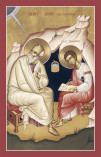 The main commemoration of this great apostle
and evangelist is on September 26th, but on May 8th is commemorated a wonderful revelation
about his grave. When St. John was more than a hundred years old, he took seven of his
disciples, went outside the city of Ephesus and told the disciples to dig a grave in the
form of a cross. Then the elder went down alive into the grave, gave up his soul to the
Lord, and was buried. When the faithful later opened John’s grave, they did not find
the body in it. And on May 8th each year a dust arose from the grave, from which those
suffering from many diseases were healed. The main commemoration of this great apostle
and evangelist is on September 26th, but on May 8th is commemorated a wonderful revelation
about his grave. When St. John was more than a hundred years old, he took seven of his
disciples, went outside the city of Ephesus and told the disciples to dig a grave in the
form of a cross. Then the elder went down alive into the grave, gave up his soul to the
Lord, and was buried. When the faithful later opened John’s grave, they did not find
the body in it. And on May 8th each year a dust arose from the grave, from which those
suffering from many diseases were healed.
|
2. Our Holy Father Arsenius the Great.
This famous saint was born of a patrician family in Rome, and was well-educated both in secular learning and philosophy and in spiritual wisdom. Abandoning all secular studies, he gave himself to the service of the Church and was deacon in a large church in Rome. Unmarried, retiring, silent and prayerful, Arsenius thought that he would spend his whole life in that way. But, by the providence of God, his life was directed in a different way. The Emperor Theodosios summoned him to bring up and educate his two sons, Arkadios and Honorios, and made him a senator, surrounding him with wealth, honor and luxury. But this was a greater burden than pleasure to the heart of Arsenius. It happened at one time that Arkadios was at fault, and Arsenius punished him for it. The insulted Arkadios thought up a harsh revenge on his teacher, and when Arsenius discovered this, he dressed himself in simple clothing, went to the coast, got into a boat and sailed off to Egypt. When he arrived at the famous Sketis, he became a disciple of John Kolovos and gave himself to asceticism. He considered himself as one dead, and when he was informed that a rich kinsman had died and left him all his goods, he replied: ‘I died before he did. How, then, can I be his heir?’ He retired to a cell in the desert as into a grave, and there he spent his days weaving baskets from palm leaves and his nights in prayer. He fled from men and from every conversation with men. Only on feast days did he leave his cell and come to the church for Communion. In order not to become idle, he often put this question to himself: ‘Arsenius, why did you come into the desert?’ He spent thirty-five years as a hermit, and all that time he was an example to the monks and the glory of monasticism. In all, he lived a hundred years and departed this life peacefully in 448, after long labors and trials voluntarily taken on himself. He went to the kingdom of Christ the Lord, Whom he had loved with all his heart and soul.
3. St. Emilia.
She was the mother of St. Basil the Great. In her youth, she desired to remain a life-long virgin, but was forced to marry. She bore nine children, and so endowed each of them with a Christian spirit that five of them became Christian saints: Basil the Great, Gregory of Nyssa, Peter of Sebaste, Makrina and Theosevia. She founded a monastery in her old age, where she lived with her daughter Makrina, and where she entered into rest in the Lord on May 8th, 375.
4. Our Holy Father Arsenius the Lover of Labor.
A monk of Kiev, he never gave himself any rest, but worked without pause. He ate only once a day, at sunset. He lived in asceticism and died in the 14th century.
FOR CONSIDERATION
A monk complained to St. Arsenius that, while reading the holy Scriptures, he felt neither the power of the words he read nor any sweetness in his heart. To this the great saint replied: ‘My child, just read! I have heard that snake-charmers, when they cast a spell on the snakes, pronounce words that they themselves do not understand; but the snakes, hearing the words spoken, feel their power and are tamed. So with us, when we constantly keep the words of holy Scripture on our lips; even if we cannot feel their power, the evil spirits, hearing these words, flee in terror, for they cannot abide the word of the Holy Spirit. My child, just read. The Holy Spirit, Who wrote the divine words through those He inspired, will hear and understand, and will hasten to your aid; and the demons will hear and understand, and will flee from you. That is: He Whom you summon to your aid will understand, and he whom you want to drive from you will understand, and both goals will be reached.’
Daily Scripture Readings taken from The Orthodox New Testament, translated and published by Holy Apostles Convent, Buena Vista, Colorado, copyright © 2000, used with permission, all rights reserved.
Daily Prologue Readings taken from The Prologue of Ochrid, by Bishop Nikolai Velimirovic, translated by Mother Maria, published by Lazarica Press, Birmingham, England, copyright © 1985, all rights reserved. Edited by Dormition Skete.