

Daily Devotional
Wednesday, May 19, 2027 (NS), May 6, 2027 (OS)
Fast Day, but Wine and Olive Oil Allowed.
Wednesday of the Third Week
The commemoration of the holy and Righteous Job the much-suffering.
Scripture Readings
Paschalion — Movable Calendar
Wednesday of the Third Week
Epistle
The Reading is from the Acts of the Apostles [§ 19]. In those days:
8 18After Simon saw that through the laying on of the hands of the apostles the Holy Spirit was given, he offered them money, 19saying, “Give me also this authority, that on whomsoever I lay hands, he may receive the Holy Spirit.” 20But Peter said to him, “May thy silver be with thee for destruction, because thou didst think to acquire the gift of God by means of money. 21“There is neither part nor lot to thee in this matter, for thy heart is not straight before God. 22“Repent therefore of this thy wickedness, and entreat God if perhaps the thought of thy heart be forgiven thee. 23“For I perceive thee to be in the gall of bitterness and in the bond of unrighteousness.” 24And Simon answered and said, “Entreat ye the Lord for me, so that nothing of which ye have spoken might come upon me.” 25They therefore indeed, having testified and spoken the word of the Lord, returned to Jerusalem and preached the Gospel to many villages of the Samaritans.
Gospel
The Reading is from the Holy Gospel according to Saint John [§ 21]. The Lord said to the Jews who had believed Him:
6 35“I am the bread of life; the one who cometh to Me in no wise shall hunger; and the one who believeth in Me in no wise shall thirst at any time. 36“But I said to you that ye also have seen Me, and believe not. 37“All that the Father giveth to Me shall come to Me, and the one who cometh to Me in no wise will I cast out; 38“for I have come down out of the heavens, not in order that I may do Mine own will, but the will of the One Who sent Me. 39“And this is the will of the Father Who sent Me, that all that He hath given Me I should not lose anything of it, but should raise it up in the last day.”
Menaion — Fixed Calendar
The commemoration of the holy and Righteous Job the much-suffering.
Epistle
The Reading is from the Epistle of Saint Paul to the Galatians [§ 213]. Brethren:
5 22The fruit of the Spirit is love, joy, peace, long-suffering, kindness, goodness, faith, 23meekness, self-control; against such things there is no law. 24But they who are of the Christ crucified the flesh with the passions and the lusts. 25If we live by the Spirit, let us also be walking by the Spirit. 26Let us not become vainglorious, provoking one another, envying one another.
6 1Brethren, even if a man should be overtaken in some transgression, ye, the spiritual ones, be restoring such a one in the spirit of meekness, looking out for thyself, lest thou also be tempted. 2Keep on bearing one another’s burdens, and thus fill up the law of the Christ.
Gospel
The Reading is from the Holy Gospel according to Saint Matthew [§ 43]. The Lord said to His disciples:
11 27“All things were delivered to Me by My Father. And no one doth fully know the Son, except the Father; nor doth anyone fully know the Father, except the Son, and he to whomsoever the Son is willing to reveal Him. 28“Come to Me, all ye who labor and are burdened, and I will give you rest. 29“Take up My yoke upon you and learn from Me, for I am meek and humble in heart; and ye shall find rest to your souls. 30“For My yoke is good and My burden is light.”
Lives of the Saints (Prologue)
May 19th – Civil Calendar
May 6th – Church Calendar
1. Holy, Righteous, and Long-suffering Job.
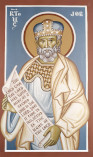 Job was a descendant of Esau the grandson of
Abraham, and lived in Arabia about 2,000 years before Christ. His father’s name was Zareth
and his mother’s Bosora; his full name was Jobab. He was an honorable and God-fearing man,
and was very rich. But when he reached the age of seventy-nine, God permitted heavy temptation
from Satan to fall on him, as is written in detail in the Book of Job. In one day, Job lost all
his great possessions and his sons and daughters. Then a great sickness fell on him, from which
his whole body was covered with sores from top to toe, and Job lay on a rubbish heap outside the
town and scoured his boils with sherds of broken pottery. But Job did not complain of God, but
patiently endured all his sufferings to the end. Therefore the Lord restored his health and gave
him riches greater than he had had before, and there were born to him seven sons and three
daughters; as many as he had had before. And Job lived for 248 years, glorifying and praising
God. Job is regarded as the model of patient endurance of every suffering that God sends us, and
is a type of the suffering Christ.
Job was a descendant of Esau the grandson of
Abraham, and lived in Arabia about 2,000 years before Christ. His father’s name was Zareth
and his mother’s Bosora; his full name was Jobab. He was an honorable and God-fearing man,
and was very rich. But when he reached the age of seventy-nine, God permitted heavy temptation
from Satan to fall on him, as is written in detail in the Book of Job. In one day, Job lost all
his great possessions and his sons and daughters. Then a great sickness fell on him, from which
his whole body was covered with sores from top to toe, and Job lay on a rubbish heap outside the
town and scoured his boils with sherds of broken pottery. But Job did not complain of God, but
patiently endured all his sufferings to the end. Therefore the Lord restored his health and gave
him riches greater than he had had before, and there were born to him seven sons and three
daughters; as many as he had had before. And Job lived for 248 years, glorifying and praising
God. Job is regarded as the model of patient endurance of every suffering that God sends us, and
is a type of the suffering Christ.
2. The Holy Martyr Barbaros.
Barbaros was a soldier in the time of Julian the Apostate. When the imperial commander Bacchus led the Roman army against the Franks, Barbaros was in that army, a secret Christian. In this battle there appeared a hero on the Frankish side, like the earlier Goliath, and he challenged the Romans to send one of their number out to single combat. The commander told Barbaros to go. Barbaros prayed in his heart to the living Lord, went out and conquered this giant. As a result, the Frankish army was confused and overcome. Then the commander made a great triumph, and ordered that sacrifice be made to idols. But, at this sacrificing, he noticed that Barbaros was standing to one side. When he asked him why, Barbaros revealed that he was a Christian. The commander informed the emperor, and the emperor commanded that Barbaros be put to the harshest torture, which Barbaros endured with rare courage and composure. At the time of his martyrdom, many marvels were seen and many soldiers, seeing them, embraced the Christian Faith. Among these was the commander Bacchus himself, with Callimachus and Dionysius. All three of them were beheaded for the name of Christ, and after them, Barbaros, in 362. Their souls went to the kingdom of Christ the immortal King.
FOR CONSIDERATION
Abba Isaias said of himself: ‘I see myself as a horse wandering without a rider. Whoever finds it sits thereon and trots on it whither he wishes. When the rider leaves the horse, a second takes it and does the same, then a third and so forth.’ This great ascetic, of whom all said with wonder that he had achieved perfection, said this of himself either out of humility or from the memory of the time of his imperfection. This saying is true in relation to every Christian who walks spiritually ungirt and unbridled. No sooner has one passion dismounted than another mounts. As soon as one has worn him out and left him in despair, another mounts him, with a diminished capacity to make him happy. Such a man has no rider to guide him in the right path without deviating either to the right or left. The only friendly rider, to be welcomed with joy, is a holy and powerful Christian spirit.
Daily Scripture Readings taken from The Orthodox New Testament, translated and published by Holy Apostles Convent, Buena Vista, Colorado, copyright © 2000, used with permission, all rights reserved.
Daily Prologue Readings taken from The Prologue of Ochrid, by Bishop Nikolai Velimirovic, translated by Mother Maria, published by Lazarica Press, Birmingham, England, copyright © 1985, all rights reserved. Edited by Dormition Skete.