

Daily Devotional
Sunday, May 9, 2027 (NS), April 26, 2027 (OS)
No Fasting.
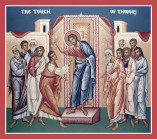
| The Sunday of the Antipascha (The Sunday After Pascha) The Sunday of the Holy Apostle Thomas Mode One — First Eothinon |
The commemoration of Hieromartyr Basil, Bishop of Amasea, and our father among the saints, Stephen, Bishop of Perm.
Scripture Readings
Paschalion — Movable Calendar
The Sunday of the Antipascha (The Sunday After Pascha)
The Sunday of the Holy Apostle Thomas
Mode One — First Eothinon
Epistle
The Reading is from the Acts of the Apostles [§ 14]. In those days:
5 12Through the hands of the apostles many signs and wonders were being wrought among the people. And they were all with one accord in the porch of Solomon. 13And of the rest not even one was daring to be joined to them, but the people were magnifying them. 14And more believers were being added to the Lord, multitudes both of men and of women, 15insomuch that they carried out the sick into the streets and laid them upon beds and pallets, in order that at least the shadow of Peter as he came might overshadow some of them. 16And also the multitude kept on coming together out of the cities round about to Jerusalem, bearing sick people and those who were troubled by unclean spirits—all of whom were being healed.
17Then the high priest rose up and all those with him (the sect which is of the Sadducees), and were full of jealousy, 18and laid their hands on the apostles and put them in state custody. 19But an angel of the Lord during the night opened the doors of the prison and led them out, and said, 20“Go and take a stand in the temple, and be speaking to the people all the words of this life.”
Gospel
The Reading is from the Holy Gospel according to Saint John [§ 65].
20 19When it was evening on that day, the first of the week—and the doors were closed where the disciples were gathered together for fear of the Jews—Jesus came and stood in the midst, and saith to them, “Peace be to you.” 20And after He said this, He showed them His hands and His side. Then were the disciples glad, after they saw the Lord. 21Then Jesus said to them again, “Peace be to you; even as the Father hath sent Me forth, I also send you.” 22And after He said this, He breathed on them, and saith to them, “Receive ye the Holy Spirit: 23“if ye forgive the sins of any, they are forgiven to them; if ye retain the sins of any, they are retained.” 24But Thomas, one of the twelve, who is called Didymos, was not with them when Jesus came. 25The other disciples therefore were saying to him, “We have seen the Lord.” But he said to them, “Unless I should see in His hands the mark of the nails, and put my finger into the mark of the nails, and put my hand into His side, in no wise will I believe.” 26And after eight days His disciples were again inside, and Thomas with them. Then cometh Jesus, the doors having been shut, and He stood in the midst, and said, “Peace be to you.” 27Then He saith to Thomas, “Bring thy finger here, and behold My hands; and bring thy hand, and put it into My side. And cease being unbelieving, but believing.” 28And Thomas answered and said to Him, “My Lord and my God.” 29Jesus said to him, “Because thou hast seen Me, thou hast believed; blessed are they who did not see, and yet believed.”
30Then indeed Jesus also did many other signs in the presence of His disciples, which are not written in this book; 31but these things have been written that ye might believe that Jesus is the Christ, the Son of God, and that believing ye may have life in His name.
Menaion — Fixed Calendar
The commemoration of Hieromartyr Basil, Bishop of Amasea, and our father among the saints, Stephen, Bishop of Perm.
Epistle
For St. Stephen:
The Reading is from the Epistle of Saint Paul to the Hebrews [§ 318]. Brethren:
7 26Such a High Priest was fitting for us: holy, guileless, undefiled, Who hath been separated from the sinners and hath become higher than the heavens, 27Who hath no need daily, even as the high priests, to offer up sacrifices, first for his own sins, then for those of the people; for this He did once for all after He offered up Himself. 28For the law appointeth men high priests who have weakness; but the word of the oath, which is after the law, appointeth the Son, Who hath been perfected forever.
8 1Now in reference to the things being spoken of, the chief point is: We have such a High Priest, Who sat down on the right of the throne of the majesty in the heavens, 2a Liturgist of the holies and of the tabernacle, the true one, which the Lord pitched, and not man.
Gospel
The Reading is from the Holy Gospel according to Saint Matthew [§ 24]. The Lord said:
7 24“Everyone who heareth these words of Mine, and doeth them, I will liken him to a prudent man who built his house upon the rock. 25“And the rain came down, and the rivers rose, and the winds blew, and fell upon that house; and yet it fell not, for it had been founded upon the rock. 26“And everyone who heareth these words of Mine, and doeth them not, shall be likened to a foolish man who built his house upon the sand. 27“And the rain came down, and the rivers rose, and the winds blew, and struck against that house; and it fell. And the fall of it was great.”
28And it came to pass, when Jesus had brought these words to an end, the crowds were astonished at His teaching, 29for He was teaching them as one having authority, and not as the scribes.
8 1And after He came down from the mountain, great crowds followed Him. 2And behold, a leper came and was making obeisance to Him, saying, “Lord, if Thou art willing, Thou art able to cleanse me.” 3And Jesus stretched forth His hand and touched him, saying, “I am willing; be thou cleansed.” And straightway his leprosy was cleansed. 4And Jesus saith to him, “See that thou tell no one; but go thy way, show thyself to the priest, and offer the gift which Moses commanded, for a testimony to them.”
Lives of the Saints (Prologue)
May 9th – Civil Calendar
April 26th – Church Calendar
1. The Hieromartyr Basil, Bishop of Amaseia.
Licinius, the brother-in-law of the Emperor Constantine, whose sister he had married, dissembled before the great emperor, saying that he was a Christian. When he received authority over the whole of the East, he began, at first secretly but then publicly, to persecute the Christians and to uphold idolatry. His wife grieved greatly over this, but could not turn her husband back from this dishonor. Giving himself over to idolatry, Licinius gave himself over to all the passions, and especially to brutality towards women. Through this fall into such an impure passion, he desired to deflower the maiden Glaphyra, who was in waiting at the imperial court. She complained to the empress, who sent her away from the court at Nikomedia secretly to the coast of Pontus. The maiden got as far as the town of Amaseia, and was there warmly received by the bishop, Basil, and the other Christians. Glaphyra was very joyful that God had preserved her virginity, and wrote of this to the empress. And the empress rejoiced and sent her money for the Church in Amaseia. But one letter of Glaphyra’s, on its way to the empress, fell into the hands of an imperial eunuch, who showed it to Emperor Licinius. Discovering where Glaphyra was to be found, he immediately sent orders that she and the bishop be brought to Nikomedia. In the meantime, Glaphyra died, and the soldiers brought only Basil, in bonds. After torture and imprisonment, this blessed man was beheaded and thrown into the sea, in the year 322. His priests, with the help of an angel of God, found his body near the town of Synope, took it out of the water with the aid of fishing nets and carried it to Amaseia, where they gave it burial in the church which he had built by his labors. The Emperor Constantine raised an army against Licinius, overcame him, arrested him and sent him into exile in Gaul, where he ended his God-hating days.
2. St. Janik of Devič.
He was a Serb from Zeta. As a young man, overcome with love for Christ, he left his home and went off to the region of the Ibar, to the mouth of the Black River, to a narrow cave in which, according to tradition, St. Peter of Koriša had lived in asceticism before him. But when his fame began to spread among the people, he fled to Drnica and hid himself in the thick forest of Devič. St. Janik spent years there in solitude, silence and prayer. According to tradition, the Serbian Prince George (Đurađ) Branković brought his mad daughter to him, and the saint healed her. In gratitude, George built a monastery in that place known today by the name of Devič. Here are kept Janik’s holy and wonder-working relics. In this monastery there lived a famous and godly nun, Ephemia, better known in the Kosovo region as Blessed Stojna. She entered into rest in the Lord in 1895.
3. St. Stefan (Stephen) of Perm.
A Russian by birth, he gave himself from his youth to prayer and pondering on God, and as a young man went to Rostov, where he became a monk in the monastery of St. Gregory the Theologian. Learning about the land of Perm, all overgrown with the weeds of paganism, Stefan conceived the desire to be a missionary in that land. He immediately set about learning the language, and when he had become proficient, compiled an alphabet and translated the service books. With the blessing of the Metropolitan of Moscow, he, as a priest, set off on his apostolic labors and began with apostolic zeal to preach the Gospel in the thick darkness of Permian paganism. Baptising a number of souls, he labored to build in Perm a church dedicated to the Annunciation. And, when the Church in Perm grew larger, he was consecrated as its bishop. Enduring all toil, pain, evil and humiliation, he succeeded in dispersing the darkness among the pagan Permians and in illumining them with the light of Christ. He returned once in old age to Moscow, and there went to the Lord in 1396.
FOR CONSIDERATION
The saints are alive, and their God-given power is not diminished by time. St. Janik of Devič performs miracles today as he did in his lifetime five hundred years ago. A man called Milos from Herzegovina was preparing to go to Jerusalem to venerate the saints. Just as he was ready to set off, St. Janik appeared to him in a dream and told him not to go to Jerusalem. ‘You’d do better,’ the saint explained, ‘to go to Devič and clean up my church there, and put it in order, than to go to Jerusalem.’ Milos obeyed and went to the neglected Devič, cleaned it up, put it in order and gave it new life. There he became a monk and remained to the end of his days.
At the time of the First World War and the Austrian occupation, an officer, a Hungarian, came to Devič with a detachment of soldiers. He took the abbot, Damascene, to the tomb of St. Janik and asked him what was under the slab. ‘A holy place,’ replied the abbot. ‘What sort of holy place?’—the officer smiled. ‘You’ve got things hidden under there!’ And he ordered the soldiers to break up the slab with pickaxes. But while they were finishing this, the officer was seized with pains all round the middle of his body. He lay down on a bed and died before the evening of the same day. The terrified soldiers left their work unfinished and fled from the monastery.
Daily Scripture Readings taken from The Orthodox New Testament, translated and published by Holy Apostles Convent, Buena Vista, Colorado, copyright © 2000, used with permission, all rights reserved.
Daily Prologue Readings taken from The Prologue of Ochrid, by Bishop Nikolai Velimirovic, translated by Mother Maria, published by Lazarica Press, Birmingham, England, copyright © 1985, all rights reserved. Edited by Dormition Skete.