

Daily Devotional
Sunday, May 2, 2027 (NS), April 19, 2027 (OS)
No Fasting.
| The Holy and Great Sunday of Pascha |
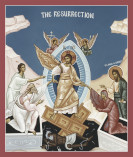
The commemoration of Hieromartyr Paphnutios of Jerusalem, and our venerable Father John of the Ancient Caves in Palestine.
Scripture Readings
Paschalion — Movable Calendar
The Holy and Great Sunday of Pascha
Epistle
The Reading is from the Acts of the Apostles [§ 1].
1 1The first account indeed I made for myself concerning all which, O Theophilos, Jesus began both to do and teach, 2until the day in which He was taken up, after He gave command to the apostles whom He chose for Himself through the Holy Spirit, 3to whom also He presented Himself alive after He had suffered by many proofs, being seen by them during forty days and speaking the things concerning the kingdom of God. 4And being assembled together with them, He ordered them not to depart from Jerusalem, but to wait for the promise of the Father, “which,” He said, “ye heard of Me; 5“for John indeed baptized with water, but ye shall be baptized in the Holy Spirit not many days after these.” 6Indeed therefore, after they came together, they kept on questioning, saying, “Lord, dost Thou at this time restore the kingdom to Israel?” 7And He said to them, “It is not yours to know times or seasons which the Father Himself put in His own authority. 8“But ye shall receive power, after the Holy Spirit is come upon you; and ye shall be witnesses to Me both in Jerusalem, and in all Judæa and Samaria, and unto the ends of the earth.”
Gospel
In the Liturgy
The Reading is from the Holy Gospel according to Saint John [§ 1].
1 1In the beginning was the Logos, and the Logos was with God, and the Logos was God. 2This One was in the beginning with God. 3All things came into being through Him, and without Him not even one thing came into being that hath come to be. 4In Him was life, and the Life was the light of men. 5And the light shineth in the darkness, and the darkness overcame it not.
6There came to be a man who was sent forth from God, whose name was John. 7This same came for a witness, in order that he might bear witness concerning the Light, that all might believe through Him. 8He was not that One, the Light, but was sent that he might bear witness concerning the Light. 9That was the true Light, which giveth light to every man coming into the world. 10He was in the world, and the world came into being through Him, and the world knew Him not. 11He came to His own, and His own received Him not. 12But as many as received Him, to them He gave power to become children of God, to those who believe in His name: 13who were begotten not of blood, nor of the will of the flesh, nor of the will of man, but of God. 14And the Logos became flesh and tabernacled among us, and we beheld His glory, the glory as of an only-begotten from the Father, full of grace and truth. 15John beareth witness concerning Him, and hath cried out, saying, “This One was He of Whom I said, ‘The One Who cometh after me hath come to be before me, for He was before me.’” 16And of His fullness we all received, and grace for grace; 17for the law was given through Moses, but the grace and the truth came to be by Jesus Christ.
In Vespers
The Reading is from the Holy Gospel according to Saint John [§ 65].
20 19When it was evening on that day, the first of the week—and the doors were closed where the disciples were gathered together for fear of the Jews—Jesus came and stood in the midst, and saith to them, “Peace be to you.” 20And after He said this, He showed them His hands and His side. Then were the disciples glad, after they saw the Lord. 21Then Jesus said to them again, “Peace be to you; even as the Father hath sent Me forth, I also send you.” 22And after He said this, He breathed on them, and saith to them, “Receive ye the Holy Spirit: 23“if ye forgive the sins of any, they are forgiven to them; if ye retain the sins of any, they are retained.” 24But Thomas, one of the twelve, who is called Didymos, was not with them when Jesus came. 25The other disciples therefore were saying to him, “We have seen the Lord.” But he said to them, “Unless I should see in His hands the mark of the nails, and put my finger into the mark of the nails, and put my hand into His side, in no wise will I believe.”
Menaion — Fixed Calendar
The commemoration of Hieromartyr Paphnutios of Jerusalem, and our venerable Father John of the Ancient Caves in Palestine.
No readings given.
Lives of the Saints (Prologue)
May 2nd – Civil Calendar
April 19th – Church Calendar
1. Our Holy Father John of the Ancient Caves.
He labored in asceticism in the Ancient Caves or Lavra of Chariton the Great in Palestine. He came to love Christ the Lord with all his heart and soul and mind, and in his youth began travelling around all the holy places to seek the instruction and advice of holy men. He finally settled in Chariton’s cave, where he undertook a rigorous ascetic life, spending his days in fasting, prayer and vigils, constantly meditating on death and teaching himself humility. Like a well-ripened fruit, he was taken by death and entered into Paradise. He lived and died in the eighth century.
2. The Holy Martyrs Christopher, Theonas and Antonios.
These three were young officers under the Emperor Diocletian. When St. George the Great Martyr was being tortured, they witnessed his sufferings and the miracles that were performed at that time. Having seen all this, they came to the emperor, threw down their arms, removed their soldiers’ belts and courageously confessed the name of the Lord Jesus. They were subjected to many tortures and finally thrown into the fire, where their bodies were burned while their souls ascended to the one Lord in eternal joy. They suffered in Nikomedia in 303.
3. St. Tryphon, Patriarch of Constantinople.
The Emperor Romanos, who ruled Byzantium at the beginning of the 10th century, had a son, Theophylact, who was sixteen years old when Patriarch Stephen died. The emperor wished his own son to become patriarch, because he had been promised to a spiritual calling right from a small boy, but because of his youth he was timid about this. Tryphon, a simple, chaste and honorable old man, occupied the patriarchal throne and held that position for three years. When the emperor’s son attained his twentieth year, the emperor had it in mind to remove Tryphon and replace him with his own son as patriarch. St. Tryphon would not relinquish his throne voluntarily, considering it a great scandal for such a young man to be elected to so responsible and difficult a position as that of patriarch. The signature of the innocent Tryphon was obtained on a blank piece of paper through the scheming of an evil bishop, and a false resignation was written above his signature in the imperial court. The emperor announced his resignation, and a difficult time of unrest began in the Church, since the people and the clergy took the side of Tryphon, the man of God. Then the emperor deposed the old patriarch by force and placed him in a monastery, raising his own son, Theophylact, to the patriarchate. St. Tryphon lived in the monastery as an ascetic for two years and five months, and went to the Lord in 933.
4. Our Holy Father Agathangelos.
From Thrace, his worldly name being Anastasios, he was a slave to some Turks, and they compelled him to embrace Islam in Smyrna. As a penitent, he was tonsured at the monastery of Esphigmenou on the Holy Mountain. Tormented by his conscience, he desired to wash his sins in his own blood, so he went to Smyrna, where he showed a Cross and an icon of Christ’s Resurrection to the Turks. He was beheaded on April 19th, 1819, at the age of nineteen. He appeared to his spiritual father, Germanos, after his death.
5. Our Holy Father Simeon the Barefoot.
He labored in asceticism on the Holy Mountain and was abbot of Philotheou for a short time. He strengthened Christians in many Balkan countries in the Faith, and is renowned as a wonder-worker.
FOR CONSIDERATION
A spiritual guide and elder once said: ‘Remain indoors, speak with yourself alone; work, O body, that you may be fed; be vigilant, O soul, that you may be saved and inherit the kingdom.’ These are not mere idle words; rather, they have been the rule of many thousands of monks through the centuries, the daily rule of their lives. They fed themselves by their labor and were vigilant in prayer. But why only monks? Why should it not be the rule for every follower of Christ? Has not Christ Himself provided us with a clear example of bodily labor and unceasing vigilance in prayer?
Daily Scripture Readings taken from The Orthodox New Testament, translated and published by Holy Apostles Convent, Buena Vista, Colorado, copyright © 2000, used with permission, all rights reserved.
Daily Prologue Readings taken from The Prologue of Ochrid, by Bishop Nikolai Velimirovic, translated by Mother Maria, published by Lazarica Press, Birmingham, England, copyright © 1985, all rights reserved. Edited by Dormition Skete.