

Daily Devotional
Wednesday, April 28, 2027 (NS), April 15, 2027 (OS)
Fast Day. No Meat, Fish, Dairy, Eggs, Alcohol or Olive Oil Allowed.
Holy Week
| Holy and Great Wednesday |
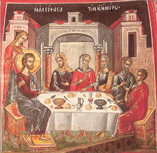
The commemoration of the holy Martyr Crescens in Myra of Lycia, and the holy Apostles Aristarchos, Pudens, and Trophimos of the Seventy (commemorated on Gk. calendar on the 14th of April), and the Martyrs Vasilissa and Anastasia of Rome, disciples of the Apostles Peter and Paul.
Scripture Readings
Paschalion — Movable Calendar
Holy and Great Wednesday
Epistle
There is no Epistle Reading this day because of Holy Week.
Gospel
In the Orthros
The Reading is from the Holy Gospel according to Saint John [§ mid 41]. At that time:
12 17The crowd that was with Jesus when He called Lazarus out of the grave and raised him from the dead bore witness. 18On this account the crowd also went to meet Him, because it heard that He had done this sign. 19The Pharisees therefore said among themselves, “Observe ye that ye profit nothing? Behold, the world hath gone away after Him.”
20And there were certain Greeks from among those going up that they might do reverence at the feast. 21Then these came to Philip, who was from Bethsaida of Galilee, and asked him, saying, “Sir, we wish to see Jesus.” 22Philip cometh and telleth Andrew, and again Andrew and Philip tell Jesus. 23But Jesus answered them, saying, “The hour hath come that the Son of Man should be glorified. 24“Verily, verily, I say to you, unless the grain of the wheat that falleth into the earth should die, it abideth alone; but if it should die, it beareth much fruit. 25“The one who loveth his life shall lose it; and the one who hateth his life in this world shall keep it to life eternal. 26“If anyone serve Me, let him keep on following Me; and where I am, there My servant shall be also. And if anyone serve Me, the Father shall honor him. 27“Now My soul hath been troubled; and what shall I say? ‘Father, save Me from this hour’; but on this account I came to this hour. 28“Father, glorify Thy name.” Then a voice came out of the heaven: “I both glorified it and will glorify it again.” 29The crowd then that stood by and heard it was saying that thunder had occurred; others were saying, “An angel hath spoken to Him.” 30Jesus answered and said, “This voice hath not occurred for My sake, but for your sakes. 31“Now is a judgment of this world; now the ruler of this world shall be cast out. 32“And I, if I be lifted up from the earth, will draw all to Myself.” 33But He was saying this, signifying by what manner of death He was about to die. 34The crowd answered Him, “We heard out of the law that the Christ abideth forever; and how sayest Thou, ‘The Son of Man must be lifted up’? Who is this Son of Man?” 35Then Jesus said to them, “Yet a little while is the light with you. Be walking while ye have the light, that darkness might not overtake you; and indeed the one who walketh in the darkness knoweth not where he goeth. 36“While ye have the light, keep on believing in the light, that ye might become sons of light.” Jesus spoke these things, and departed, and was hidden from them.
37But though He had done so many signs before them, yet they kept on not believing in Him, 38that the word of Esaias the prophet might be fulfilled, which he spoke, “Lord, who believed our report? And to whom was the arm of the Lord revealed [Is. 53:1]?” 39On this account they were not able to believe, because Esaias said again, 40“He hath blinded their eyes and hardened their heart, that they should not see with their eyes and understand with their heart and should be converted; and I shall heal them [cf. Is. 6:9, 10].” 41These things said Esaias when he saw His glory and spoke concerning Him. 42Yet, nevertheless, from among the rulers also many believed in Him, but because of the Pharisees they were not confessing Him, lest they should be expelled from the synagogue; 43for they loved the glory of men more than the glory of God. 44But Jesus cried and said, “The one who believeth in Me, believeth not in Me, but in the One Who sent Me; 45“and the one who seeth Me, seeth the One Who sent Me. 46“I have come a light into the world, that everyone who believeth in Me should not abide in the darkness. 47“And if anyone hear My words and believe not, I judge him not; for I came not that I might judge the world, but that I might save the world. 48“The one who rejecteth Me and receiveth not My words, hath that which judgeth him—the word which I spoke, that shall judge him in the last day. 49“For I spoke not of Myself, but the Father Who sent Me, He Himself gave a commandment to Me, what I should say and what I should speak. 50“And I know that His commandment is life everlasting. Therefore, what things I speak, as the Father hath said to Me, so I speak.”
In the Liturgy of the Presanctified Gifts
The Reading is from the Holy Gospel according to Saint Matthew [§ 108]. At that time:
26 6When Jesus was in Bethany, in the house of Simon the leper, 7a woman came to Him having an alabaster flask of very costly perfumed ointment, and she poured it upon His head as He reclined at table. 8But His disciples, having seen it, became indignant, saying, “For what is this loss? 9“For it was possible for this perfumed ointment to have been sold for much and to have been given to the poor.” 10But Jesus, perceiving it, said to them, “Why do ye cause trouble to the woman? For she wrought a good work toward Me. 11“For ye have the poor among yourselves always, but Me ye have not always. 12“For in putting this perfumed ointment upon My body, she did it for My burial. 13“Verily I say to you, wheresoever this Gospel shall be proclaimed in all the world, also what she did shall be spoken of for a memorial of her.” 14Then one of the twelve, who was called Judas Iscariote, went to the chief priests, 15and said, “What are ye willing to give to me, and I will deliver Him up to you?” And they fixed by agreement with him for thirty pieces of silver. 16And from that time he sought an opportunity that he might deliver Him up.
Menaion — Fixed Calendar
The commemoration of the holy Martyr Crescens in Myra of Lycia, and the holy Apostles Aristarchos, Pudens, and Trophimos of the Seventy (commemorated on Gk. calendar on the 14th of April), and the Martyrs Vasilissa and Anastasia of Rome, disciples of the Apostles Peter and Paul.
No readings given.
Lives of the Saints (Prologue)
April 28th – Civil Calendar
April 15th – Church Calendar
1. The Holy Apostles Aristarchus, Pudens and Trophimus.
These were all numbered among the Seventy. Aristarchus was Bishop of Apameia in Syria. The Apostle Paul mentions him several times (Acts 19:29; Col. 4:10; Philem. v.24). He was seized in Ephesus, together with Gaius, by a mob that had risen up against Paul. The apostle wrote to the Colossians: ‘Aristarchus my fellow-prisoner saluteth you,’ and in the Epistle to Philemon, Paul calls Aristarchus ‘my fellow-laborer,’ together with Mark, Demas and Luke. Pudens was an eminent Roman citizen. The Apostle Paul mentions him once (II Tim. 4:21). Pudens’ house was first the refuge of the chief apostles and was then turned into a church dedicated to the Good Shepherd. Trophimus was an Asian (Acts 20:4), and accompanied St. Paul on his journeys. In one place, Paul writes: ‘Trophimus have I left at Miletum sick’ (II Tim. 4:21). During Nero’s persecution, when the Apostle Paul was beheaded, these glorious martyrs were also beheaded.
2. The Holy Martyr Savvas the Goth.
There was a brutal persecution of Christians on the part of the Goths. A Gothic prince came to the village where this devout Savvas lived, and asked the villagers if there were any Christians there. They answered him on their honor that there were none. Then Savvas stood before the prince and the people, and said: ‘Let no one swear an oath on my behalf. I am a Christian.’ The prince, seeing this poor wretch, let him go in peace, saying: ‘This one can do neither harm nor good.’ The next year, just at Pascha, a priest, Sansal, came to the village and celebrated Pascha with Savvas. The pagans, coming to hear of this, descended suddenly on Savvas’ house and began to belabor the men of God without mercy, then, having dragged Savvas naked through thorns, bound them both to trees and tried to force them to eat meat offered to idols. But the men of God, remembering the apostle’s words, would not touch the unclean, diabolical sacrifices. The prince finally sentenced Savvas to death and handed him over to the soldiers. Savvas went to the place of execution full of joy, praising God. Recognising in him a good man, the soldiers sought to set him free on the way, but Savvas was greatly distressed by this and told the soldiers that they were in duty bound to carry out the prince’s command. Then the soldiers brought him to a river, tied a rock round his neck and threw him into the water. His body was cast up onto the bank. Later the Greek commander Ionnios Soranos, in the time of the Emperor Valens, found Savvas’ body during a war with the Goths and took it to Cappadocia. St. Savvas suffered in 372, at the age of 31.
3. The Holy Martyrs Vasilissa and Anastasia.
Two devout Roman women, they gathered the bodies of the apostles’ disciples for burial during Nero’s persecutions. They were arrested for this and imprisoned, and after prolonged torture in which their breasts were cut off and their tongues cut out, they were beheaded.
FOR CONSIDERATION
St. Gregory of Sinai writes on meditation: ‘We reckon that there are eight main subjects for meditation: first, God, unseen and invisible, without beginning and uncreated, the first Cause of all that is, threefold and one in His divine being; second, the order and state of the angelic powers; third, the structure of visible things; fourth, the incarnation of the Logos; fifth, the general resurrection; sixth, the dreadful Second Coming of the Lord; seventh, eternal torment; eighth, the kingdom of heaven. The first four have already been revealed and belong to the past. The last four have not yet been revealed and belong to the future, although these four are able to be considered by those who, with the help of the grace they have received, acquire a truly pure mind. He who approaches this labor (meditation) without the light of grace, let him know that he is building fantasies, not meditation.’ So writes the great and discerning Gregory of Sinai, whose knowledge came from experience.
Daily Scripture Readings taken from The Orthodox New Testament, translated and published by Holy Apostles Convent, Buena Vista, Colorado, copyright © 2000, used with permission, all rights reserved.
Daily Prologue Readings taken from The Prologue of Ochrid, by Bishop Nikolai Velimirovic, translated by Mother Maria, published by Lazarica Press, Birmingham, England, copyright © 1985, all rights reserved. Edited by Dormition Skete.