

Daily Devotional
Sunday, April 18, 2027 (NS), April 5, 2027 (OS)
Fast Day, but Shellfish, Wine and Olive Oil Allowed.
Holy & Great Fast
| The Fifth Sunday of the Great Fast, in which we Commemorate St. Mary of Egypt. Mode Plagal One — Second Eothinon |
The commemoration of the holy Martyrs Claudius, Diodoros, Victor, Victorinos, Pappias, Nikephoros, and Serapion, and the holy Martyrs Theodoulos, Agathopodes, and those with them.
Scripture Readings
Paschalion — Movable Calendar
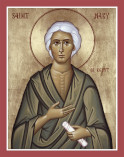
The Fifth Sunday of the Great Fast, in which we Commemorate St. Mary of Egypt.
Mode Plagal One — Second Eothinon
Epistle
The Reading is from the Epistle of Saint Paul to the Hebrews [§ mid 321]. Brethren:
9 11Christ, Who came as High Priest of the coming good things, by means of the greater and more perfect tabernacle—not made by hand, that is, not of this creation, 12nor by blood of goats and of calves, but by His own blood—entered once for all into the Holies, having Himself obtained eternal redemption. 13For if the blood of bulls and of goats and ashes of a heifer, sprinkling those who have been defiled, sanctifieth to the purity of the flesh, 14how much more shall the blood of the Christ, Who through the eternal Spirit offered Himself without blemish to God, purify your conscience from dead works in order to worship the living God?
COMMEMORATION OF SAINT MARY OF EGYPT
The Reading is from the Epistle of Saint Paul to the Galatians [§§ 208, 209]. Brethren:
3 23Before faith came, we were being guarded under the law, having been closed up to the faith about to be revealed. 24Therefore the law hath become our tutor until Christ, in order that we might be justified by faith. 25But faith having come, we are no longer under a tutor. 26For all are sons of God through faith in Christ Jesus. 27For as many as were baptized into Christ, ye put on Christ. 28There is neither Jew nor Greek, there is neither slave nor free, there is neither male and female; for ye are all one in Christ Jesus. 29And if ye are Christ’s, then are ye Abraham’s seed, and heirs according to promise.
4 1Now I say, as long as the heir is an infant, he differeth nothing from a slave, though he is lord of all; 2but he is under guardians and stewards until the appointed time of the father. 3So we also, when we were infants, were enslaved under the elements of the world. 4But when the fullness of the time came, God sent forth His Son, born of a woman, born under the law, 5in order that He might redeem those under the law, that we might receive what is our due, the adoption as sons.
Gospel
The Reading is from the Holy Gospel according to Saint Mark [§ 47]. At that time:
10 32Jesus took aside His twelve disciples, and began to tell them the things that were about to happen to Him, 33saying, “Behold, we are going up to Jerusalem, and the Son of Man shall be delivered up to the chief priests and to the scribes; and they shall condemn Him to death and deliver Him up to the Gentiles. 34“And they shall mock Him, and scourge Him, and spit upon Him, and kill Him. And on the third day He shall raise Himself.”
35And Iakovos and John, the sons of Zebedee, go to Him, saying, “Teacher, we wish that Thou shouldest do for us whatsoever we shall ask.” 36And He said to them, “What do ye wish for Me to do for you?” 37And they said to Him, “Grant to us that we might sit, one on Thy right and one on Thy left, in Thy glory.” 38But Jesus said to them, “Ye know not what ye ask for yourselves. Are ye able to drink the cup that I drink, and to be baptized with the baptism with which I am baptized?” 39And they said to Him, “We are able.” And Jesus said to them, “The cup indeed that I drink, ye shall drink, and the baptism with which I am baptized, ye shall be baptized; 40“but to sit on My right and on My left is not Mine to give, but it shall be given to those for whom it hath been prepared.” 41And after the ten heard it, they began to be indignant on account of Iakovos and John. 42But Jesus called them to Himself, and saith to them, “Ye know that those who are accounted to rule over the nations exercise lordship over them, and their great ones exercise authority over them. 43“Yet it shall not be so among you. But whosoever doth wish to become great among you shall be your servant; 44“and whosoever doth wish to become first among you shall be slave of all. 45“For even the Son of Man came not to be served, but to serve, and to give His life a ransom for many.”
Commemoration of Saint Mary of Egypt
The Reading is from the Holy Gospel according to Saint Luke [§ 33]. At that time:
7 36A certain one of the Pharisees was asking Jesus that He would eat with him. And He entered into the house of the Pharisee, and reclined at table. 37And behold, a woman in the city who was a sinner, when she found out that He was reclining at table in the house of the Pharisee, brought an alabaster flask of perfumed ointment, 38and she stood beside His feet behind Him, weeping; and she began to wet His feet with tears, and was wiping them off with the hairs of her head; and she was kissing His feet ardently and anointing them with the perfumed ointment. 39Now when the Pharisee who invited Him saw it, he spoke within himself, saying, “This One, if He were a prophet, would know who and of what sort the woman is who toucheth Him, for she is a sinner.” 40And Jesus answered and said to him, “Simon, I have something to say to thee.” And he saith, “Teacher, say it.” 41“There were two debtors to a certain creditor: the one was owing five hundred denarii, and the other fifty. 42“But when they had nothing to pay back the debt, he showed himself gracious to both. Say which of them then will love him more?” 43Simon answered and said, “I suppose that he, to whom he showed himself the more gracious.” And He said to him, “Rightly thou didst judge.” 44And He turned to the woman, and said to Simon, “Seest thou this woman? I entered into thy house; water thou gavest Me not for My feet, but she with tears did wet My feet, and with the hairs of her head wiped them off. 45“A kiss thou gavest Me not, but she from the time that I entered did not cease from ardently kissing My feet. 46“With oil thou didst not anoint My head, but she anointed My feet with perfumed ointment. 47“For which reason I say to thee, her sins, which are many, have been forgiven, for she loved much. But to whom little is forgiven, the same loveth little.” 48And He said to her, “Thy sins have been forgiven.” 49And those reclining at table with Him began to say among themselves, “Who is this Who even forgiveth sins?” 50And He said to the woman, “Thy faith hath saved thee; go thy way in peace.”
Menaion — Fixed Calendar
The commemoration of the holy Martyrs Claudius, Diodoros, Victor, Victorinos, Pappias, Nikephoros, and Serapion, and the holy Martyrs Theodoulos, Agathopodes, and those with them.
No readings given.
Synaxarion Readings
Synaxarion for the Fifth Sunday of Great Lent
St. Mary of Egypt
On this day, the fifth Sunday of Great Lent, we celebrate the memory of our holy and venerable Mother, Mary of Egypt.
The recorder of the life of this wonderful saint is St. Sophronius, Patriarch of Jerusalem. A hieromonk, the Elder Zossima, had gone off at one time during the Great Fast on a twenty-days’ walk into the wilderness across the Jordan. He suddenly caught sight of a human being with a withered and naked body and with hair as white as snow, who fled in its nakedness from Zossima’s sight. The elder ran a long way, until this figure stopped at a stream and called out, “Father Zossima, forgive me for the Lord’s sake. I cannot turn around to you, for I am a naked woman.” Then Zossima threw her his outer cloak, and she wrapped herself in it and turned around to him. The elder was amazed at hearing his name from the lips of this unknown woman. After considerable pressure on his part, she told him the story of her life.
She had been born in Egypt and had lived as a prostitute in Alexandria from the age of twelve, spending seventeen years in this way of life. Urged by the lustful fire of the flesh, she one day boarded a ship that was sailing for Jerusalem. Arriving at the Holy City, she attempted to go into one of the churches to venerate the Precious Cross, but some unseen power prevented her from entering. In great fear, she turned to an icon of the Mother of God that was in the entrance and begged her to let her go in and venerate the Cross, confessing her sin and impurity and promising that she would then go wherever the most pure one led her. She was then allowed to enter the church. After venerating the Cross, she went out again to the entrance, and standing in front of the icon, thanked the Mother of God. Then she heard a voice saying, “If you cross the Jordan, you will find true peace.” She immediately bought three loaves of bread and set off for the Jordan, arriving there the same evening. She received Holy Communion the following morning in the monastery of St. John the Baptist, and then crossed the river. She spent the next forty-eight years in the wilderness in the greatest torments, in terror, in struggles with passionate thoughts like gigantic beasts, feeding only on plants.
Later, when she was standing in prayer, Zossima saw her lifted up in the air. She begged him to bring her Holy Communion the next year on the bank of the Jordan, and she would come to receive it. The following year, Zossima came with the holy Gifts to the bank of the Jordan in the evening and stood in amazement at the following sight. He saw her coming in the moonlight and, arriving on the opposite bank, make the sign of the Cross over the river. She then walked across it as though it were dry land. When she had received Holy Communion, she begged him to come again the following year to the same place where they had first met. The next year Zossima went and found her dead body there on that spot. Above her head in the sand was written: “Abba Zossima, bury in this place the body of the humble Mary. Give dust to dust. I passed away on April 1st, on the very night of Christ’s Passion, after Communion of the divine Mysteries.” For the first time, Zossima learned her name and also the awe-inspiring marvel that she had instantly arrived at that streambed the previous year on the night of the same day on which she had received Holy Communion—a place that he had taken twenty days to reach. And thus Zossima buried the body of the wonderful saint, Mary of Egypt. When he returned to the monastery, he recounted the whole story of her life and the wonders to which he had been an eyewitness. Thus the Lord glorifies repentant sinners. She entered into rest in about the year 530.
St. Mary is remembered today, as we reach the end of the Great Fast, to arouse the energy of the slothful and to urge sinners to repentance, imitating her example. She is also commemorated on April 1. The Righteous Zossima, who buried St. Mary, is commemorated on April 4.
O Christ our God, through the intercessions of our venerable Mother Mary of Egypt, have mercy on us and save us. Amen.
Translated from Triodion, siest ‘Tripesnets: Triod’ Postnaya, Moscow, 1904, by Robert Parent.
Lives of the Saints (Prologue)
April 18th – Civil Calendar
April 5th – Church Calendar
1. The Holy Martyrs Agathopous and Theodulus.
Agathopous, adorned with the white hairs of age, was a deacon and Theodulus, with the chastity of youth, was a reader in the Church in Thessalonica. In the time of Diocletian’s hunting of Christians, these two were summoned for trial. They went there joyfully, and each holding the other by the hand, went in crying: ‘We are Christians!’ The whole court’s urging them to deny Christ and worship idols was in vain. After long imprisonment and starvation, they were condemned to death by drowning in the sea. Their hands were bound behind them and a large stone tied to their necks, and they were taken off to be drowned. When they went to throw Agathopous into the depths, he cried out: ‘Lo, by second Baptism we are washed from all our sins, and will go cleansed to Christ Jesus!’ The sea quickly threw their drowned bodies onto the shore, and Christians gave them burial. St. Theodulus appeared to his friends in the form of a shining angel in white raiment and commanded them to distribute all his remaining goods to the poor. These great soldiers of Christ suffered with honor under the Emperor Diocletian and Faustinus the governor of Thessalonica, in the year 303.
2. Our Holy Father Mark of Trache.
He is also known as ‘the Athenian’ because Athens was his birthplace. When he had finished his higher schooling in Athens, his parents died. He pondered within himself on the inevitability of death, and that one must prepare in good time for a holy departure from this world. He gave his goods away to the poor and seated himself on a plank in the sea, with profound faith in God’s help and the prayer that God would lead him wherever He desired. And, by the providence of God, he was kept safe and taken to Libya (or Ethiopia), to a mountain called Trache. Mark lived in asceticism on that mountain for ninety-five years, seeing neither man nor beast. For thirty whole years he had an intense struggle with evil sprits, and was tormented by hunger and thirst, cold and heat. He ate earth and drank sea-water. After thirty years of the most intense sufferings, the conquered demons fled from him and angels of God started bringing him food every day in the form of bread, fish and fruit. St. Serapion visited him just before his death, and later recorded the wonderful life of this saint. Mark was asking Serapion if there were in the world any Christians who could say to the mountain they were on: ‘Get up and cast yourself into the sea,’ and it would do so. At that moment the mountain began to move like a wave. But Mark raised a hand and quieted it, such being the miraculous power of this man of God. At the time of his death, he prayed for the salvation of all men and gave his soul into God’s hands. St. Serapion saw an angel bearing Mark’s soul, and a hand extended from heaven to receive it. St. Mark lived for a hundred and thirty years and entered into rest in about 400.
FOR CONSIDERATION
‘Live as though you were out of this world, and you will have peace.’ Thus St. Anthony spoke to his disciple. This is a strange teaching, but a true one. We experience the greatest trouble and unease in ourselves when we feel ourselves more and more to be in this world. But, the more a man withdraws from the world, the more often he contemplates this world as existing without him and the more strongly, in his thoughts, he ponders on the utter needlessness of his presence in this world, so much the closer will he stay to God and so much the deeper will be the spiritual peace that he will have. ‘I die daily’ (I Cor 15:31), says the Apostle Paul. That is, I feel every day that I am not in this world. But, because of this, he feels himself every day in spirit a citizen of heaven. When the torturer Faustinus asked St. Theodulus: ‘Isn’t life better than a harsh death?’ St. Theodulus replied: ‘Indeed, I bear in mind that life is better than death; and have therefore decided to scorn this mortal and transitory life on earth that I might be a partaker of life immortal.’
Daily Scripture Readings taken from The Orthodox New Testament, translated and published by Holy Apostles Convent, Buena Vista, Colorado, copyright © 2000, used with permission, all rights reserved.
Daily Prologue Readings taken from The Prologue of Ochrid, by Bishop Nikolai Velimirovic, translated by Mother Maria, published by Lazarica Press, Birmingham, England, copyright © 1985, all rights reserved. Edited by Dormition Skete.