

Daily Devotional
Thursday, March 4, 2027 (NS), February 19, 2027 (OS)
No Fasting.
Thursday of the Thirty-Fifth Week
The commemoration of the holy Apostles Archippos, Philemon, and Apfia, martyred at Colossae of Phrygia.
Scripture Readings
Paschalion — Movable Calendar
Thursday of the Thirty-Fifth Week
Epistle
The Reading is from the First General Epistle of Saint John [§ 74]. Beloved:
4 20If anyone should say, “I love God,” and be hating his brother, he is a liar; for the one not loving his brother whom he hath seen, how is he able to love God Whom he hath not seen? 21And this commandment have we from Him, that the one loving God, be loving his brother also.
5 1Everyone who believeth that Jesus is the Christ hath been born of God; and everyone who loveth Him Who begat loveth also him who hath been begotten of Him. 2In this we know that we love the children of God, whenever we love God and keep His commandments. 3For this is the love of God, that we be keeping His commandments. And His commandments are not heavy. 4For everything that hath been born of God overcometh the world. And this is the victory, the victory having overcome the world—our faith. 5Who is the one overcoming the world, if not the one believing that Jesus is the Son of God? 6This is the One Who came by water and blood, Jesus Christ; not in the water only, but in the water and the blood. And the Spirit is the One Who beareth witness, because the Spirit is the truth. 7For there are three bearing witness in the heaven: the Father, the Logos, and the Holy Spirit; and these Three are One. 8And there are three bearing witness in the earth: the Spirit, and the water, and the blood; and the three are for the one. 9If we receive the witness of man, the witness of God is greater; for this is the testimony of God which He hath testified concerning His Son. 10The one believing in the Son of God hath the witness in himself; the one not believing God hath made Him a liar, because he hath not believed in the testimony which God hath testified concerning His Son. 11And this is the testimony, that God gave us eternal life, and this life is in His Son. 12The one having the Son hath the life; the one not having the Son of God hath not the life.
13I am writing these things to you who believe in the name of the Son of God, that ye may know that ye have eternal life, and in order that ye may believe in the name of the Son of God. 14And this is the boldness which we have toward Him, that if we be asking anything for ourselves according to His will, He heareth us. 15And if we know that He hear us, whatsoever we may be asking for ourselves, we know that we have the requests which we have asked from Him. 16If anyone should see his brother sinning a sin not unto death, he shall ask, and He shall give life to him, for those that sin not unto death. There is a sin unto death; not concerning that do I say one should make request. 17All unrighteousness is sin; and there is a sin not unto death. 18We know that everyone who hath been born of God sinneth not, but the one who was born of God keepeth himself, and the evil one doth not take hold of him. 19We know that we are of God, and the whole world lieth in the evil one. 20But we know that the Son of God is come, and hath given us an understanding, in order that we may know Him Who is true; and we are in the true One, in His Son Jesus Christ. This is the true God and Life Eternal.
21Little children, guard yourselves from the idols. Amen.
Gospel
The Reading is from the Holy Gospel according to Saint Mark [§ 66]. At that time:
15 1The chief priests held a consultation with the elders and scribes and the whole sanhedrin, and bound Jesus, and carried Him away, and delivered Him up to Pilate. 2And Pilate questioned Him, “Thou art the King of the Jews?” And He answered and said to him, “Thou sayest.” 3And the chief priests were accusing Him of many things, but He answered nothing. 4And Pilate was questioning Him again, saying, “Answerest Thou nothing? Behold how many things they bear witness against Thee.” 5But Jesus answered nothing any more, so that Pilate marvelled. 6Now at the feast he used to release to them one prisoner, whomsoever they were asking for themselves. 7And there was one called Barabbas, who had been bound with fellow insurrectionists who had committed murder in the sedition. 8And the crowd, having cried out, began to ask him to do even as he always used to do for them. 9But Pilate answered them, saying, “Do ye wish that I release to you the King of the Jews?” 10For he was perceiving that the chief priests had delivered Him up by reason of envy. 11But the chief priests stirred up the crowd, in order that he should rather release Barabbas to them. 12And Pilate answered and said again to them, “What do ye wish then that I should do to Him Whom ye call King of the Jews?” 13And they cried out again, “Crucify Him.” 14But Pilate was saying to them, “Why, what evil did He do?” And they cried out more exceedingly, “Crucify Him.” 15And Pilate, willing to do that which was satisfactory to the crowd, released Barabbas to them; and he delivered up Jesus, after he scourged Him, in order that He might be crucified.
Menaion — Fixed Calendar
The commemoration of the holy Apostles Archippos, Philemon, and Apfia, martyred at Colossae of Phrygia.
No readings given.
Lives of the Saints (Prologue)
March 4th – Civil Calendar: Non-Leap Year
March 3rd – Civil Calendar: Leap Year
February 19th – Church Calendar
1. The Holy Apostles Archippus, Philemon and Apphia.
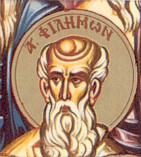 Archippus was one of the Seventy. The Apostle Paul mentions him in his
Epistles to the Colossians (4:17) and to Philemon (Philem. 2), calling him his fellow-soldier in
the battle. The Christians’ gathering-place for prayer in the town of Colossae was in the
house of Philemon. The Apostle Paul, writing to Philemon, calls this ‘the Church in thy
house’. This was in the time when the apostles were consecrating their disciples to the
episcopate—some to permanent sees and others as missionaries, travelling to various places.
Philemon was one of these latter. Apphia, Philemon’s wife, remained to serve the
house-church with fasting. At the time of a feast of the pagan goddess Artemis, all the faithful
in Colossae were, as was their custom, gathered at prayer in the house of Philemon. The pagans
came to hear of this gathering, rushed in on them and seized all the Christians. They flogged
Archippus, Philemon and Apphia as their leaders, then buried them up to the waist in the ground
and stoned them. Philemon and Apphia died of this, but they took Archippus out of the hole barely
alive and left him for the children to play with. They took knives and stabbed him all over, and
thus this fellow-soldier of Paul’s in the battle made a good end of his earthly road.
Archippus was one of the Seventy. The Apostle Paul mentions him in his
Epistles to the Colossians (4:17) and to Philemon (Philem. 2), calling him his fellow-soldier in
the battle. The Christians’ gathering-place for prayer in the town of Colossae was in the
house of Philemon. The Apostle Paul, writing to Philemon, calls this ‘the Church in thy
house’. This was in the time when the apostles were consecrating their disciples to the
episcopate—some to permanent sees and others as missionaries, travelling to various places.
Philemon was one of these latter. Apphia, Philemon’s wife, remained to serve the
house-church with fasting. At the time of a feast of the pagan goddess Artemis, all the faithful
in Colossae were, as was their custom, gathered at prayer in the house of Philemon. The pagans
came to hear of this gathering, rushed in on them and seized all the Christians. They flogged
Archippus, Philemon and Apphia as their leaders, then buried them up to the waist in the ground
and stoned them. Philemon and Apphia died of this, but they took Archippus out of the hole barely
alive and left him for the children to play with. They took knives and stabbed him all over, and
thus this fellow-soldier of Paul’s in the battle made a good end of his earthly road.
2. Our Holy Father Dositheos.
Dositheos was a disciple of the famous Abba Dorotheos, who lived with Saints Seridos, John and Barsanuphius the Great. He was kinsman to a general and traveled to Jerusalem to see the holy places. While he was looking at an icon of the Dreadful Judgement in some church, a woman in purple robes came up and explained many things to him. Finally, at parting, she told him that, if he sought salvation, he must fast and not eat meat, and pray frequently to God. This was the most holy Mother of God. The heart of the young Dositheos was set afire and he desired the monastic life. Dorotheos received him as his cell-servant and commanded him utterly to forsake his own will and obey his spiritual father. He left him for several days to eat as much as he wanted, then after a certain time cut his food down to a quarter, and after a while to a quarter of that, until he became accustomed to living on the smallest amount of food, always telling him: ‘Eating is a habit, and one eats what one is used to eating.’ He was saved and glorified by total obedience. He remains forever as an example of monastic obedience and devotion to one’s spiritual father. This young saint lived early in the 6th century.
FOR CONSIDERATION
St. Anthony teaches: ‘As a man comes forth naked from his mother’s womb, so the soul goes forth naked from the body. And one soul is pure and light, a second soiled by sin and a third blackened by many sins. If a body coming forth from an unhealthy womb cannot live, so also a soul; if it has not come to the knowledge of God through good conduct, it cannot be saved or be in communion with God. The organ of bodily vision is the eye; the organ of spiritual vision is the mind. As the body is blind without the eyes, so is the soul blind without a right mind and a right life.’
Daily Scripture Readings taken from The Orthodox New Testament, translated and published by Holy Apostles Convent, Buena Vista, Colorado, copyright © 2000, used with permission, all rights reserved.
Daily Prologue Readings taken from The Prologue of Ochrid, by Bishop Nikolai Velimirovic, translated by Mother Maria, published by Lazarica Press, Birmingham, England, copyright © 1985, all rights reserved. Edited by Dormition Skete.