

Daily Devotional
Friday, February 12, 2027 (NS), January 30, 2027 (OS)
Fast Day, but Fish, Wine and Olive Oil Allowed.
Friday of the Thirty-Seventh Week
The commemoration of our holy fathers and œcumenical teachers, Basil the Great, Gregory the Theologian, and John Chrysostom, and our holy father among the saints, Hippolytos, Pope of Rome, and those with him.
Scripture Readings
Paschalion — Movable Calendar
Friday of the Thirty-Seventh Week
Epistle
The Reading is from the Epistle of Saint Paul to the Philippians [§ 245]. Brethren:
3 8I suffered the loss of all things, and deem them to be dung, that I might win Christ, 9and might be found in Him, not having a righteousness of mine own, which is of the law, but that which is through faith in Christ, the righteousness of God on the basis of faith, 10to come to know Him, and the power of His resurrection, and the partaking of His sufferings, being conformed to His death, 11if by any means I might attain to the resurrection of the dead. 12Not that I already received, or already have been perfected; but I pursue, if I might also apprehend that for which I also was apprehended by the Christ, Jesus. 13Brethren, I count not myself to have apprehended; but one thing I do, forgetting the things which are behind, and stretching forth to those things which are before, 14I pursue toward the mark for the prize of the high calling of God in Christ Jesus. 15Let us therefore, as many as are perfect, be of this mind; and if ye are otherwise minded in anything, God shall reveal even this to you. 16Only to what we attained, let us walk by the same rule, let us mind the same thing.
17Brethren, keep on becoming imitators together of me and look to those who so walk, as ye have us for an example. 18For many walk about, of whom I was telling you often, and now tell even weeping, that they are the enemies of the Cross of Christ: 19whose end is destruction, whose god is the belly, and who glory in their shame—they who mind earthly things!
Gospel
The Reading is from the Holy Gospel according to Saint Luke [§ 32].
7 31The Lord said, “To what then shall I liken the men of this generation? And to what are they like? 32“They are like little children sitting in a marketplace and calling to one another, and saying, ‘We played on the flute to you, and ye danced not; we sang a dirge to you, and ye wept not.’ 33“For John the Baptist hath come neither eating bread nor drinking wine, and ye say, ‘He hath a demon.’ 34“The Son of Man hath come eating and drinking, and ye say, ‘Behold, a man, a glutton and a wine-drinker, a friend of tax collectors and sinners.’ 35“And yet wisdom is justified by all of her children!”
Menaion — Fixed Calendar
The commemoration of our holy fathers and œcumenical teachers, Basil the Great, Gregory the Theologian, and John Chrysostom, and our holy father among the saints, Hippolytos, Pope of Rome, and those with him.
Epistle
The Reading is from the Epistle of Saint Paul to the Hebrews [§ 334]. Brethren:
13 7Be remembering those who lead you, who spoke to you the word of God, whose faith keep on imitating, observing attentively the end of their conduct: 8Jesus Christ, the same yesterday and today and to the ages. 9Cease being carried about by various and strange teachings. For it is good for the heart to be confirmed by grace, not by foods, in which those walking therein were not profited. 10We have an altar from which those serving the tabernacle have no authority to eat; 11for the bodies of those animals, “whose blood is being brought into the holies for sins” by the high priest, “are being burned outside of the encampment [cf. Lev. 16:27].” 12Wherefore Jesus also, that He might sanctify the people by His own blood, suffered outside of the gate. 13Let us be going forth therefore to Him outside of the encampment, bearing His reproach; 14for we have no abiding city here, but we seek the coming one. 15Through Him, then, let us be offering up a “sacrifice of praise [Lev. 7:2(12)]” continually to God, that is, “the fruit of the lips [cf. Hos. 14:3(2); Is. 57:19],” giving thanks to His name. 16But cease being forgetful of doing good and of contributing; for God is well pleased with such sacrifices.
Gospel
The Reading is from the Holy Gospel according to Saint Matthew [§ 11]. The Lord said to His disciples:
5 14“Ye are the light of the world. A city situated on the top of a mountain cannot be hid. 15“Nor do they light a lamp and put it under the bushel, but upon the lampstand, and it giveth light to all those in the house. 16“Thus, let your light shine before men, that they might see your good works, and might glorify your Father Who is in the heavens.
17“Do not begin to think that I came to abolish the law or the prophets; I came not to abolish, but to fulfill. 18“For verily I say to you, until the heaven and the earth shall have passed away, one iota or one tittle in no wise shall pass away from the law, until all shall have taken place. 19“Whosoever then shall break one of the least of these commandments, and shall teach men so, he shall be called least in the kingdom of the heavens; but whosoever shall do and teach them, this one shall be called great in the kingdom of the heavens.”
Lives of the Saints (Prologue)
February 12th – Civil Calendar
January 30th – Church Calendar
1. The Three Great Hierarchs: Saints Basil the Great, Gregory the Theologian and John Chrysostom.
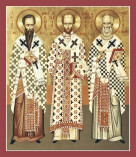 Each has his personal feast day in the month of January; Basil on the 1st, Gregory
on the 25th and Chrysostom on the 27th. The common feast we celebrate today was instituted in the
11th century, in the time of the Emperor Alexios Komnenos. At one time there was a dispute among
the people about who was the greatest of the three. Some gave St. Basil the pre-eminence for his
purity and courage; others St. Gregory for the unfathomable depth and height of his theological
mind; others still St. Chrysostom for the wonderful beauty of his speech and the clarity of his
presentation of the Faith. So the first were called Basilians, the second Gregorians and the
third Johannites. But, by the providence of God, this dispute was resolved to the benefit of the
Church and the yet greater glory of the three saints. The Bishop of Efchaita, John (June 14th),
had a vision in his sleep, in which each of these saints appeared to him in great glory and
indescribable beauty, and then all three together. They then said to him: ‘We are one in
God, as you see, and there is no dispute among us;...neither is there among us a first or a
second.’ The saints also advised Bishop John to compile a common feast for them and to set
aside for them a day of common commemoration. The quarrel was settled as indicated by the
wonderful vision, January 30th being set aside for the common commemoration of the three
hierarchs. The Greeks regard this feast not only as a Church festival, but as their greatest
national and scholastic holiday.
Each has his personal feast day in the month of January; Basil on the 1st, Gregory
on the 25th and Chrysostom on the 27th. The common feast we celebrate today was instituted in the
11th century, in the time of the Emperor Alexios Komnenos. At one time there was a dispute among
the people about who was the greatest of the three. Some gave St. Basil the pre-eminence for his
purity and courage; others St. Gregory for the unfathomable depth and height of his theological
mind; others still St. Chrysostom for the wonderful beauty of his speech and the clarity of his
presentation of the Faith. So the first were called Basilians, the second Gregorians and the
third Johannites. But, by the providence of God, this dispute was resolved to the benefit of the
Church and the yet greater glory of the three saints. The Bishop of Efchaita, John (June 14th),
had a vision in his sleep, in which each of these saints appeared to him in great glory and
indescribable beauty, and then all three together. They then said to him: ‘We are one in
God, as you see, and there is no dispute among us;...neither is there among us a first or a
second.’ The saints also advised Bishop John to compile a common feast for them and to set
aside for them a day of common commemoration. The quarrel was settled as indicated by the
wonderful vision, January 30th being set aside for the common commemoration of the three
hierarchs. The Greeks regard this feast not only as a Church festival, but as their greatest
national and scholastic holiday.
2. The Hieromartyr Hippolytus, Bishop of Rome.
He suffered for the Faith in the time of Claudius. When, in Rome, the virgin Chrysa was being martyred for Christ, St. Hippolytus stood up for her before her torturers and denounced them. Because of this protest, he was brought to trial and condemned to death after prolonged torture. They bound his hands and feet and cast him into the sea. Twenty other martyrs suffered with him and Chrysa in about 236.
3. The Holy Martyr Theophilus the New.
As commander-in-chief under the Emperor Constantine and Empress Irene, he was enslaved by the Hagarenes and held four years in prison. When he withstood all the Moslems’ insistence that he repudiate the Christian Faith, he was beheaded with the sword in the year 784, and went to the Lord.
4. St. Peter, King of Bulgaria.
He was the son of Simeon, and a great admirer of St. John of Rila. He made the Bulgarian Church independent of Constantinople and defended Orthodoxy in Bulgaria against the Bogomils. He died in 967 at the age of 56, after an unsuccessful war against the Hungarians and Russians.
FOR CONSIDERATION
Here is an example of how kings seek counsel of the saints, of how saints flee from vanity and riches, and how they counsel kings. The Orthodox King Peter of Bulgaria set off with his retinue to the mountain of Rila, urged by the irresistible desire to see St. John of Rila and benefit from his instruction. The king sent men on ahead, to let the saint know. But the saint would not agree to see the king. The saddened king sent other men with some food, a fair amount of gold and the request that the saint would commit to writing some advice for him. St. John received the food and returned the gold, refusing to touch it, and replied to the king: ‘If you desire the heavenly kingdom, be merciful as is your heavenly Father. Do not give yourself to injustice and be not greedy; be meek, quiet, accessible to all. Do not listen to praise from your nobles. May your royal purple shine with all the virtues. Let the remembrance of death never leave your soul. Humble yourself before the feet of Mother Church; bow your head before her greatest saints, so that the King of kings, seeing your devotion, may give you such blessings as have never entered into the heart of man.’ Receiving this letter, the king kissed it, and later referred to it frequently.
Daily Scripture Readings taken from The Orthodox New Testament, translated and published by Holy Apostles Convent, Buena Vista, Colorado, copyright © 2000, used with permission, all rights reserved.
Daily Prologue Readings taken from The Prologue of Ochrid, by Bishop Nikolai Velimirovic, translated by Mother Maria, published by Lazarica Press, Birmingham, England, copyright © 1985, all rights reserved. Edited by Dormition Skete.