

Daily Devotional
Thursday, February 4, 2027 (NS), January 22, 2027 (OS)
No Fasting.
Thursday of the Thirty-Sixth Week
The commemoration of the holy Apostle Timothy of the Seventy, and the holy Martyr Anastasios the Persian.
Scripture Readings
Paschalion — Movable Calendar
Thursday of the Thirty-Sixth Week
Epistle
The Reading is from the Epistle of Saint Paul to the Philippians [§ 238]. Brethren:
1 20In nothing shall I be ashamed, but in all boldness, as always, also now Christ shall be magnified in my body, whether by life or by death. 21For to me, to live is Christ, and to die is gain. 22But if I live on in the flesh, this to me is the fruit of labor; and what I shall choose I know not. 23For I am being constrained by the two, having the desire to depart and to be with Christ, for that is very much better; 24but to abide in the flesh is more necessary for your sakes. 25And having been persuaded of this, I know that I shall stay and continue with you all for your progress and joy in the faith, 26in order that the basis for your boasting might abound in Christ Jesus in me, through my presence with you again. 27Only be conducting yourselves worthily of the Gospel of the Christ, that whether I come and see you or am absent, I might hear of the things concerning you, that ye stand in one spirit, with one soul striving together for the faith of the Gospel.
Gospel
The Reading is from the Holy Gospel according to Saint Luke [§ 23]. At that time:
6 12Jesus went out into the mountain to pray, and He was passing the night in prayer to God. 13And when it became day, He called to Himself His disciples. And from them He chose for Himself twelve, whom He also named apostles: 14Simon, whom He also named Peter, and Andrew his brother; Iakovos and John; Philip and Bartholomew; 15Matthew and Thomas; Iakovos the son of Alphæos, and Simon who was called Zealot; 16Judas the brother of Iakovos, and Judas Iscariote, who also became the betrayer. 17And He came down with them and stood upon a level place. And there was a crowd of His disciples, and a great multitude of the people from all of Judæa and Jerusalem and the seacoast of Tyre and Sidon, who came to hear Him, and to be healed of their diseases— 18even those who were troubled by unclean spirits; and they were cured. 19And all the crowd was seeking to touch Him, for power was coming forth from Him and healing all.
Menaion — Fixed Calendar
The commemoration of the holy Apostle Timothy of the Seventy, and the holy Martyr Anastasios the Persian.
Epistle
The Reading is from the Second Epistle of Saint Paul to Saint Timothy [§ mid 290]. Child Timothy:
1 3I have gratitude toward God, Whom I worship from my forefathers in a pure conscience, as without ceasing I have the remembrance of thee in mine entreaties night and day, 4longing to see thee, having been reminded of thy tears, in order that I might be filled full of joy, 5when I am put in remembrance of the unhypocritical faith in thee, which dwelt first in thy grandmother Lois and in thy mother Evnike, and I have been persuaded that it is in thee also. 6For which cause I remind thee to rekindle the gracious gift of God which is in thee by the laying on of my hands; 7for God gave us not a spirit of cowardice, but of power, and of love, and of a sound mind. 8Therefore do thou not become ashamed of the testimony of our Lord, nor me His prisoner, but suffer hardship with the Gospel, according to God’s power, 9Who saved us and called us with a holy calling, not according to our works, but according to His own purpose and grace which was given to us in Christ Jesus before the ages of time.
Gospel
The Reading is from the Holy Gospel according to Saint Matthew [§§ 38, mid 79]. The Lord said to his disciples:
10 32“Everyone who shall confess in Me before men, I also will confess in him before My Father Who is in the heavens. 33“But whosoever shall deny Me before men, him will I also deny before My Father Who is in the heavens.... 37“The one who loveth father or mother more than Me is not worthy of Me; and the one who loveth son or daughter more than Me is not worthy of Me. 38“And whosoever taketh not his cross and followeth after Me is not worthy of Me.”...
19 27Peter answered and said to Him, “Behold, we left all things and followed Thee; what then shall be for us?” 28And Jesus said to them, “Verily I say to you, that ye who followed Me, in the regeneration, whenever the Son of Man shall have taken His seat upon the throne of His glory, ye also shall sit upon twelve thrones, judging the twelve tribes of Israel. 29“And everyone who leaveth houses, or brothers, or sisters, or father, or mother, or wife, or children, or lands, on account of My name, shall receive a hundredfold, and shall inherit life everlasting. 30“But many who are first shall be last, and the last first.”
for Sl. usage, see [Lk. 10:1-15].
Lives of the Saints (Prologue)
February 4th – Civil Calendar
January 22nd – Church Calendar
1. The Holy Apostle Timothy.
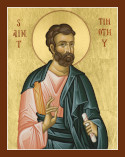 One of the Seventy, he was born in Lystra of Lykaonia
of a Greek father and a Jewish mother. His mother and grandmother were praised by the Apostle
Paul for their sincere faith (2 Tim. 1:4-5). He met the great apostle for the first time in
Lystra, and was the only witness of Paul’s healing of the man lame from birth. Later,
Timothy was an almost constant travelling companion of Paul’s, visiting Achaia, Macedonia,
Italy and Spain with him. A great zealot for the Faith, a superb preacher and of a gentle spirit,
Timothy contributed greatly to the spreading and establishing of the Christian Faith. St. Paul
called him his own son in the faith (I Tim. 1:2). After Paul’s martyrdom, Timothy had St.
John the Evangelist as his teacher. But when the Emperor Domitian exiled John from Ephesus to the
island of Patmos, Timothy remained in Ephesus as bishop. At the time of an idolatrous feast
called Katagogium, pagans wearing masks, resentful of the Christians, made a merciless attack on
St. Timothy and killed him, in about the year 93. His honored relics were later taken to
Constantinople and buried in the Church of the Holy Apostles by the graves of St. Luke the
Evangelist and St. Andrew the First-Called.
One of the Seventy, he was born in Lystra of Lykaonia
of a Greek father and a Jewish mother. His mother and grandmother were praised by the Apostle
Paul for their sincere faith (2 Tim. 1:4-5). He met the great apostle for the first time in
Lystra, and was the only witness of Paul’s healing of the man lame from birth. Later,
Timothy was an almost constant travelling companion of Paul’s, visiting Achaia, Macedonia,
Italy and Spain with him. A great zealot for the Faith, a superb preacher and of a gentle spirit,
Timothy contributed greatly to the spreading and establishing of the Christian Faith. St. Paul
called him his own son in the faith (I Tim. 1:2). After Paul’s martyrdom, Timothy had St.
John the Evangelist as his teacher. But when the Emperor Domitian exiled John from Ephesus to the
island of Patmos, Timothy remained in Ephesus as bishop. At the time of an idolatrous feast
called Katagogium, pagans wearing masks, resentful of the Christians, made a merciless attack on
St. Timothy and killed him, in about the year 93. His honored relics were later taken to
Constantinople and buried in the Church of the Holy Apostles by the graves of St. Luke the
Evangelist and St. Andrew the First-Called.
2. Our Holy Father, the Martyr Anastasius.
He was a Persian by birth, with the pagan name of Magundat. When the Emperor Herakleios waged war against the Persians, Magundat deserted to the Christians and went to Jerusalem. There he was baptized and given the name Anastasius. It was not enough for him to be baptized; he also became a monk in order to give himself entirely to the service of God. Among other ascetic practices, he very early read the lives of the holy martyrs, and reading this, wetted the book with his tears, greatly yearning for martyrdom himself. The Lord finally crowned him with the wreath of martyrdom. He lay long in prison and was horribly tortured until King Chozroes condemned him to death. After this condemnation, Anastasius was drowned, then taken out of the water and beheaded by the executioner, who sent his head to the king. Anastasius suffered on January 22nd, 628, in the town of Bethsaloe near Nineveh.
FOR CONSIDERATION
The Orthodox Church possesses an inexhaustible treasure in the evidence of life after death. To note one example among many, one which at the same time witnesses that the spirit of man lives after bodily death and that voluntary obedience brings blessed immortality: when St. Theodosios the Great had founded a monastery, he had at first only seven monks. To establish them well in remembrance of death, he ordered them to dig a grave. When the grave was ready, Theodosios stood over it, gathered the seven of them together and said: ‘Well, my children; the grave is now ready! Is there among you one who is ready for death, to be buried in this grave?’ One of them, a priest called Basil, fell to his knees and besought Theodosios’ blessing to die. Theodosios ordered that the memorial services be held for Basil on the third, ninth and fortieth day, as is the custom for the departed. When the fortieth memorial was finished, Basil, in full health, lay down and died. And he was buried in the new grave. On the fortieth day after his burial, Basil appeared in the morning among the brethren in church and sang with them. At first only Theodosios saw him, but he prayed to God that He would open the eyes of the others. Then all the brethren looked and saw Basil among them. One of the brethren, Letius, joyfully spread his arms wide, intending to embrace Basil, but the latter disappeared. Basil’s voice was heard: ‘Save yourselves, my fathers and brethren, save yourselves!’
Daily Scripture Readings taken from The Orthodox New Testament, translated and published by Holy Apostles Convent, Buena Vista, Colorado, copyright © 2000, used with permission, all rights reserved.
Daily Prologue Readings taken from The Prologue of Ochrid, by Bishop Nikolai Velimirovic, translated by Mother Maria, published by Lazarica Press, Birmingham, England, copyright © 1985, all rights reserved. Edited by Dormition Skete.