

Daily Devotional
Sunday, January 3, 2027 (NS), December 21, 2026 (OS)
Fast Day, but Shellfish, Wine and Olive Oil Allowed.
The Sunday Before the Nativity of Christ: The Commemoration of the Holy Fathers.
Sunday of the Thirty-First Week
Mode Plagal Two — Ninth Eothinon
The commemoration of the Virgin-martyr Julianna of Nicomedia, and all those with her, and our holy father among the saints, Peter, Metropolitan of Kiev and all Russia.
Scripture Readings
Special Commemorations
The Sunday Before the Nativity of Christ: The Commemoration of the Holy Fathers.
Epistle
The Reading is from the Epistle of Saint Paul to the Hebrews [§ 328]. Brethren:
For Gk. usage, read Heb. 11:9, 10, 32-40; for Sl. usage, read Heb. 11:9, 10, 17-23, 32-40.
11 9By faith Abraham sojourned in the land of the promise, as in a foreign land, having dwelt in tents with Isaac and Jacob, the joint-heirs of the same promise; 10for he was waiting for the city which hath the foundations of which the artificer and maker is God....
Sl. usage adds Heb. 11:17-23, and then verses 32-40, but Gk. usage skips to Heb. 11:32-40.
17By faith Abraham, when he was put to the test, offered up Isaac, and he who received the promises offered up his only-begotten son, 18as to whom it was said “for in Isaac thy seed shall be called [Gen. 21:12],” 19reckoning that God was able to raise even from the dead; from which also he received him for himself in a type. 20By faith Isaac blessed Jacob and Esau concerning coming things. 21By faith Jacob, when he was dying, blessed each of the sons of Joseph, and “did reverence upon the top of his staff [Gen. 47:31].” 22By faith Joseph, when he was dying, made mention concerning the exodus of the sons of Israel, and gave command concerning his bones. 23By faith Moses, after he was born, was hid three months by his parents, because “they saw the little child was fair [cf. Ex. 2:2],” and they were not afraid of the edict of the king....
Both Gk. and Sl. usages conclude with Heb. 11:32-40.
32And what more shall I say? For the time will fail me narrating about Gideon and Barak and also Samson and Jephthae, and about David and Samuel and the prophets, 33who through faith struggled against kingdoms, wrought righteousness, attained to promises, stopped mouths of lions, 34quenched the power of fire, escaped the edges of the sword, were empowered out of weakness, became strong in battle, turned back encampments of aliens. 35Women received their dead by resurrection. And others were tortured, not accepting release, that they might attain a better resurrection. 36And others received trial of mockings and of scourgings, and, moreover, of bonds and of imprisonment. 37They were stoned, they were sawn asunder, were tempted; they died, murdered by the sword. They went about in sheepskins, in goatskins, being in need, afflicted, ill-treated— 38of whom the world was not worthy. They were made to wander in deserts, and in mountains, and in caves, and in the holes of the earth. 39And these all, having been approved by testimony through faith, received not for themselves the promise, 40God having foreseen some better thing concerning us, that they should not be made perfect without us.
Gospel
The Reading is from the Holy Gospel according to Saint Matthew [§ 1].
1 1The book of the generation of Jesus Christ, the Son of David, the Son of Abraham.
2Abraham begat Isaac, and Isaac begat Jacob, and Jacob begat Judas and his brethren, 3and Judas begat Phares and Zara of Thamar, and Phares begat Esrom, and Esrom begat Aram, 4and Aram begat Aminadab, and Aminadab begat Naasson, and Naasson begat Salmon, 5and Salmon begat Booz of Rachab, and Booz begat Obed of Ruth, and Obed begat Jesse, 6and Jesse begat David the king. And David the king begat Solomon of her who had been the wife of Urias, 7and Solomon begat Roboam, and Roboam begat Abia, and Abia begat Asa, 8and Asa begat Josaphat, and Josaphat begat Joram, and Joram begat Ozias, 9and Ozias begat Joatham, and Joatham begat Achaz, and Achaz begat Ezekias, 10and Ezekias begat Manasses, and Manasses begat Amon, and Amon begat Josias, 11and Josias begat Jechonias and his brethren, in the time of the deportation to Babylon. 12And after the deportation to Babylon, Jechonias begat Salathiel, and Salathiel begat Zorobabel, 13and Zorobabel begat Abiud, and Abiud begat Eliakeim, and Eliakeim begat Azor, 14and Azor begat Sadok, and Sadok begat Acheim, and Acheim begat Eliud, 15and Eliud begat Eleazar, and Eleazar begat Matthan, and Matthan begat Jacob, 16and Jacob begat Joseph the husband of Mary, of whom was born Jesus Who is called Christ.
17Then all the generations from Abraham until David are fourteen generations, and from David until the deportation to Babylon are fourteen generations, and from the deportation to Babylon until the Christ are fourteen generations.
18Now the birth of Jesus Christ was thus: For His Mother, Mary, having been betrothed to Joseph, before they came together, was found to be with child of the Holy Spirit. 19But Joseph her husband, being just, and yet not willing to make her an example, wished to divorce her secretly. 20And after he pondered these things, behold, an angel of the Lord appeared to him in a dream, saying, “Joseph, son of David, do not become afraid to take to thee Mariam thy wife; for that which is in her was begotten of the Holy Spirit. 21“And she shall bring forth a Son and thou shalt call His name Jesus, for He shall save His people from their sins. 22“Now all this came to pass, in order that it might be fulfilled that which was spoken by the Lord through the prophet, saying, 23“‘Behold, the virgin shall be with child, and shall bring forth a son, and they shall call His name Emmanuel [cf. Is. 7:14],’” which is, being interpreted, “God with us.” 24And Joseph, having been awakened from sleep, did as the angel of the Lord commanded him, and took to him his wife, 25and was not knowing her until she brought forth her Son, the firstborn; and he called His name Jesus.
Paschalion — Movable Calendar
Sunday of the Thirty-First Week
Mode Plagal Two — Ninth Eothinon
Epistle
The Reading is from the First Epistle of Saint Paul to Timothy [§ mid 280]. Child Timothy:
1 15Faithful is the saying and worthy of all acceptance, that Christ Jesus came into the world to save sinners, of whom I am first. 16But for this cause I was shown mercy, that in me first Jesus Christ might show forth all long-suffering, for a pattern to those who are about to believe on Him to life everlasting. 17Now to the King of the ages, incorruptible, invisible, the only wise God, be honor and glory, to the ages of the ages. Amen.
Gospel
The Reading is from the Holy Gospel according to Saint Luke [§ 91]. At that time:
18 18A certain ruler came to Jesus and questioned Him, saying, “Good Teacher, by doing what shall I inherit eternal life?” 19And Jesus said to him, “Why callest thou Me good? No one is good except One: God. 20“Thou knowest the commandments: ‘Do not commit adultery, do not murder, do not steal, do not bear false witness, be honoring thy father and thy mother [cf. Ex. 20:13, 15, 14, 16, 12].’” 21And he said, “All these I kept for myself from my youth.” 22And after Jesus heard these things, He said to him, “Yet one thing is wanting to thee: sell all, as much as thou hast, and distribute to the poor, and thou shalt have treasure in heaven; and come and keep on following Me.” 23And after he heard these things, he became deeply grieved, for he was exceedingly rich. 24And after Jesus saw him become deeply grieved, He said, “How with difficulty shall they who have riches enter into the kingdom of God! 25“For it is easier for a camel to enter through a needle’s eye than for a rich man to enter the kingdom of God.” 26And they who heard it said, “And who is able to be saved?” 27And He said, “The things impossible with men are possible with God.”
Menaion — Fixed Calendar
The commemoration of the Virgin-martyr Julianna of Nicomedia, and all those with her, and our holy father among the saints, Peter, Metropolitan of Kiev and all Russia.
Epistle
For the Hierarch:
The Reading is from the Epistle of Saint Paul to the Hebrews [§ 318]. Brethren:
7 26Such a High Priest was fitting for us: holy, guileless, undefiled, Who hath been separated from the sinners and hath become higher than the heavens, 27Who hath no need daily, even as the high priests, to offer up sacrifices, first for his own sins, then for those of the people; for this He did once for all after He offered up Himself. 28For the law appointeth men high priests who have weakness; but the word of the oath, which is after the law, appointeth the Son, Who hath been perfected forever.
8 1Now in reference to the things being spoken of, the chief point is: We have such a High Priest, Who sat down on the right of the throne of the majesty in the heavens, 2a Liturgist of the holies and of the tabernacle, the true one, which the Lord pitched, and not man.
Gospel
The Reading is from the Holy Gospel according to Saint Luke [§ 24]. At that time:
6 17Jesus stood upon a level place. And there was a crowd of
His disciples, and a great multitude of the people from all of Judæa and Jerusalem and the
seacoast of Tyre and Sidon, who came to hear Him, and to be healed of their diseases—
18even those who were troubled by unclean spirits; and they were cured.
19And all the crowd was seeking to touch Him, for power was coming forth from Him and
healing all. 20And He lifted up His eyes to His disciples, and began to say:
“Blessed are the poor, for yours is the kingdom of God.
21“Blessed are ye who hunger now, for ye shall be
filled.
Blessed are ye who weep now, for ye shall laugh.
22“Blessed are ye whenever men hate you, and whenever they
separate you, and reproach you, and cast out your name as evil, on account of the Son of
Man.
23“Rejoice in that day and leap for joy, for behold, your
reward is great in the heavens.”
Lives of the Saints (Prologue)
January 3rd – Civil Calendar
December 21st – Church Calendar
1. The Holy Martyr Juliana, and the 630 martyrs with her.
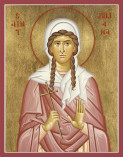 This glorious virgin martyr was born in Nikomedia of pagan
parents. Hearing the Gospel preached, she turned to Christ with all her heart and began to live
in exact observance of the Lord’s commandments. A certain senator, Eleusius, was her
betrothed. In order to free herself from him, Juliana told him that she would not marry him
unless he became eparch of that city. She said this thinking that the young man would not be in
the least likely to attain to such a high position, but Eleusius worked at it, and by flattery
and bribes, gained the post of Eparch of Nikomedia. Juliana then revealed to him that she was a
Christian, and could not enter into marriage with him unless he accepted her faith, saying:
‘What would it profit us to be united physically but divided in spirit?’ Eleusius was
exasperated, and denounced her to her father. Her furious father poured scorn on her and whipped
her, and then handed her over to the eparch for torture. The eparch ordered that she be harshly
beaten; then she was thrown into prison all torn and bleeding. But the Lord healed her in the
prison, and she appeared before the eparch whole and unharmed. He then put her into a glowing
furnace, but the fire did not burn her. Seeing this wonder, many came to believe in Christ the
Lord. Five hundred men and a hundred thirty women were converted. The eparch condemned them all
to death, and ordered that they be beheaded with the sword, and their souls entered into
Paradise. Then the wicked judge condemned holy Juliana to be beheaded with the sword. Rejoicing
in spirit, Juliana went out to the scaffold, prayed on her knees to God and laid her head on the
block. Her head was cut off, and her soul went to Christ’s eternal kingdom of light, in the
year 304. God’s punishment quickly fell on Eleusius: sailing over the sea, his ship broke
up and he fell into the water. He did not find death in the waves, but swam to an island, where
the dogs tore him to pieces and devoured him.
This glorious virgin martyr was born in Nikomedia of pagan
parents. Hearing the Gospel preached, she turned to Christ with all her heart and began to live
in exact observance of the Lord’s commandments. A certain senator, Eleusius, was her
betrothed. In order to free herself from him, Juliana told him that she would not marry him
unless he became eparch of that city. She said this thinking that the young man would not be in
the least likely to attain to such a high position, but Eleusius worked at it, and by flattery
and bribes, gained the post of Eparch of Nikomedia. Juliana then revealed to him that she was a
Christian, and could not enter into marriage with him unless he accepted her faith, saying:
‘What would it profit us to be united physically but divided in spirit?’ Eleusius was
exasperated, and denounced her to her father. Her furious father poured scorn on her and whipped
her, and then handed her over to the eparch for torture. The eparch ordered that she be harshly
beaten; then she was thrown into prison all torn and bleeding. But the Lord healed her in the
prison, and she appeared before the eparch whole and unharmed. He then put her into a glowing
furnace, but the fire did not burn her. Seeing this wonder, many came to believe in Christ the
Lord. Five hundred men and a hundred thirty women were converted. The eparch condemned them all
to death, and ordered that they be beheaded with the sword, and their souls entered into
Paradise. Then the wicked judge condemned holy Juliana to be beheaded with the sword. Rejoicing
in spirit, Juliana went out to the scaffold, prayed on her knees to God and laid her head on the
block. Her head was cut off, and her soul went to Christ’s eternal kingdom of light, in the
year 304. God’s punishment quickly fell on Eleusius: sailing over the sea, his ship broke
up and he fell into the water. He did not find death in the waves, but swam to an island, where
the dogs tore him to pieces and devoured him.
2. St. Peter the Wonder-worker, Metropolitan of Russia.
Born in the province of Volinsk, he received the monastic schema at the age of twelve. He was a great ascetic and an icon-painter. He founded a monastery on the River Rata, and became its abbot. He was made Metropolitan of Kiev against his will, and consecrated in Constantinople by Patriarch Athanasius. As metropolitan, he suffered a great deal at the hands of the envious and of heretics, governing the Church for eighteen years as a good and zealous pastor. During his lifetime, he built himself a tomb in the Church of the Dormition, where his holy and wonder-working relics are preserved to this day. He entered into rest in 1326, and went to his true homeland.
3. The Holy Martyr Themistocles.
As a herdsman, the young Themistocles kept sheep in a field near Myra in Lycia. At that time, the persecutors of the Christians were seeking St. Dioscorides, and came upon Themistocles, asking him if he knew where Dioscorides was hiding. Themistocles, although he knew, refused to say, and declared himself a Christian. He was tortured and beheaded in the time of Decius, in 251.
FOR CONSIDERATION
He who sets his sights on Christ’s kingdom will have to encounter obstructions, and these obstructions are manifold and varied. They are mostly the evil workings of demons. Therefore every man zealous for the spiritual life must be on his guard not to take every shining vision from the other world as a divine revelation. That the adversary is able to appear as an angel of light is shown in the life of the holy martyr Juliana. When this holy maiden was lying in prison, the adversary appeared to her in angelic light, smiled at her, and counseled her to offer sacrifice to idols and so avoid torture. The frightened Juliana asked: ‘Who are you?’ The adversary replied: ‘I am an angel of God. God is greatly concerned for you, and has therefore sent me with the message that you should obey the eparch, that your body may not be covered in wounds. The Lord is gracious, and will forgive you for the weakness of your body.’ The martyr was horrified at these words, and confused, and fell to prayer with tears, begging God to show her who it was who had spoken with her. Then she heard a voice from heaven: ‘Be brave, Juliana; I am with you, giving you power and authority over the one who has come to you, and by this you will know who he is.’ And the devil was bound, and forced to reveal that he was the same who tempted Eve in Paradise, who told Cain to kill Abel and Herod to kill the children in Bethlehem, the Jews to stone Stephen, Nero to crucify Peter upside down and behead Paul, and so forth. Thus this holy maiden, fortified by God’s strength, did not give herself to delusion from the evil spirit, but by her vigilant and ardent prayer, overcame him.
Daily Scripture Readings taken from The Orthodox New Testament, translated and published by Holy Apostles Convent, Buena Vista, Colorado, copyright © 2000, used with permission, all rights reserved.
Daily Prologue Readings taken from The Prologue of Ochrid, by Bishop Nikolai Velimirovic, translated by Mother Maria, published by Lazarica Press, Birmingham, England, copyright © 1985, all rights reserved. Edited by Dormition Skete.