

Daily Devotional
Saturday, January 2, 2027 (NS), December 20, 2026 (OS)
Fast Day, but Shellfish, Wine and Olive Oil Allowed.
The Saturday Before the Nativity of Christ
Saturday of the Thirty-First Week
20.The commemoration of Hieromartyr Ignatios the God-bearer, and St. John of Kronstadt.
Scripture Readings
Special Commemorations
The Saturday Before the Nativity of Christ
Epistle
The Reading is from the Epistle of Saint Paul to the Galatians [§ 205]. Brethren:
3 8The Scripture, having foreseen that God justifieth the nations by faith, proclaimed the good tidings beforehand to Abraham that “in thee all the nations shall be blessed [cf. Gen. 12:3].” 9Therefore those who are of faith are being blessed with the faithful Abraham. 10For as many as are of the works of the law are under a curse; for it hath been written: “Cursed is everyone who continueth not in all the things which have been written in the book of the law to do them [cf. Deut. 27:26].” 11Now that no one is being justified by the law before God is manifest, for “the just shall live by faith [cf. Hab. 2:4].” 12And the law is not of faith, but “the man who doeth these things shall live in them [cf. Lev. 18:5].”
Gospel
The Reading is from the Holy Gospel according to Saint Luke [§ 72]. The Lord said this parable:
13 18“To what is the kingdom of God like, and to what shall I liken it? 19“It is like a grain of mustard, which a man took and cast into his own garden; and it grew and became a great tree, and the birds of the heaven settled in its branches.” 20And again He said, “To what shall I liken the kingdom of God? 21“It is like leaven, which a woman took and hid in three measures of wheat meal until the whole was leavened.”
22And He was going through, by cities and villages, teaching, and making His way toward Jerusalem. 23And one said to Him, “Lord, are they few who are being saved?” And He said to them, 24“Be striving to enter in through the narrow gate, for many, I say to you, will seek to enter in and shall not be able. 25“From the time when the Master of the house riseth and shutteth the door, and ye begin to stand outside and to knock at the door, saying, ‘Lord, Lord, open to us,’ and He shall answer and say to you, ‘I do not know where ye are from,’ 26“then ye shall begin to say, ‘We ate before Thy face and drank, and Thou didst teach in our streets.’ 27“But He shall say, ‘I tell you, I do not know where ye are from; stand off from Me, all ye workers of unrighteousness.’ 28“There shall be there the weeping and the gnashing of the teeth, whenever ye see Abraham, and Isaac, and Jacob, and all the prophets, in the kingdom of God, and ye yourselves being cast out. 29“And they shall come from the east and west, and from the north and south, and shall be made to recline in the kingdom of God.”
Paschalion — Movable Calendar
Saturday of the Thirty-First Week
Epistle
The Reading is from the Epistle of Saint Paul to the Colossians [§ 249].
For Gk. usage, see Col. 1:1-6; for Sl. usage, see Col. 1:3-6.
1 1Paul, an apostle of Jesus Christ by the will of God, and Timothy our brother, 2to the saints and faithful brethren in Christ at Colossæ: Grace to you, and peace, from God our Father and the Lord Jesus Christ.
3We give thanks to the God and Father of our Lord Jesus Christ, praying always for you, 4after we heard of your faith in Christ Jesus, and the love which ye have toward all the saints, 5on account of the hope which is laid up for you in the heavens, which ye heard before in the word of the truth of the Gospel, 6which is come to you, even as it is also in all the world, and is bearing fruit and increasing, as also in you, from the day in which ye heard and knew the grace of God in truth.
Gospel
The Reading is from the Holy Gospel according to Saint Luke [§ 74]. At that time:
14 1Jesus entered into a house of one of the rulers of the Pharisees on a sabbath to eat bread; and they themselves were watching Him closely. 2And behold, there was a certain man before Him suffering from dropsy. 3And Jesus, answering, spoke to the doctors of the law and Pharisees, saying, “Is it lawful to cure on the sabbath?” 4But they became silent. And He took hold of him, and healed him, and let him go. 5And He answered and said to them, “Who is there among you, whose son or ox shall fall into a well, and he will not straightway draw him up on the sabbath day?” 6And they were not able to answer Him again to these things. 7And He was speaking a parable to those who were invited, aiming at how they kept on choosing for themselves the chief places, saying to them, 8“Whenever thou art invited by anyone to wedding festivities, do not begin to recline at table in the chief place, lest perchance one more honorable than thou may have been invited by him; 9“and the one who invited thee and him, having come, shall say to thee, ‘Give this one place’; and then thou begin with shame to occupy the lowest place. 10“But whenever thou art invited, go and recline at table in the lowest place, that whenever the one who hath invited thee should come, he might say to thee, ‘Friend, go up higher’; then there shall be honor to thee before those who recline at table with thee. 11“For everyone who exalteth himself shall be humbled, and the one who humbleth himself shall be exalted.”
Menaion — Fixed Calendar
20.The commemoration of Hieromartyr Ignatios the God-bearer, and St. John of Kronstadt.
Epistle
For the God-bearer:
The Reading is from the Epistle of Saint Paul to the Hebrews [§ 325]. Brethren:
10 32Remind yourselves of the former days in which, after ye were illuminated, ye endured a great contest of sufferings: 33partly, being made a show of both by reproaches and affliction; and partly, having become partners of those who conducted themselves thus. 34For ye also sympathized with those in bonds and ye yourselves accepted the seizure of your possessions with joy, knowing in yourselves that ye have in the heavens a better and abiding possession. 35Do not begin therefore to cast away your boldness which hath great recompense. 36For ye have need of patience, that, after ye do the will of God, ye might receive for yourselves the promise. 37“For yet a very little while, the One Who cometh will come, and will not delay [cf. Hab. 2:3]. 38“Now the just shall live by faith; and if one should draw himself back, My soul hath no pleasure in him [cf. Hab. 2:4].”
for Sl. usage, see [Heb. 4:14-5:6].
For St. John:
The Reading is from the First General Epistle of Saint John [§ mid 73].
4 7Beloved, let us be loving one another, for love is of God, and everyone who loveth hath been born of God and knoweth God. 8The one who loveth not knoweth not God, for God is love. 9In this was manifest the love of God among us, because God hath sent forth His only-begotten Son into the world, in order that we might live through Him. 10In this is love, not that we loved God, but that He Himself loved us, and sent forth His Son to be an expiation for our sins. 11Beloved, if God so loved us, we ought also to love one another.
Gospel
For the God-bearer:
The Reading is from the Holy Gospel according to Saint Mark [§ 41]. At that time:
9 33Jesus and His disciples came to Capernaum. And when He was in the house, He was questioning them, “What were ye discussing among yourselves on the way?” 34But they were keeping silent; for on the way they discussed with one another who was greater. 35And He sat down and called the twelve, and saith to them, “If anyone doth wish to be first, he shall be last of all and servant of all.” 36And He took a little child and set him in their midst. And after He took him into His arms, He said to them, 37“Whosoever shall receive one of such little children in My name, receiveth Me; and whosoever shall receive Me, receiveth not Me, but the One Who sent Me forth.”
38And John answered Him, saying, “Teacher, we saw someone who doth not follow us casting out demons in Thy name, and we hindered him, because he doth not follow us.” 39But Jesus said, “Cease hindering him, for there is no one who shall do a work of power in My name, and be able quickly to speak evil of Me. 40“For he who is not against us is for us. 41“For whosoever shall give you a cup of water to drink in My name, because ye are of Christ, verily I say to you, in no wise shall he lose his reward.”
For St. John:
The Reading is from the Holy Gospel according to Saint Luke [§ 26]. The Lord said:
6 31“Even as ye wish that men be doing to you, also be ye doing to them in like manner. 32“And if ye should love those who love you, what kind of thanks is there to you? For even the sinners love those who love them. 33“And if ye should do good to those who do good to you, what kind of thanks is there to you? For even the sinners do the same. 34“And if ye should lend to those from whom ye hope to receive, what kind of thanks is there to you? For also the sinners lend to sinners, in order that they might receive the same. 35“But keep on loving your enemies and doing good, and lending, hoping to receive back nothing; and your reward shall be great, and ye shall be sons of the Highest; for He is kind to the unthankful and to the evil. 36“Therefore keep on becoming compassionate, even as your Father also is compassionate.”
Lives of the Saints (Prologue)
January 2nd – Civil Calendar
December 20th – Church Calendar
1. The Hieromartyr Ignatius the God-Bearer, Bishop of Antioch.
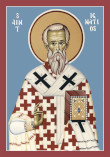 This holy man was named the
‘God-Bearer’ because he always carried the name of the living God in his heart and on
his lips. Also, by tradition, he was thus named because he was held in the arms of God incarnate,
Jesus Christ. On a day when the Lord was teaching His disciples humility, He took a child and set
it among them, saying: ‘Whosoever shall humble himself as this little child, the same is
greatest in the kingdom of heaven’ (Matt. 18:4). This child was Ignatius. He was later a
disciple of St. John the Theologian, together with Polycarp, the Bishop of Smyrna. As bishop in
Antioch, he governed the Church of God as a good shepherd, and was the first to introduce
antiphonal singing into the Church, in which two choirs alternate. This way of singing was
revealed to St. Ignatius from among the angels in heaven. When the Emperor Trajan passed through
Antioch on his way to battle with the Persians, he heard about Ignatius, summoned him and urged
him to offer sacrifice to idols, so that he could be made a senator. The emperor’s urgings
and threats being in vain, holy Ignatius was put in irons and sent to Rome, escorted by ten
bestial soldiers, to be thrown to the wild beasts. Ignatius rejoiced to be suffering for his
Lord, and prayed to God that the wild beasts should be the tomb for his body, and that none
should hinder his death. After a long and difficult journey from Asia through Thrace, Macedonia
and Epirus, Ignatius reached Rome, where he was thrown to the lions in the circus. They tore him
to pieces and devoured him, leaving only a few of the larger bones and his heart. This glorious
lover of the Lord Christ suffered in the year 106 in Rome, in the time of the Emperor Trajan. He
appeared many times from the other world and worked wonders, helping to this day all who call on
him for help.
This holy man was named the
‘God-Bearer’ because he always carried the name of the living God in his heart and on
his lips. Also, by tradition, he was thus named because he was held in the arms of God incarnate,
Jesus Christ. On a day when the Lord was teaching His disciples humility, He took a child and set
it among them, saying: ‘Whosoever shall humble himself as this little child, the same is
greatest in the kingdom of heaven’ (Matt. 18:4). This child was Ignatius. He was later a
disciple of St. John the Theologian, together with Polycarp, the Bishop of Smyrna. As bishop in
Antioch, he governed the Church of God as a good shepherd, and was the first to introduce
antiphonal singing into the Church, in which two choirs alternate. This way of singing was
revealed to St. Ignatius from among the angels in heaven. When the Emperor Trajan passed through
Antioch on his way to battle with the Persians, he heard about Ignatius, summoned him and urged
him to offer sacrifice to idols, so that he could be made a senator. The emperor’s urgings
and threats being in vain, holy Ignatius was put in irons and sent to Rome, escorted by ten
bestial soldiers, to be thrown to the wild beasts. Ignatius rejoiced to be suffering for his
Lord, and prayed to God that the wild beasts should be the tomb for his body, and that none
should hinder his death. After a long and difficult journey from Asia through Thrace, Macedonia
and Epirus, Ignatius reached Rome, where he was thrown to the lions in the circus. They tore him
to pieces and devoured him, leaving only a few of the larger bones and his heart. This glorious
lover of the Lord Christ suffered in the year 106 in Rome, in the time of the Emperor Trajan. He
appeared many times from the other world and worked wonders, helping to this day all who call on
him for help.
2. St. Danilo, Archbishop of Serbia.
The son of rich and God-loving parents, he was given a careful upbringing. King Milutin took him to his court, but from love of God, he fled and became a monk in the monastery of Konculsk near the Ibar. He was later abbot of Hilandar and suffered much at the hands of the plundering Latin crusaders. He was Bishop of Banja and then of Hum, and finally Archbishop of Serbia. He was from beginning to end a strict ascetic, with a special gift of tears. He made peace between Kings Dragutin and Milutin, and later between Milutin and Stefan of Dečani, and fought fiercely against the Latins and the Bogomils. Under his supervision, the monasteries of Banja and Dečani were built, and he restored and built many other churches. He also recorded the lives of the Serbian kings and saints. Untiring in the service of God to the end of his life, he entered peacefully into rest in the time of King Dušan, on the night of December 19/20th, 1338. He was a great hierarch, a great ascetic, a great worker and a great patriot.
FOR CONSIDERATION
The holy martyrs, consumed by love for Christ, were like unquenchable flames. This love eased their sufferings and made death sweet. St. John Chrysostom says of St. Ignatius: ‘He put off his body as easily as a man takes off his clothes.’ Travelling to Rome to his death, Ignatius had only one fear: that Christians would somehow impede his martyrdom for Christ, by their prayers or in some outward way. He therefore implored them constantly, in writing and in speech, not to do this. ‘Forgive me,’ he said, ‘I know what is useful to me. I but begin to be a disciple of Christ when I desire nothing, either visible or invisible, but to come to Christ. May every devilish torture come upon me: fire, crucifixion, wild beasts, the sword, tearing asunder, the breaking of my bones, the crushing of my whole body—only that I may receive Jesus Christ. It is better for me to die for Christ than to reign to the ends of the earth.... My love cleaves to the Cross, and there is no spark of love in me for any earthly thing.’ When he was taken to the circus, he spoke thus to the people: ‘Citizens of Rome, know that I am not being punished for any wrong-doing, neither have I been condemned to death for any transgressing, but for the sake of my God, by Whose love I am gripped and Whom I desire with an insatiable desire. I am His wheat; may I be ground by the teeth of beasts, that I may be His pure bread.’
Daily Scripture Readings taken from The Orthodox New Testament, translated and published by Holy Apostles Convent, Buena Vista, Colorado, copyright © 2000, used with permission, all rights reserved.
Daily Prologue Readings taken from The Prologue of Ochrid, by Bishop Nikolai Velimirovic, translated by Mother Maria, published by Lazarica Press, Birmingham, England, copyright © 1985, all rights reserved. Edited by Dormition Skete.