

Daily Devotional
Wednesday, December 30, 2026 (NS), December 17, 2026 (OS)
Fast Day, but Wine and Olive Oil Allowed.
Wednesday of the Thirty-First Week
17. The commemoration of the holy Prophet Daniel, and the holy Three Children, Ananias, Azarias, and Misael, and our holy father among the saints, Dionysios of Zakynthos, Archbishop of Aegina.
Scripture Readings
Paschalion — Movable Calendar
Wednesday of the Thirty-First Week
Epistle
The Reading is from the General Epistle of Saint Iakovos (James) [§ 50 B].
1 1Iakovos, a slave of God and of the Lord Jesus Christ, to the twelve tribes which are in the diaspora: Rejoice.
2My brethren, deem it all joy whenever ye fall into diverse temptations, 3knowing that the testing of your faith worketh out patience. 4But let patience keep on having a perfect work, that ye may be perfect and entire, lacking in nothing. 5But if any of you lack wisdom, let him keep on asking from God Who giveth to all liberally, and reproacheth not, and it shall be given to him. 6But let him keep on asking in faith, doubting nothing; for he who doubteth is like a billow of the sea being driven and tossed by the wind. 7For let not that man be supposing that he shall receive anything from the Lord. 8A double-minded man is unstable in all his ways. 9But let the brother of low degree be boasting in his high estate, 10and the rich man in his low estate, because as a flower of the grass he shall pass away. 11For the sun ariseth with its burning heat, and drieth up the grass, and its flower falleth, and the comeliness of its appearance perisheth. Thus also the rich man shall wither in his ways. 12Happy is the man who endureth temptation; because having become approved, he shall receive the crown of life, which the Lord promised to those who love Him. 13Let no one when he is tempted be saying, “I am tempted of God”; for God is incapable of being tempted of evils, and He Himself tempteth no one. 14But each is tempted when he is drawn away and enticed by his own desire. 15Then after he conceiveth the desire, it bringeth forth sin; and sin, after it is fully formed, bringeth forth death. 16Cease being led astray, my beloved brethren; 17every good gift and every perfect gift is from above, coming down from the Father of the lights, with Whom is no alternation or a shadow cast by turning. 18Having willed it, He brought us forth by the Logos of truth, for us to be a kind of firstfruits of His creatures.
Gospel
The Reading is from the Holy Gospel according to Saint Mark [§ 36]. At that time:
8 30Jesus strictly warned His disciples that they should tell no one about Him, that He is the Christ. 31And He began to teach them that it is necessary for the Son of Man to suffer many things, and to be rejected by the elders and chief priests and scribes, and to be killed, and after three days to rise; 32and He was speaking the saying openly. And Peter took Him to himself and began to rebuke Him. 33But after He turned about and looked at His disciples, He rebuked Peter, saying, “Get thee behind Me, Satan; for thou mindest not the things of God, but the things of men.” 34And having called to Himself the crowd with His disciples, He said to them, “Whosoever is willing to follow after Me, let him deny himself, and take up his cross, and keep on following Me.”
Menaion — Fixed Calendar
17. The commemoration of the holy Prophet Daniel, and the holy Three Children, Ananias, Azarias, and Misael, and our holy father among the saints, Dionysios of Zakynthos, Archbishop of Aegina.
Epistle
For the Prophet and the Three Children:
For Gk. usage, see [Heb. 11:33-12:2]. For Sl. usage, see [Heb. 11:33-40].
The Reading is from the Epistle of Saint Paul to the Hebrews [§§ 330, 331]. Brethren:
11 33All the saints through faith struggled against kingdoms, wrought righteousness, attained to promises, stopped mouths of lions, 34quenched the power of fire, escaped the edges of the sword, were empowered out of weakness, became strong in battle, turned back encampments of aliens. 35Women received their dead by resurrection. And others were tortured, not accepting release, that they might attain a better resurrection. 36And others received trial of mockings and of scourgings, and, moreover, of bonds and of imprisonment. 37They were stoned, they were sawn asunder, were tempted; they died, murdered by the sword. They went about in sheepskins, in goatskins, being in need, afflicted, ill-treated— 38of whom the world was not worthy. They were made to wander in deserts, and in mountains, and in caves, and in the holes of the earth. 39And these all, having been approved by testimony through faith, received not for themselves the promise, 40God having foreseen some better thing concerning us, that they should not be made perfect without us.
12 1Therefore we also, having so great a cloud of witnesses which is set around us, and having laid aside every weight and sin that is easily circumvented, let us by means of patience be running the course which is set before us, 2looking to Jesus, the originator and accomplisher of our faith, Who, in exchange for the joy set before Him, endured a cross, having despised the shame, and hath sat down on the right of the throne of God.
For the Hierarch:
The Reading is from the Epistle of Saint Paul to the Hebrews [§ 334]. Brethren:
13 7Be remembering those who lead you, who spoke to you the word of God, whose faith keep on imitating, observing attentively the end of their conduct: 8Jesus Christ, the same yesterday and today and to the ages. 9Cease being carried about by various and strange teachings. For it is good for the heart to be confirmed by grace, not by foods, in which those walking therein were not profited. 10We have an altar from which those serving the tabernacle have no authority to eat; 11for the bodies of those animals, “whose blood is being brought into the holies for sins” by the high priest, “are being burned outside of the encampment [cf. Lev. 16:27].” 12Wherefore Jesus also, that He might sanctify the people by His own blood, suffered outside of the gate. 13Let us be going forth therefore to Him outside of the encampment, bearing His reproach; 14for we have no abiding city here, but we seek the coming one. 15Through Him, then, let us be offering up a “sacrifice of praise [Lev. 7:2(12)]” continually to God, that is, “the fruit of the lips [cf. Hos. 14:3(2); Is. 57:19],” giving thanks to His name. 16But cease being forgetful of doing good and of contributing; for God is well pleased with such sacrifices.
Gospel
For the Prophet and the Three Children:
The Reading is from the Holy Gospel according to Saint Luke [§ 62]. The Lord said to those Jews who had come to Him:
11 47“Woe to you! For ye build the sepulchers of the prophets, and your fathers killed them. 48“So then ye bear witness and consent to the works of your fathers; for they indeed killed them, and ye build their sepulchers. 49“On this account the wisdom of God also said, ‘I will send forth to them prophets and apostles, and some of them they shall kill and persecute,’ 50“that the blood of all the prophets, which is being poured out from the foundation of the world, might be required of this generation, 51“from the blood of Abel unto the blood of Zacharias, who perished between the altar and the temple. Yea, I say to you, it shall be required of this generation. 52“Woe to you, the doctors of the law! For ye took away the key of knowledge; ye yourselves entered not, and those trying to enter ye hindered.” 53And as He said these things to them, the scribes and the Pharisees began to hold it against Him terribly and to interrogate Him concerning many things, 54lying in wait for Him, seeking to catch something out of His mouth, that they might accuse Him.
12 1In the meantime, after myriads of the populace were gathered together, insomuch that they trampled upon one another, He began to say to His disciples first, “Be on your guard against the leaven of the Pharisees, which is hypocrisy.”
For the Hierarch:
The Reading is from the Holy Gospel according to Saint John [§ 36]. The Lord said to the Jews who had come to Him:
10 9“I am the door; by Me if anyone should enter, he shall be saved, and shall go in and go out and find pasture. 10“The thief cometh not, except that he might steal, and slay, and destroy. I came that they may have life, and may have it abundantly. 11“I am the good shepherd. The good shepherd layeth down his life for the sheep. 12“But the hireling, who indeed is not a shepherd, whose own the sheep are not, seeth the wolf coming, and leaveth the sheep and fleeth; and the wolf seizeth them and scattereth the sheep. 13“Now the hireling fleeth, because he is a hireling and careth not about the sheep. 14“I am the good shepherd; and I know those that are Mine, and am known of those that are Mine. 15“Even as the Father knoweth Me, I also know the Father; and I lay down My life for the sheep. 16“And I have other sheep which are not of this fold; them also it is needful for Me to bring, and they shall hear My voice; and there shall be one flock and one Shepherd.”
Lives of the Saints (Prologue)
December 30th – Civil Calendar
December 17th – Church Calendar
1. The Holy Prophet Daniel and the Three Children: Ananias, Azarias and Misael.
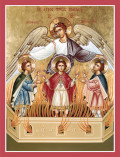 All four of
them were of the royal tribe of Judah. When Nebuchadnezzar destroyed and plundered Jerusalem,
Daniel, as a boy, was taken off into slavery together with Jehoiachin, King of Judah, and many
other Israelites. The account of his life, sufferings and prophecies can be found in detail in
his book. Utterly given to God, Daniel from his early youth received from God the gift of great
discernment. His fame among the Jews in Babylon began when he denounced two lecherous and
unrighteous elders, and saved the chaste Susannah from an unjust death. But his fame among the
Babylonians stemmed from the day when he solved and interpreted the dream of King Nebuchadnezzar.
For this, the king made him a prince at his court. When the king made a golden idol in the Plain
of Dura, the Three Children refused to worship it, for which they were cast into the burning
fiery furnace. But an Angel of God appeared in the furnace and soothed the flames, so that the
Children walked in the furnace untouched by the fire, and sang: ‘Blessed art Thou, Lord God
of our fathers!’ The king saw this marvel, and was amazed. He then brought the Children out
of the furnace and did them great honor.
All four of
them were of the royal tribe of Judah. When Nebuchadnezzar destroyed and plundered Jerusalem,
Daniel, as a boy, was taken off into slavery together with Jehoiachin, King of Judah, and many
other Israelites. The account of his life, sufferings and prophecies can be found in detail in
his book. Utterly given to God, Daniel from his early youth received from God the gift of great
discernment. His fame among the Jews in Babylon began when he denounced two lecherous and
unrighteous elders, and saved the chaste Susannah from an unjust death. But his fame among the
Babylonians stemmed from the day when he solved and interpreted the dream of King Nebuchadnezzar.
For this, the king made him a prince at his court. When the king made a golden idol in the Plain
of Dura, the Three Children refused to worship it, for which they were cast into the burning
fiery furnace. But an Angel of God appeared in the furnace and soothed the flames, so that the
Children walked in the furnace untouched by the fire, and sang: ‘Blessed art Thou, Lord God
of our fathers!’ The king saw this marvel, and was amazed. He then brought the Children out
of the furnace and did them great honor.
In the time of King Belshazzar, when the king was eating and drinking with his guests at a feast out of consecrated vessels taken from the temple in Jerusalem, an invisible hand wrote these three words on the wall: ‘Mene, Tekel, Upharsin’. No one could interpret these words but Daniel. That night, King Belshazzar was killed. Daniel was thrown into a den of lions for his faith in the one, living God, and God preserved him alive. Daniel saw God on His throne with the angelic powers, often saw angels, had insight into the future of certain people, of kingdoms and of the whole human race, and prophesied the time of the coming of the Savior on earth. According to St. Kyril of Alexandria, Daniel and the Three Children lived to great old age in Babylon, and were beheaded with the sword for the true Faith. When Ananias was beheaded, Azarias held out his robe and caught his head, then Misael caught Azarias’ head and Daniel Misael’s. An angel of God carried their bodies to Judea, to Mount Gebal, and placed them under a rock. According to tradition, these four men arose at the time of the death of the Lord Jesus and appeared to many, then fell asleep again. Daniel is counted as one of the four Great Prophets (with Isaias, Jeremias and Ezekiel). He lived and prophesied halfway through the thousand years before Christ.
2. Our Holy Father Daniel.
He was a nobleman, and governor of the island of Niberta, near Cadiz in Spain. Being acquainted with all the vanity of this world, he forsook its glory and riches and went to Rome, where he became a monk. After this, he went to Constantinople, where he spoke with the Emperors Constantine and Romanos Porphyrogenitus, then continued on to Jerusalem. In Jerusalem, he received the Great Habit at the hands of Patriarch Christodoulos, who gave him the name Stephen. Abused by the Saracens, who put pressure on him to shave off his beard, he went to Egypt, where he suffered greatly and died for the name of Christ. He entered into the kingdom of Christ in the tenth century.
3. Our Holy Fathers, the New-Martyrs Paisius (Paisy) and Avakum.
Paisius was abbot of the monastery of Trnava near Čačak in Serbia, and Avakum his companion and deacon. Both of them were, as Christians, impaled on stakes by the Turks on Kalemegdan in Belgrade, on December 17th, 1814. Dragging his spike through the streets of Belgrade, the courageous Habakkuk sang. When his mother begged him with tears to save his life by accepting Islam, this wonderful soldier of Christ replied to her, thanking her for her motherhood and not for her advice, and quoting the great figures of the Old Testament who suffered for, and glorified, God, and looking to the end of his own martyrdom in the immortal kingdom of Christ.
FOR CONSIDERATION
Bodily purity is primarily attained through fasting, and through bodily purity comes spiritual purity. Abstinence from food, according to the words of that son of grace, St. Ephraim the Syrian, means: ‘Not to desire or demand much food, either sweet or costly; to eat nothing outside the stated times; not to give oneself over to gratification of the appetite; not to stir up hunger in oneself by looking at good food; and not to desire one or another sort of food.’ There is a great fallacy that abstinence from food and the eating of fasting foods are harmful to physical health. It is a known fact that those who fast are the longest-lived and the least prone to sickness. The holy Prophet Daniel and the Three Holy Children offer us an example of this. When the king commanded his eunuch to feed the young men on meat from the royal table, and give them good wine to drink, Daniel told the eunuch that they were not willing to take the meat and wine from the king’s table, but wanted only herbs (for Daniel did not want to eat meat sprinkled with blood from the idolatrous sacrifices). But the eunuch was afraid that the young men would be weakened by the fasting food, and spoke of his fear to Daniel. Then the prophet suggested that he make a test, to see whether the fasting food would weaken them or not: to give food from the king’s table to the other young men at court, but to feed these four only on herbs for ten days, and then compare them. The eunuch did what Daniel advised. After ten days, the faces of the four young fasters were fairer and their bodies stronger than those of the Babylonian youths, who had eaten and drunk from the king’s table.
Daily Scripture Readings taken from The Orthodox New Testament, translated and published by Holy Apostles Convent, Buena Vista, Colorado, copyright © 2000, used with permission, all rights reserved.
Daily Prologue Readings taken from The Prologue of Ochrid, by Bishop Nikolai Velimirovic, translated by Mother Maria, published by Lazarica Press, Birmingham, England, copyright © 1985, all rights reserved. Edited by Dormition Skete.